
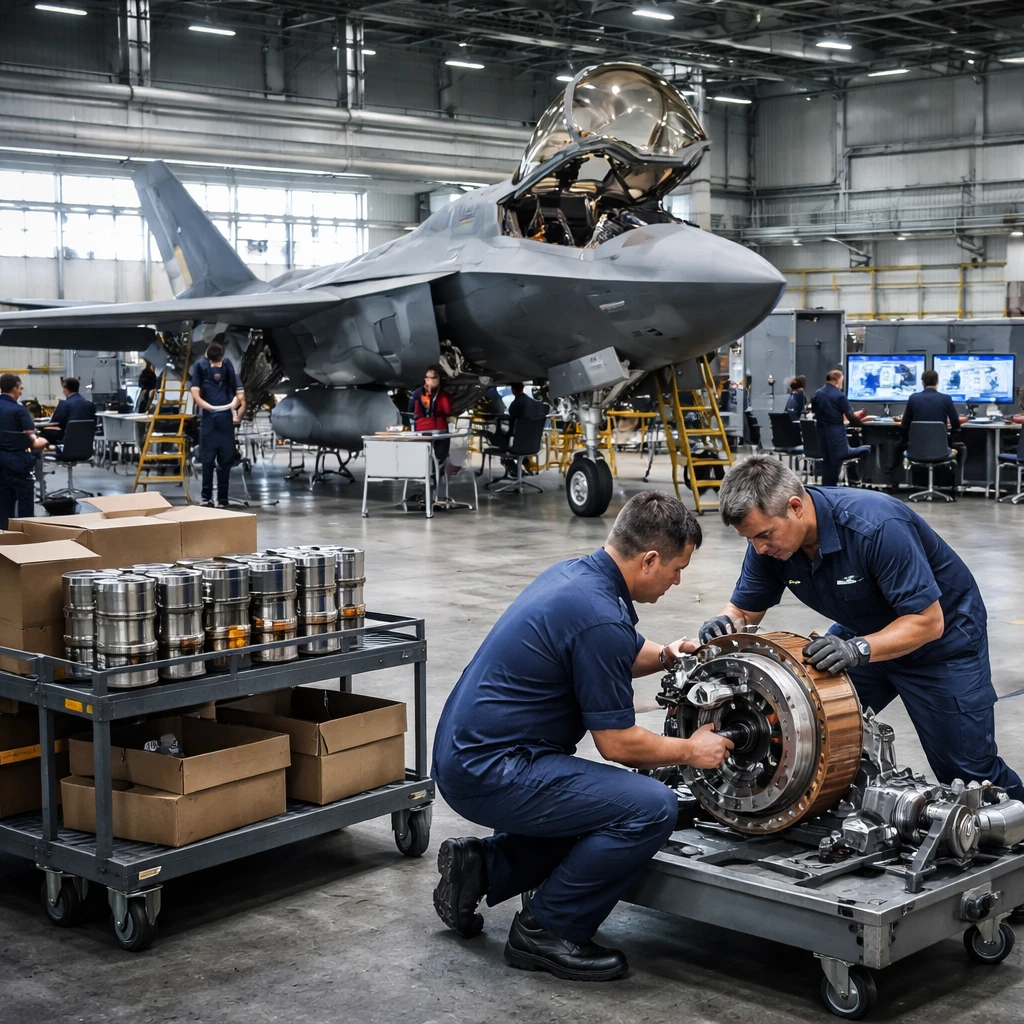
Lockheed Martin Corp. reported two defense contract awards from the U.S. Department of Defense totaling roughly $114.8 million, covering components for the F-35 Lightning II fleet and engineering services tied to the Multiple Launch Rocket System.
In the larger award, Lockheed Martin Aeronautics Co., based in Fort Worth, Texas, received a $100.5 million firm-fixed-price order for 1,459 brake assembly heat sinks intended for F-35 aircraft. The order specifies 1,075 units for the F-35A conventional takeoff and landing variant and 384 units for the F-35B short takeoff and vertical landing variant. These parts will support depot-level brake repairs across the U.S. Air Force, Navy, Marine Corps, international F-35 program partners, and Foreign Military Sales customers.
The work on the brake assembly heat sinks will be carried out in South Bend, Indiana, with an expected completion date in March 2030. Funding for this order is drawn from multiple sources: fiscal 2026 aircraft procurement funds allocated to the Air Force amounting to $43.8 million, Navy aircraft procurement funds totaling $28.6 million, $10.9 million provided by Foreign Military Sales customers, and $17.2 million from F-35 program partners.
Separately, Lockheed Martin’s Grand Prairie, Texas, facility received a $14.3 million contract modification for engineering services supporting the Multiple Launch Rocket System and related support equipment. That modification increases the aggregate value of contract W31P4Q-24-C-0007 to $230 million.
Work associated with the rocket-system engineering modification will be performed in Grand Prairie, Texas, with an estimated completion date of May 27, 2027. The modification is financed with fiscal 2025 research, development, test and evaluation Army funds.
Context and near-term execution
Both awards designate specific sites for execution and identify the fiscal sources backing the work, detailing procurement and RDT&E funding lines and the involvement of program partners and Foreign Military Sales customers. The timeline for the brake assembly work extends to March 2030, while the rocket-system effort is scheduled to conclude in May 2027.