
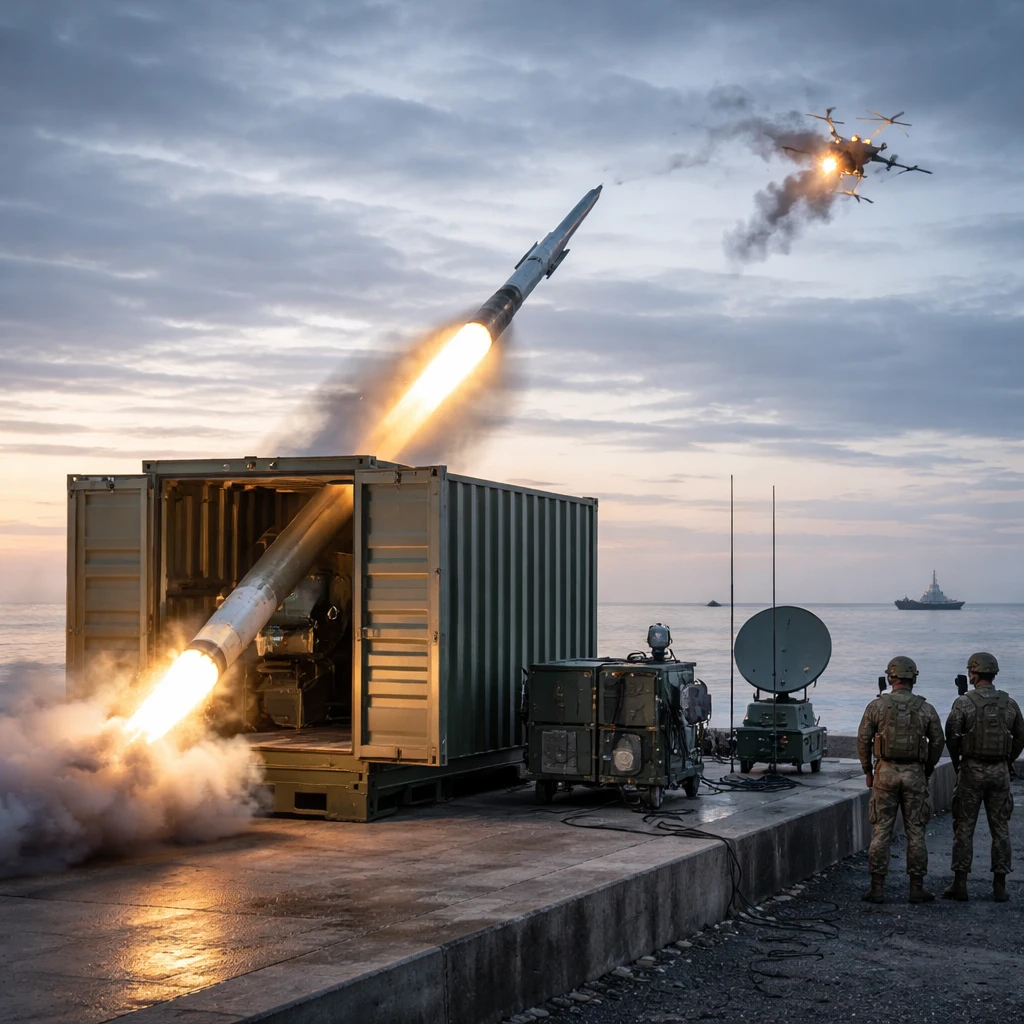
June 3 - Lockheed Martin said on Wednesday that it successfully launched a missile from a shipping container and intercepted a one-way attack drone, illustrating a lower-cost approach to countering small unmanned aerial threats.
The test employed a compact system identified as the GRIZZLY containerized launcher. The launcher is built into a 10-foot shipping container and is designed to use commercial off-the-shelf materials, an approach Lockheed says shrinks the logistics footprint and reduces acquisition expense.
How the system works
- The joint-air-to-ground missile was fired from the GRIZZLY launcher, which occupies a standard 10-foot container space.
- The target in the test was a one-way attack drone, an unmanned aircraft intended to strike by impacting a target.
- The containerized launcher can be installed on land sites or on maritime platforms, and it has the capacity to hold up to eight munitions, enabling a relatively high rate of fire from a compact package.
- Lockheed highlighted use of commercial off-the-shelf components in the launcher, a design choice intended to cut both the logistical burden and procurement cost.
Sensors, software and tracking
During the missile test, the system employed sensors and software from the Sanctum Counter-Unmanned Aerial System, which Lockheed noted was developed jointly with Microsoft. Tracking and engagement also involved R-40 radars produced by Utah-based Fortem Technologies.
Procurement context
The Pentagon has historically supported containerized weapons systems deployed from standard shipping containers as a mobile and cost-efficient defense option. In May, the Defense Department signed a framework agreement with four additional defense contractors, including Leidos, to move forward with the Low-Cost Containerized Missiles program. That initiative aims to procure 10,000 missiles over a three-year span, with purchases scheduled to begin in 2027.
Implications for logistics and defense procurement
The demonstration underscores a device-level emphasis on mobility and reduced logistics demands through use of off-the-shelf parts and a standard container form factor. The ability to mount the launcher on either ground sites or maritime platforms signals flexibility in deployment options without requiring bespoke transport or launch infrastructure.