
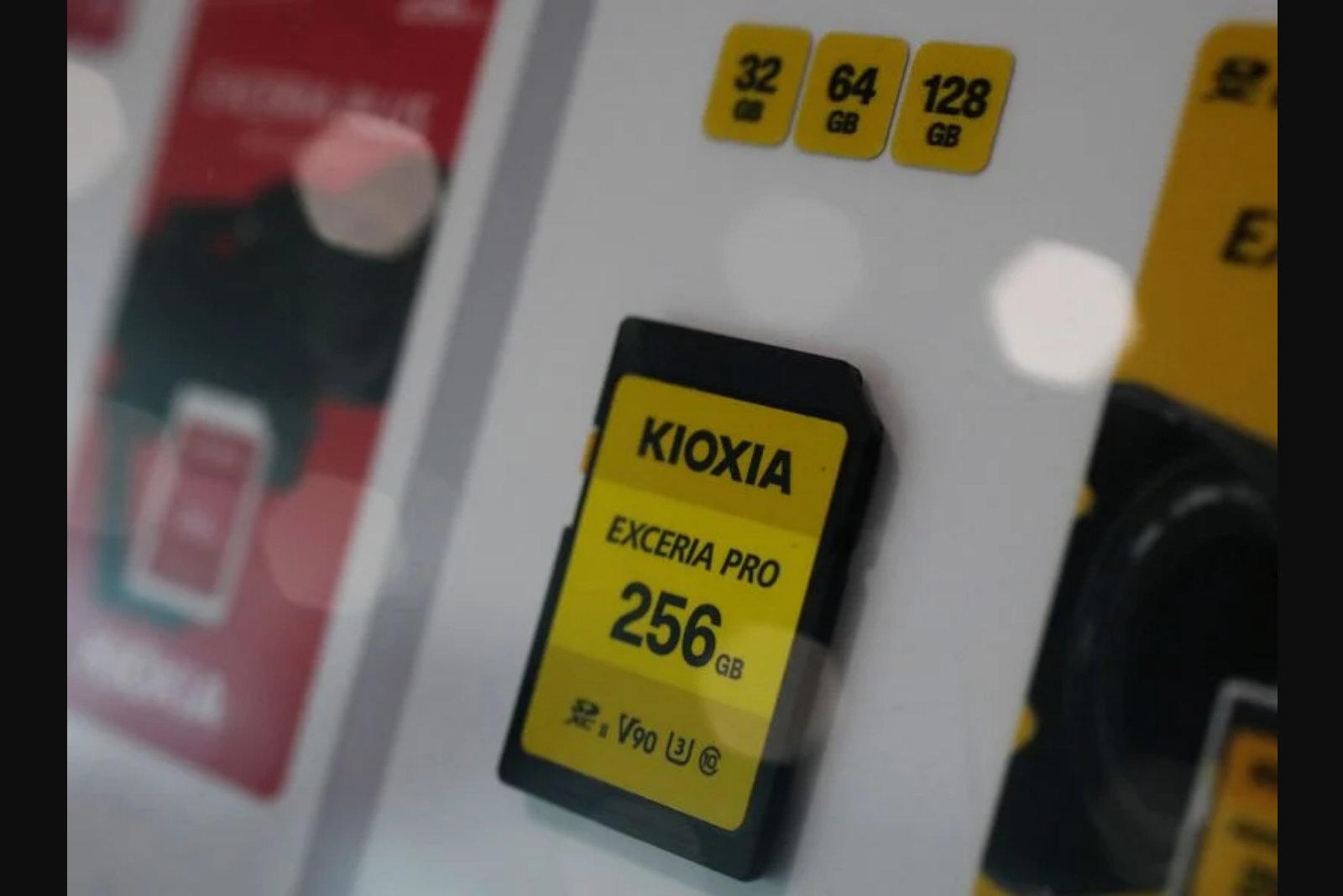
Kioxia will hold a ceremony on Friday at its semiconductor fabrication plant in northern Japan as it moves to mass manufacture next-generation memory tailored to booming AI workloads. The company has seen a dramatic rise in its share price this year, driven by surging demand for memory used in AI applications.
Once known as Toshiba Memory, the firm was bought out of troubled conglomerate Toshiba in 2018 by a Bain Capital-led investor group for 2 trillion yen ($12 billion). Over the decades, Kioxia traces its origins to the invention of NAND flash memory in the 1980s. A prolonged slump in memory prices had previously forced owners to delay plans to take the company public, with an initial target moved back to late 2024.
The rapid expansion of AI workloads has altered memory-market dynamics. Early in the AI investment cycle, industry attention focused on DRAM chips - particularly high-bandwidth memory (HBM) used in model training - and manufacturers of DRAM were widely seen as the primary beneficiaries. As AI has broadened from large-scale training to inference - the process of answering user queries - appetite for high-capacity NAND storage has expanded, lifting demand for Kioxia’s products.
Industry consultant Satoru Oyama, who previously worked at Tokyo Electron, said manufacturers had given DRAM priority to the detriment of NAND investment and development. In his words:
"They prioritized DRAM so much that they put NAND investment and development on the back burner. They haven’t been able to respond to the current NAND boom at all. That is why demand is now concentrated on Kioxia alone."
Kioxia will begin large-scale production of its 10th-generation BiCS Flash memory at its Kitakami fab in Iwate prefecture. The 10th-generation design was developed in collaboration with California-based SanDisk and, according to analysts, gives Kioxia a performance and power-consumption edge over competitors.
Kazuyoshi Saito, an analyst at IwaiCosmo Securities, said Kioxia benefits from technical strengths such as wafer bonding technology and is positioned two to four years ahead of rivals on NAND performance and power efficiency.
On the corporate front, Kioxia has signaled it is considering a stock split and has stated plans to list American depositary shares on a U.S. exchange early in the next financial year, which begins in April 2027. In parallel, South Korea’s SK Hynix is pursuing a separate U.S. listing effort and seeks to raise up to $29.4 billion, as Asian chipmakers aim to tap deeper pools of capital abroad.
Market watchers have taken note of Kioxia’s sizable market capitalisation after its share rally this year, which has pushed valuation to more than $250 billion and put it ahead of major domestic companies such as Toyota Motor. For reference, the article used an exchange rate of $1 = 162.5500 yen.
Summary
Kioxia is preparing to mass produce 10th-generation BiCS Flash NAND memory at its Kitakami plant following sharp share gains tied to AI-driven memory demand. The product was co-developed with SanDisk; Kioxia is exploring a stock split and a U.S. ADS listing early in the financial year beginning April 2027. SK Hynix is also planning a U.S. listing and aims to raise up to $29.4 billion.
Key points
- Kioxia will mass produce 10th-generation BiCS Flash memory at its Kitakami fab in Iwate prefecture.
- The company’s market value has climbed to over $250 billion following a greater-than-sevenfold share price increase this year.
- Both Kioxia and SK Hynix are planning U.S.-focused capital moves - Kioxia via potential ADS listing and SK Hynix via a planned U.S. listing targeting up to $29.4 billion.
Risks and uncertainties
- Shifts in memory pricing and demand dynamics - the article notes that previous downturns in memory prices had delayed Kioxia’s public listing plans, indicating exposure to cyclical price risk affecting semiconductor manufacturers and capital markets.
- Concentration of NAND demand - a reliance on a concentrated demand base for NAND could create operational and market risks if other suppliers accelerate investment or demand patterns change, impacting the semiconductor and storage sectors.
- Execution of capital-market plans - Kioxia’s consideration of a stock split and ADS listing, and SK Hynix’s target to raise substantial funds in a U.S. listing, carry uncertainties related to timing, market reception, and regulatory processes affecting corporate finance and investor relations in the tech sector.
Tags: semiconductors, memory, Kioxia, NAND