
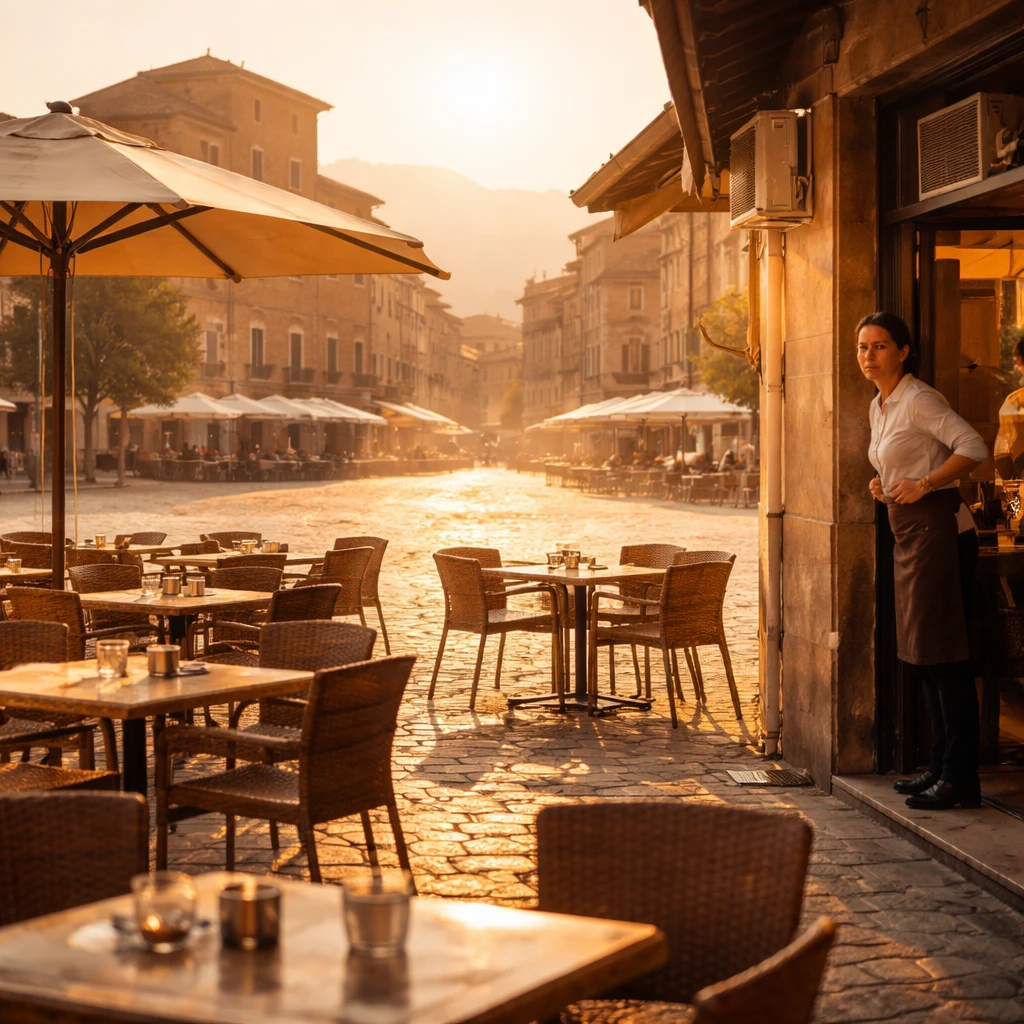
In the northern Italian city of Padua, a longstanding evening ritual is being disrupted by intense summer heat. Cafes that for generations have drawn patrons for an early evening aperitivo - the 6-7 p.m. outdoor social hour - are now seeing those customers retreat indoors to seek air-conditioning. The shift has left terraces and outdoor seating largely unused and has cut into takings for many hospitality operators.
The phenomenon in Padua mirrors a wider economic trend across Europe, where an onslaught of heatwaves this year has dented productivity, curtailed consumer spending and increased running costs for businesses. While the physical damage from floods or storms typically falls within the compass of property insurance, losses from extreme heat often arise from indirect operational disruption - a gap that insurers and firms are grappling to close.
Analysts have sought to quantify the scale of the hit. Estimates indicate last summer's heatwaves across Europe cost about 43 billion in lost economic output while producing roughly 500 million in insured payouts. The imbalance highlights a protection shortfall that is widening as extreme temperatures become more frequent.
Federica Luni, president of hospitality association APPE Padova, described how the change in customer behavior has sliced into revenues. According to a survey of roughly 600 hospitality businesses in Padua and its province, more than 80% reported turnover declines of about 20% during the recent heatwave. "A 20% decline wipes out your margin," Luni said, underscoring how concentrated a relatively modest drop in sales can be for small venues.
Insurance challenges
Insurance professionals note that extreme heat is not usually treated as a conventional insured peril. "Heat in itself is not a traditionally insured risk," said Swenja Surminski, managing director for climate and sustainability at Marsh. "Extreme heat rarely causes catastrophic physical damage the way a flood or a storm does, but the financial operational disruption that it triggers can be just as severe." Indirect consequences - from reduced customer visits to disrupted supply chains and higher cooling bills - are harder to translate into traditional indemnity claims.
Data from a 2023 survey of 9,000 small and medium-sized firms for Europe's insurance regulator illustrates how limited such coverage remains. Only 28% of firms held business interruption cover as part of their property insurance, while 17% had non-damage business interruption protection that is intended to respond to events such as strike action. Those figures point to a broad vulnerability among SMEs to disruptions that do not entail physical property loss.
Broader economic impacts
Heat can disrupt multiple parts of the economy at once. Trains and other transport services face delays, agricultural yields are threatened, factories encounter rising cooling costs and worker productivity can fall during prolonged spells of high temperature. Companies that have cited heat as a factor in their second-quarter earnings reports include Swedish shop-fitting provider ITAB Group, Italian cement maker Buzzi and French payments firm Worldline.
Experts describe heat as a compound risk that often interacts with drought, wildfires and water shortages rather than presenting as a single, cleanly defined event. That complexity makes heat harder to model and to insure than many other natural catastrophes, particularly in Europe, which is among the fastest-warming continents. Monitoring data showed the average temperature across Western Europe was nearly 10 degrees Celsius above the 1961 to 1990 average on August 11.
Environmental disclosure data indicate that 35% of companies tracked identified heatwaves as a risk driver, with the concern most prevalent among firms in manufacturing, services, infrastructure and food-related sectors.
Claims and alternative solutions
Even when policyholders receive compensation tied to physical failures - such as payouts for damage following a power outage - businesses often say that those amounts do not make up for lost sales and diminished customer activity. "The real loss is the revenue you don't make and the business activity that never takes place because of the outage," Luni said.
To narrow the protection gap, insurers are increasingly piloting parametric insurance products that trigger automatic payouts when predefined temperature thresholds are exceeded. These products avoid protracted loss-adjustment processes typical of indemnity-based policies. A report by KBV Research projects that the European parametric insurance market could reach $7.93 billion by 2031, with compound annual growth of 9.5% between 2025 and 2032. Parametric solutions are already established in agriculture, where heat directly reduces crop yields or livestock productivity, and there is perceived room to expand into transport and workforce protection.
"Parametric insurance can really play a role," said Aidan Kerr, head of UK and Ireland public sector solutions at Swiss Re.
Adaptation remains central
Industry voices emphasize that while new insurance products may help, many companies will have to prioritise adaptation to withstand more frequent extreme heat spells. Suggestions include investing in enhanced cooling systems, redesigning workplaces to limit heat exposure and stress-testing supply chains to identify vulnerabilities. "Take action to avoid the losses rather than address them once they've occurred," Surminski said.
As Europe endures repeated heatwaves, businesses and insurers are confronting how best to allocate resources between preventing operational disruption and paying for its financial aftermath. The unfolding debate will influence risk management strategies across sectors from hospitality and retail to agriculture and manufacturing.
($1 = 0.8645 euros)