
Overview
Authorities reported that a powerful magnitude-7.7 earthquake hit East Nusa Tenggara province on Saturday morning, killing at least 51 people and triggering widespread evacuations, landslides and damage to homes and infrastructure.
Casualties and injuries
Deputy Health Minister Benjamin Paulus Octavianus said in a televised meeting that 36 people were seriously injured and 77 sustained minor injuries in the quake. The death toll stands at a minimum of 51, according to official statements.
Evacuations and displacement
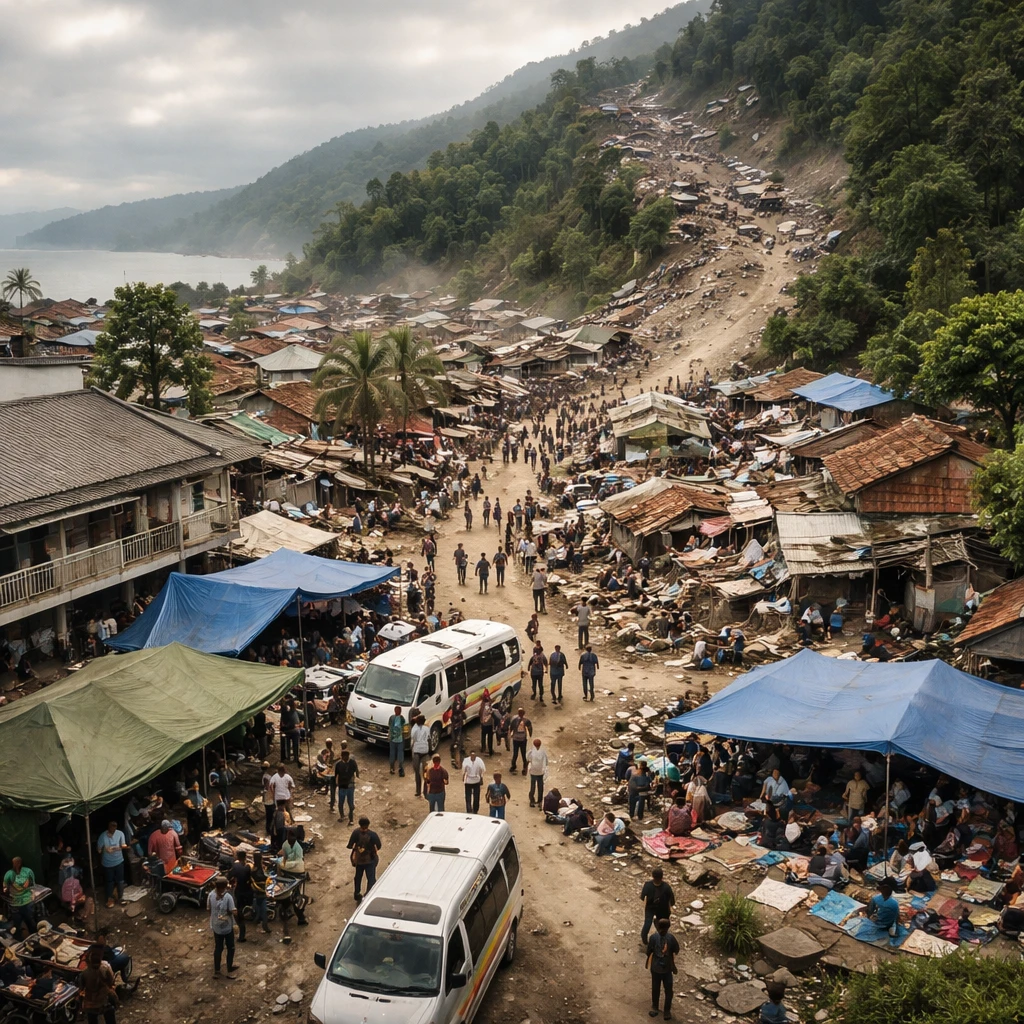
Some 5,000 people have been moved from affected areas or have relocated on their own, the disaster mitigation agency BNPB reported. In the Sikka region, more than 3,300 people either self-evacuated or were stranded at a sports arena, BNPB said. Many residents of Sikka avoided staying indoors and instead slept on porches or in tents, Simon Sabandi, deputy regent of Sikka, told KompasTV. He described makeshift shelter arrangements, with some people using tarp tents outside collapsed homes, and others receiving medical care in a tent outside a hospital in the port town of Maumere.
Search, rescue and security response
More than 3,500 personnel from the military and police have been deployed to the region, Cabinet Secretary Teddy Indra Wijaya said. Indonesia’s search and rescue agency reported that rescuers have gained access to parts of Maumere that had been cut off by landslides. BNPB said that most of the missing victims were believed to be trapped beneath rubble, and that over 1,300 homes sustained damage.
Aftershocks and ongoing instability
The initial quake was followed by approximately 341 aftershocks, making this event the country’s worst in years. Authorities noted the continuing seismic activity as complicating recovery and rescue efforts.
Infrastructure and services
Roads were blocked by landslides, hampering movement and access. Twenty petrol stations were rendered non-operational due to power outages, the state energy firm Pertamina said. The disruption to fuel availability and transport routes presents immediate logistical challenges for relief and recovery operations.
Governance and potential emergency measures
The East Nusa Tenggara government is considering declaring an emergency for the province, BNPB said. Such a declaration would enable authorities to mobilise additional resources and funding to support rescue, medical treatment and reconstruction efforts.
Historical and geographic context
Indonesia’s geophysics agency noted that the same area was hit in 1992 by a magnitude-7.5 earthquake that caused wide-scale destruction. Indonesia, a sprawling archipelago of 290 million people, straddles the "Pacific Ring of Fire", a seismically active zone where tectonic plates meet and produce frequent earthquakes and volcanic eruptions.