
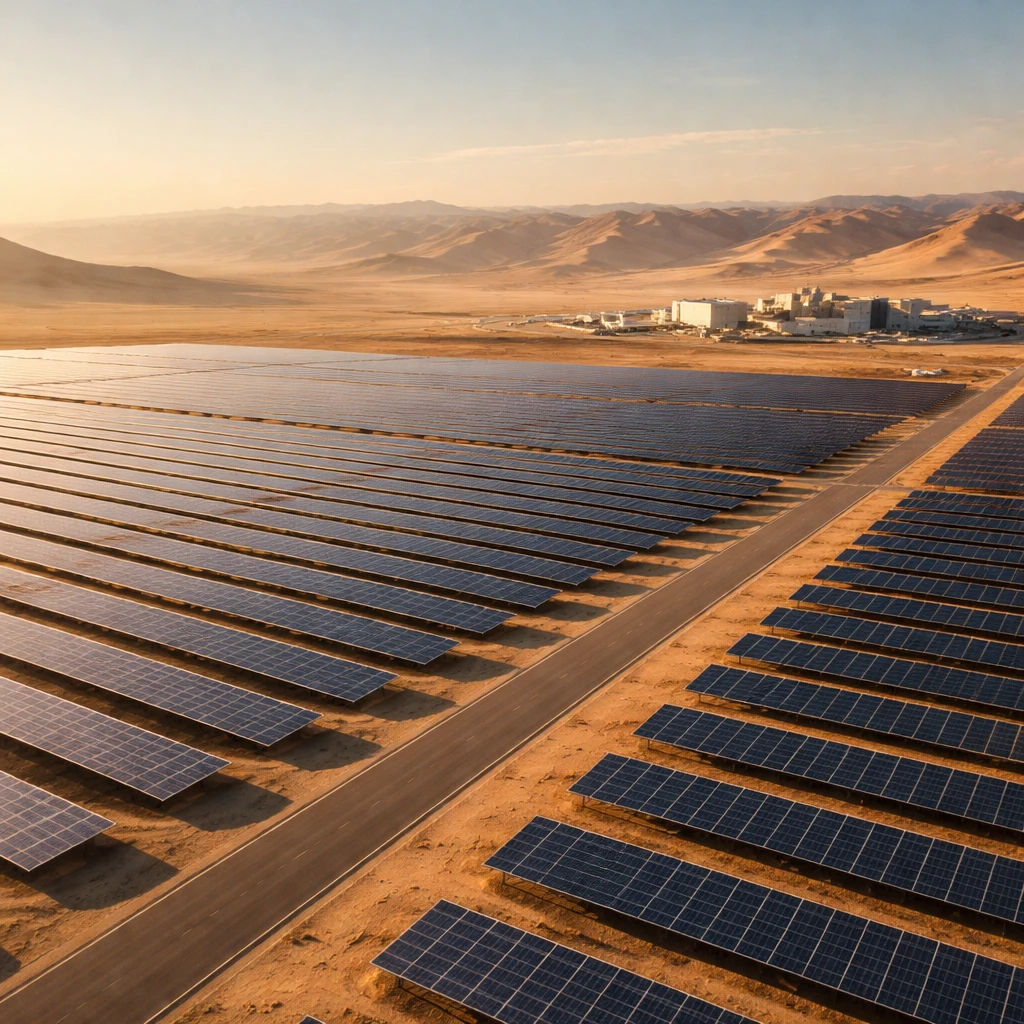
JinkoSolar Holding Co. (NYSE:JKS) has announced plans to enter the data center market by supplying power directly from its solar generation assets to a newly planned facility located on the outskirts of Zhongwei in China’s western desert region.
The company, identified as the world’s largest solar panel maker by production volume, intends not only to provide electricity but also to operate the data center. The move is positioned to address the expanding need for processing capacity tied to artificial intelligence applications, which the company cites as a driver of demand.
According to the plan, electricity will flow directly from JinkoSolar’s solar power plants to the new facility in the vast western region of China rather than being sourced indirectly. JinkoSolar has framed the initiative as a strategy to stabilize its revenue stream by combining data center operations with its ongoing solar panel manufacturing activities.
By establishing ownership and operational responsibility for a data center, the company is broadening its business model beyond manufacturing solar modules. The effort represents an expansion into power consumption services, leveraging the company’s generation capacity to serve a facility designed to handle compute-intensive workloads.
The company’s stated rationale emphasizes stabilizing revenue through operational diversification and capturing demand from AI-driven data center growth. The announcement focuses on the supply relationship between JinkoSolar’s generation assets and the Zhongwei facility as the core element of the plan.
Key points
- JinkoSolar (NYSE:JKS) will supply power directly from its solar plants to a new data center on the outskirts of Zhongwei, in China’s western desert region.
- The company plans to operate the data center in addition to supplying electricity, seeking to stabilize its revenue by combining data center operations with its solar panel manufacturing business.
- The strategy targets rising demand for computing capacity driven by artificial intelligence applications - linking the energy and data center sectors with the company’s manufacturing operations.
Risks and uncertainties
- It is not stated whether operating a data center will succeed in stabilizing JinkoSolar’s revenue stream; the company describes this as an objective rather than a guaranteed outcome - impacting corporate earnings and the renewable energy sector.
- The announcement does not provide details on the scale, timeline, financial commitments, or performance expectations for the Zhongwei facility, leaving operational and market impacts uncertain - relevant to investors and the data center market.
- While the company cites growing demand from AI applications as a driver, the article does not quantify that demand or link it to specific contracts or customers for the facility, creating uncertainty about the long-term utilization and revenue contribution - affecting tech infrastructure and energy demand forecasts.
Conclusion
JinkoSolar’s move to power and operate a data center in China’s western desert region signals a strategic expansion from module manufacturing into direct power-to-load services. The company frames the initiative as a step to diversify and stabilize revenue amid rising needs for AI-driven computing capacity, though key details on scale and financial impact were not disclosed.