
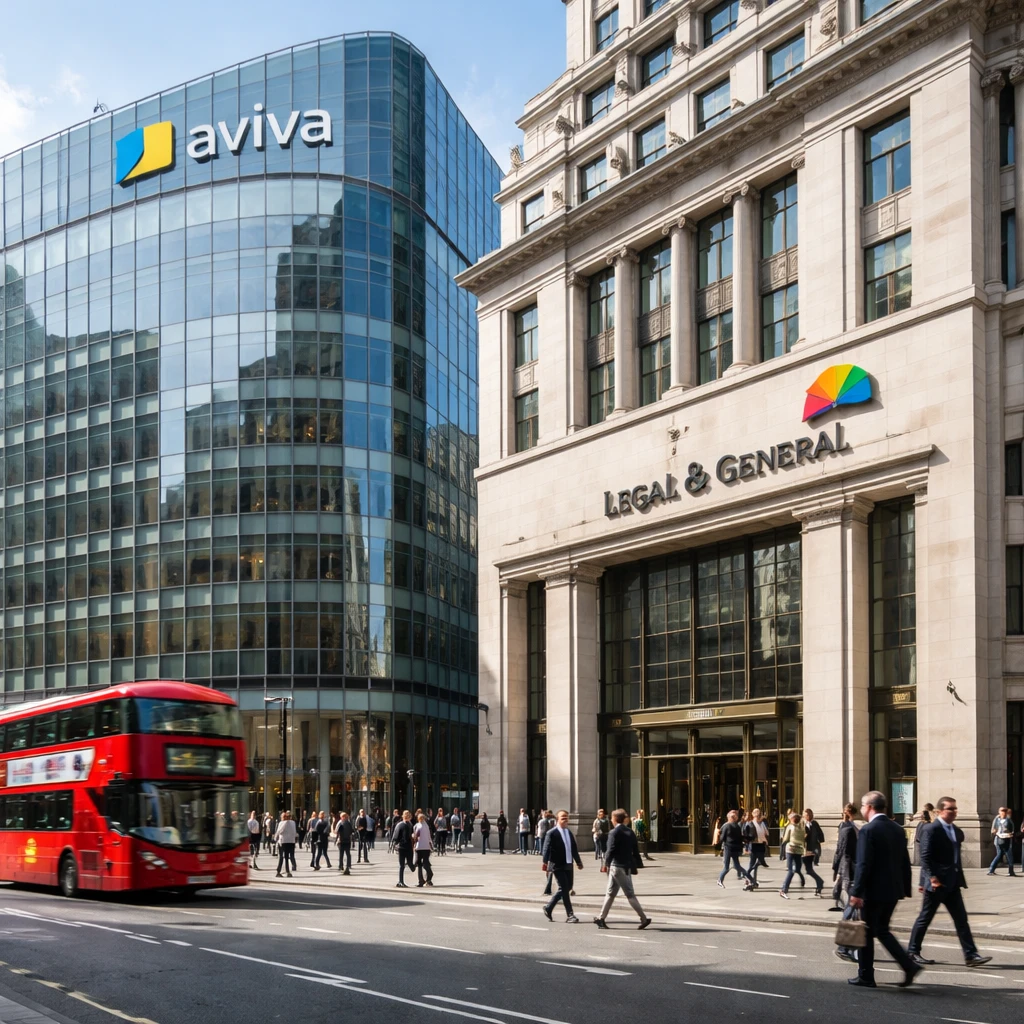
Jefferies updated its recommendations on Aviva and Legal & General on Sunday, adopting a more guarded stance toward two of the United Kingdom's largest publicly listed insurers. The broker downgraded Aviva to Hold from Buy but raised the insurer's price target to 637 pence from 560 pence. Legal & General was downgraded to Underperform from Hold, with its target price cut to 185 pence from 230 pence.
On Aviva, Jefferies' analysts said the revised rating reflects the group's transformed business mix following the acquisition of Direct Line. Management's guidance through 2028, the broker noted, is already incorporated into consensus forecasts, leaving less scope for upside surprise. Jefferies described the current risk/reward as broadly balanced.
Part of the support for Aviva, according to Jefferies, comes from an expected all-in capital return yield of around 9% per year when combining dividends and buybacks. That yield provides a floor for the stock, the broker argued, and may be particularly relevant for U.K. income-focused investors. Over the period 2026-28, Jefferies expects cumulative total yield of roughly 27% for Aviva, a level it said is comparable with Legal & General but underpinned by stronger solvency and lower leverage on Aviva's balance sheet.
However, Jefferies flagged specific risks tied to Aviva's increased exposure to UK general insurance and to pension risk transfer. Following the Direct Line acquisition, UK general insurance now accounts for nearly half of group earnings, the broker noted, increasing the company's exposure to execution risk related to integration and to pricing pressure in commercial lines.
The broker's assessment of Legal & General was more negative. Jefferies said that the insurer's income narrative is deteriorating and that its preferred free cash flow proxy - net surplus generation - is expected to remain roughly flat at around 1.2 billion through 2028. That level, the analysts said, barely covers the annual dividend cost.
Jefferies wrote that "solvency surplus generation is fully consumed by dividends, capital optionality is effectively zero, and returns rely increasingly on contingent management actions." The firm models management actions at just under 400 million per year, below what it described as the market's assumption of roughly 500 million. Jefferies also projects no share buybacks through 2028, in contrast to consensus expectations that still include 150-200 million of buybacks annually.
With solvency drifting lower and debt leverage above 30%, Jefferies said the implied equity risk premium appeared insufficient, raising the risk that investors may rotate away from Legal & General in favor of other credible income alternatives within the sector.
Context and implications
Jefferies' repositioning underscores two distinct challenges: for Aviva, the integration and pricing risks tied to a larger general insurance footprint; for Legal & General, constrained surplus generation that limits capital flexibility. Both issues have implications for income-oriented investors and for capital-allocation expectations across the U.K. insurance sector.