
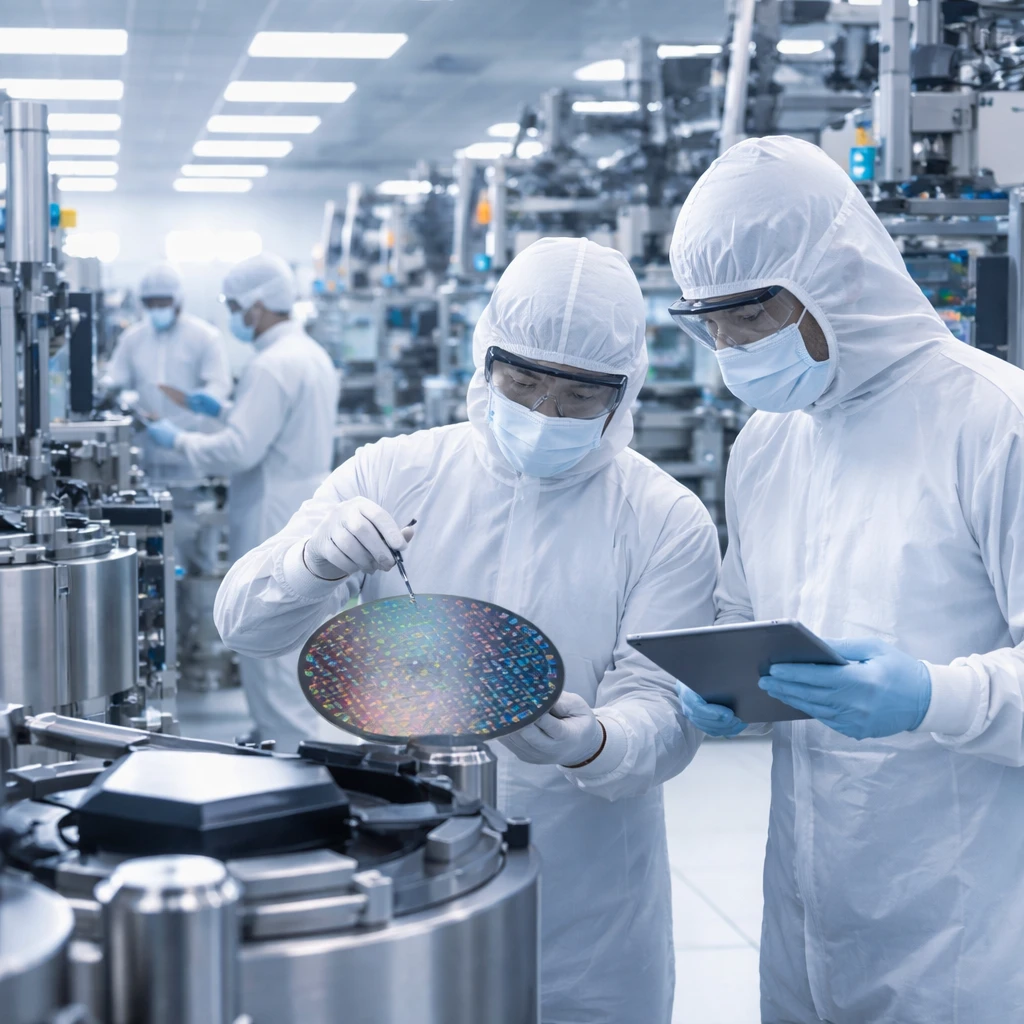
International Business Machines Co. shares climbed 5.1% in morning trading following a major federal funding announcement that directs $2 billion toward quantum computing initiatives, of which IBM will receive the largest allocation - $1 billion - under the CHIPS and Science Act.
In a joint statement, IBM and the U.S. Department of Commerce outlined a Letter of Intent to establish an American quantum chip foundry. The funding will support the research and development of a new IBM-sponsored company called Anderon, which IBM describes as the first pure-play quantum foundry in the United States.
As structured, the federal CHIPS incentives will provide $1 billion to Anderon. IBM is also committing $1 billion in cash to the venture, in addition to contributing intellectual property, assets, and a trained workforce. The announcement noted that further investors are expected to join as the company grows. IBM's chairman and CEO, Arvind Krishna, said Anderon "will be well-positioned to fuel America’s fast-growing quantum technology industry."
Anderon will be set up as a standalone business headquartered in Albany, New York, operating a 300-millimeter quantum wafer foundry. The facility is positioned to support U.S. leadership in a quantum sector that the announcement estimated could generate up to $850 billion in economic value by 2040.
Today's quantum-funding news builds on IBM's recent corporate results. In the first quarter of fiscal 2026, IBM reported total revenue growth of 6% and delivered free cash flow of $2.2 billion - a 13% increase year over year and the company's strongest first quarter in a decade. Earnings per share were $1.91 versus an estimate of $1.81, while revenue came in at $15.92 billion, ahead of the consensus forecast of $15.63 billion.
IBM also reiterated its 2026 outlook, reaffirming expectations for constant-currency revenue growth of at least 5% and roughly $1 billion of year-over-year free cash flow growth. The company expects software to expand by more than 10% and consulting to accelerate to low-to-mid single-digit growth, according to its guidance restatement.
The federal grant announcement had ripple effects across the quantum and semiconductor sectors. Alongside IBM's allocation, the Department of Commerce indicated funding for other recipients: GlobalFoundries is slated to receive $375 million, while D-Wave Quantum, Rigetti Computing, and Infleqtion were each indicated to receive approximately $100 million. These awards are being made from funds authorized by the 2022 CHIPS and Science Act.
Despite the sector-wide tailwind from the grant program, IBM's share-price gain contrasted with broader market moves. On the same day, the S&P 500 traded down 0.25%, the Dow Jones slipped 0.1%, and the NASDAQ declined 0.4%.
Taken together, the combination of a landmark, government-backed commitment to domestic quantum manufacturing and IBM's recent, solid quarterly performance provided investors with multiple concrete reasons to bid the stock higher amid an otherwise cautious macroeconomic backdrop.
Key takeaways
- IBM was awarded $1 billion from a $2 billion U.S. quantum program, intended to support Anderon, a new standalone quantum chip foundry.
- IBM reported a strong first quarter of fiscal 2026 with 6% revenue growth, $2.2 billion in free cash flow (up 13% year over year), and EPS of $1.91 versus a $1.81 estimate.
- The CHIPS-funded awards also include $375 million to GlobalFoundries and roughly $100 million each to D-Wave Quantum, Rigetti Computing, and Infleqtion, supporting a wider sector uplift.
Risks and uncertainties
- The announcement noted that additional investors are expected to join Anderon as it grows - the need for outside investment introduces execution and financing uncertainty for the new company.
- Market context remains mixed - the broader U.S. indices traded lower on the day, underscoring a cautious macro environment that could temper sustained equity gains.
- The projected scale of the quantum industry cited in the announcement - up to $850 billion by 2040 - is an estimate and its realization is not guaranteed.
For product and platform observers, the Anderon announcement is notable for how it packages federal support, corporate capital, intellectual property, and human capital into a standalone manufacturing play. That structure signals an attempt to create concentrated manufacturing capacity and a clearer commercialization pathway for quantum hardware - a development that has implications for semiconductor manufacturing, quantum hardware suppliers, and enterprise software and consulting businesses that aim to build applications on emerging quantum platforms.