
Stock Markets June 3, 2026 07:30 PM

House Passes Resolution Restricting Presidential Military Action Against Iran

Measure wins narrow, bipartisan backing in the House but must clear the Senate and overcome veto math to take effect

By Nina Shah

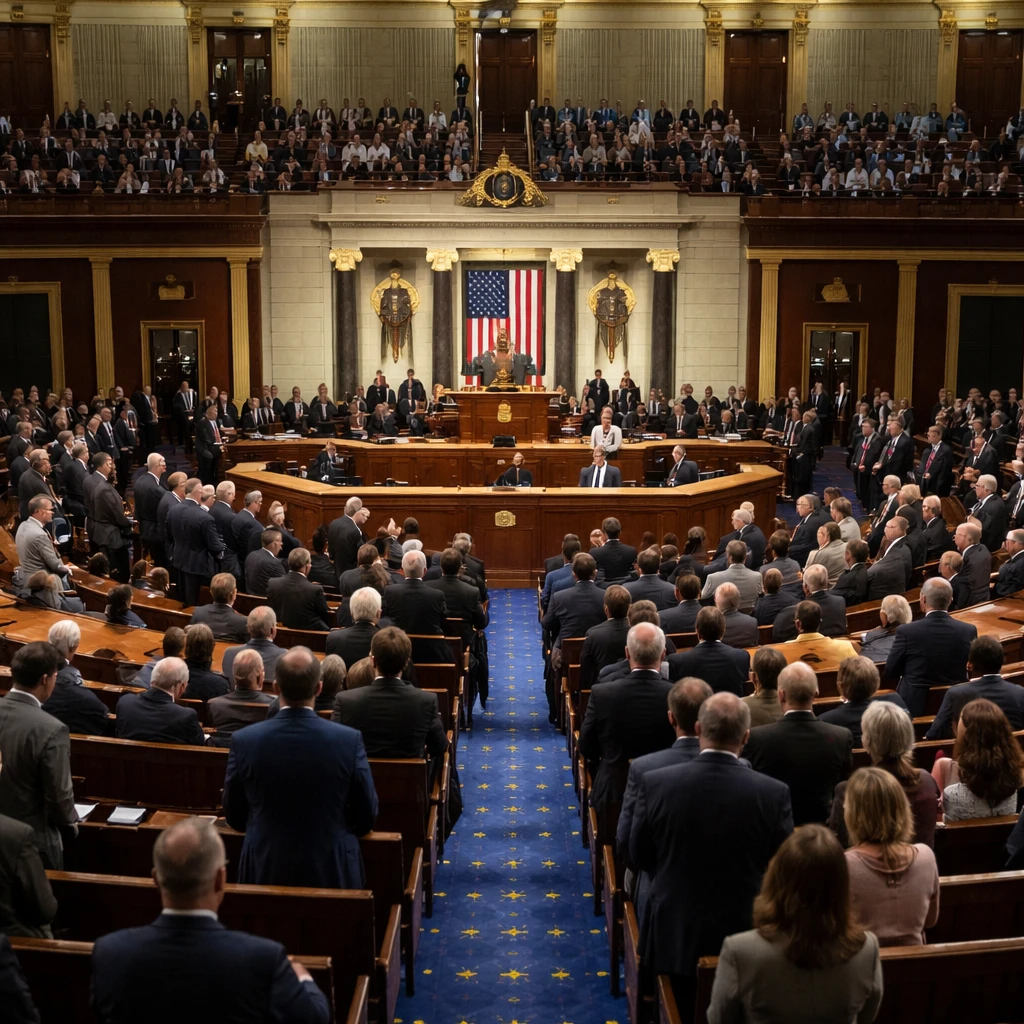
The U.S. House of Representatives approved a resolution aimed at preventing President Donald Trump from continuing military operations against Iran, with a 215-208 vote that included four Republican supporters. While the measure marks the first House success of its kind since the conflict began three months ago, it still faces substantial procedural and constitutional hurdles before it could alter executive authority.

House Passes Resolution Restricting Presidential Military Action Against Iran

Key Points

  • The House passed a resolution 215-208 to prevent the president from continuing military operations against Iran, with four Republicans voting with Democrats.
  • This is the first war powers resolution to succeed in the Republican-controlled House since the conflict began three months ago; three previous attempts in the House failed by narrow margins.
  • The resolution still requires Senate approval and would need two-thirds majorities in both chambers to override an expected presidential veto - the article does not provide further details on subsequent legislative timing or likely outcomes; the article does not specify market or sector responses.

The House of Representatives on Wednesday passed a resolution to block President Donald Trump from continuing military operations against Iran, carrying the measure by a 215 to 208 vote. The tally included four Republicans who joined Democrats in supporting the resolution.

This vote represents the first time a war powers resolution of this nature has succeeded in the Republican-controlled House since the confrontation with Iran began three months ago. According to the House outcome, three earlier attempts to pass similar resolutions in the chamber had failed narrowly.

Even with the House approval, the resolution faces significant obstacles before it could take effect. It must win approval in the Senate, and because a presidential veto is expected, it would require two-thirds majorities in both the House and the Senate to override that veto - a high threshold that is explicitly stated as necessary for the measure to become binding absent presidential concurrence.

The Senate has taken procedural steps on a similar proposal. Lawmakers in that chamber advanced a comparable measure last month by a procedural vote, following seven previous attempts that did not succeed.

Observers noted that the House vote is a rare instance of cross-party agreement to limit presidential authority regarding military engagements. The action comes as the conflict with Iran moves into its fourth month without a clear resolution, underscoring continued uncertainty about the path forward.


Context and implications

The House approval is a legislative signal about congressional intent to assert war powers authority, but the clear procedural barriers identified in the vote mean that, for now, the resolution is primarily symbolic unless further majorities are secured in both chambers or other political developments occur. The article does not specify any changes to operations on the ground or to ongoing military activities.

What the record shows

  • The resolution passed in the House by a 215-208 vote, with four Republicans joining Democrats.
  • Three prior House resolutions on the subject failed narrowly earlier in the period following the start of the conflict three months ago.
  • The Senate has advanced a similar measure procedurally after seven unsuccessful attempts last month.

Risks

  • The resolution faces a significant procedural hurdle because it needs Senate approval before it can progress - if the Senate does not pass it, the measure will not take effect.
  • An expected presidential veto is a material obstacle; overturning a veto would require two-thirds support in both the House and Senate, a threshold the article indicates but does not quantify further in terms of likelihood.
  • The article reports that despite legislative activity, the conflict has entered its fourth month with no clear resolution - ongoing uncertainty remains about the conflict's trajectory and any policy responses, and the story does not specify direct impacts on particular economic sectors or markets.

More from Stock Markets

Toronto market ends at fresh record as healthcare, financials and materials lead gains Jun 4, 2026 After-Hours Movers: Lululemon Dips on Guidance as Software and Data Names Show Mixed Reactions Jun 4, 2026 Lululemon Lowers Fiscal 2026 Revenue and EPS Guidance as U.S. Demand Softens Jun 4, 2026 Anthropic Places Engineers Inside NSA to Support Mythos AI for Offensive Cyber Tasks Jun 4, 2026 Trump Directs $700M Toward Coal Industry, Lifting Peabody Shares Jun 4, 2026