
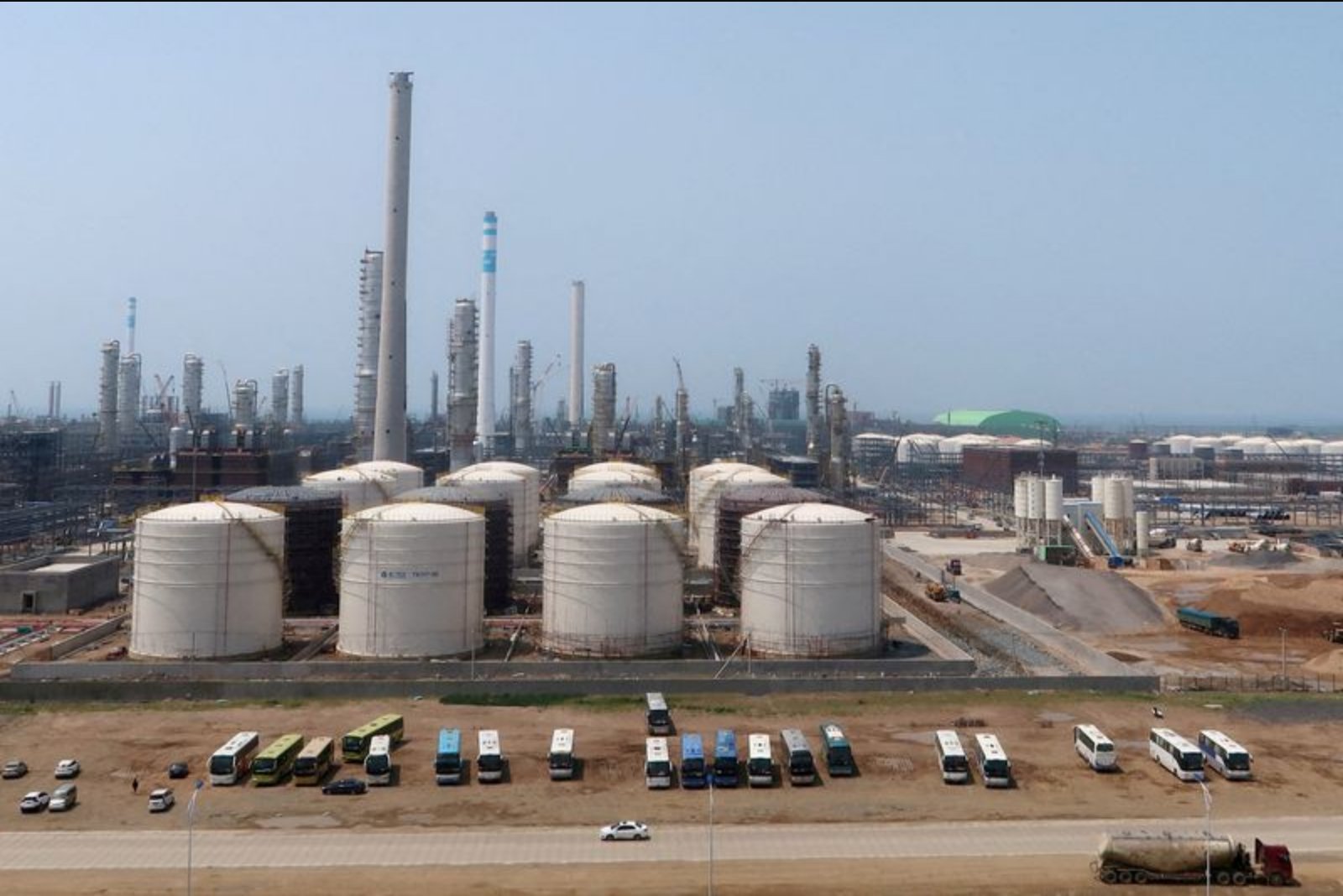
The Hengli Group - transformed over three decades from a small textile operation into a massive private player in refining and petrochemicals - has been thrust into a geopolitical confrontation after U.S. authorities blacklisted its Hengli Petrochemical division for buying Iranian crude. Hengli disputes the allegation. The sanctions, which also targeted about 40 shipping firms and vessels, arrived as diplomatic attention focused on high-level talks between the United States and China.
Hengli Petrochemical operates a 400,000 barrel-per-day refinery in Dalian in northeastern China and is the largest Chinese refiner to face U.S. sanctions to date. The action coincided with diplomatic engagement in which Washington sought greater pressure on Tehran to accept a deal to end the conflict that began after attacks on Iran by the U.S. and Israel in February - a context that officials tied to the timing of the listings.
Beijing, which historically objects to unilateral extraterritorial sanctions, responded by moving quickly to protect its companies. For the first time, Chinese authorities invoked a 2021 anti-foreign-sanctions law meant to deter domestic companies from complying with foreign sanctions regimes. The use of that law underscored the political sensitivity of targeting what Chinese officials regard as large, integrated industrial champions rather than smaller independent refiners.
Analysts noted the distinction. "Hengli is no teapot refinery. It is a world-class, world-scale plant that is representative of the large integrated refining and petrochemical facilities in which Beijing increasingly wants to consolidate its refining capacity," said Erica Downs, senior research scholar at Columbia University’s Center on Global Energy Policy. She added that the prominence of Hengli in China’s refining landscape may explain why Beijing felt compelled to invoke its anti-sanctions statute.
Immediate commercial effects
The sanctions have had near-term implications for Hengli’s operations and commercial links. The company’s principal offshore trading unit in Singapore - a trading arm that employed roughly 100 people - is set to close this month. A separate commercial consequence was Wanhua Chemical’s suspension of a long-term agreement to buy benzene from Hengli Petrochemical. Market participants also flagged potential repercussions for investment plans: the sanctions could imperil a preliminary 2024 agreement with Saudi Aramco for a 10% stake in Hengli Petrochemical, though Aramco did not provide a comment on the matter.
Despite these disruptions, Hengli’s mainly domestic orientation and Beijing’s protective response afford it some buffer against the full force of the sanctions. The company has stated that it continues to buy oil in Chinese yuan, operating outside the U.S. dollar settlement system. Observers point to precedents where sanctioned Chinese refiners shifted trade patterns and reliance toward sanctioned supplies; a prior case saw another refinery increase its use of Russian crude after facing European and British penalties for dealing in Russian oil.
Traders have said Hengli is likely to face pressure to rely more on sanctioned barrels and has already redirected a portion of its petrochemical output toward domestic buyers. Those shifts underscore how sanctions can shape both sourcing strategies and sales channels for large integrated refiners with strong domestic footprints.
Political signaling and leadership ties
The listing of Hengli coincided with wider diplomatic choreography. In a public remark while traveling from Beijing, U.S. political leadership said they were considering whether to lift sanctions on Chinese firms that had purchased Iranian oil. No immediate change followed that statement.
Within Hengli, senior management had already acknowledged geopolitical headwinds. Nine days before the sanctions were announced, Fan Hongwei, who chairs Hengli’s Shanghai-listed arm, cautioned shareholders about evolving great-power competition in a letter following Hengli Petrochemical’s reported 2025 results: net earnings of 7.07 billion yuan on revenue of 201 billion yuan. "Great-power competition continues to evolve and intertwine, and geopolitical turbulence has never ceased," she wrote. "We are well aware that the road ahead may not be smooth."
From silk trading to global petrochemicals
The company’s founders built Hengli from modest beginnings. Chen Jianhua and his wife, Fan Hongwei, expanded the business over three decades from a bankrupt textile mill into a Fortune Global 500 enterprise and one of China’s biggest private refiners. Chen, who grew up in Wujiang’s Suzhou district and left formal schooling before age 14, began his commercial life trading scrap silk and bought a struggling textile mill with 27 employees at age 23 in 1994. That move came during a period of broad economic reform in China and marked the start of Hengli’s upstream push into integrated petrochemical production.
Hengli pursued bold capacity additions to serve China’s fast-expanding manufacturing complex. The group developed a major integrated complex on Changxing island off Dalian at a cost reported internally as about $11 billion, constructed in what the company described as remote and difficult conditions - with no electricity, water, or mobile signal during early construction phases. Chen has described living and eating on the construction site for four years while the project was built.
Hengli is now the world’s largest producer of purified terephthalic acid, a key feedstock for synthetic fibres, and has broadened into shipbuilding and heavy industry. In 2022 the group acquired an idled shipyard on Changxing island and placed orders for vessels after initial skepticism from external shipowners. The firm moved to build two 300,000-ton very large crude carriers and an 82,000-ton bulk carrier. Hengli Heavy Industry has since won orders for 115 vessels amounting to more than 100 billion yuan, counting Greek, Norwegian and Japanese shippers among its customers.
Chen’s profile within China’s private sector has grown. In February 2025 he was invited to a meeting with national leaders, where private-sector executives were encouraged to support technological self-reliance and bolstering supply chain security. Chen recalled the government’s message to the private sector: "Show your talent, the time is now."
Outlook and constraints
The sanctions pose tangible operational and reputational constraints for Hengli. While Beijing’s interventions and Hengli’s domestic market focus help mitigate immediate disruptions, the company faces real choices about sourcing, sales channels and potential foreign investment partnerships. The company denies the U.S. allegation about buying Iranian oil and continues to emphasize its domestic transactions denominated in yuan. How Hengli adapts its procurement and commercial strategies under persistent geopolitical scrutiny will shape its near-term performance and integration with international partners.
Conversion note: $1 = 6.8012 Chinese yuan renminbi.