
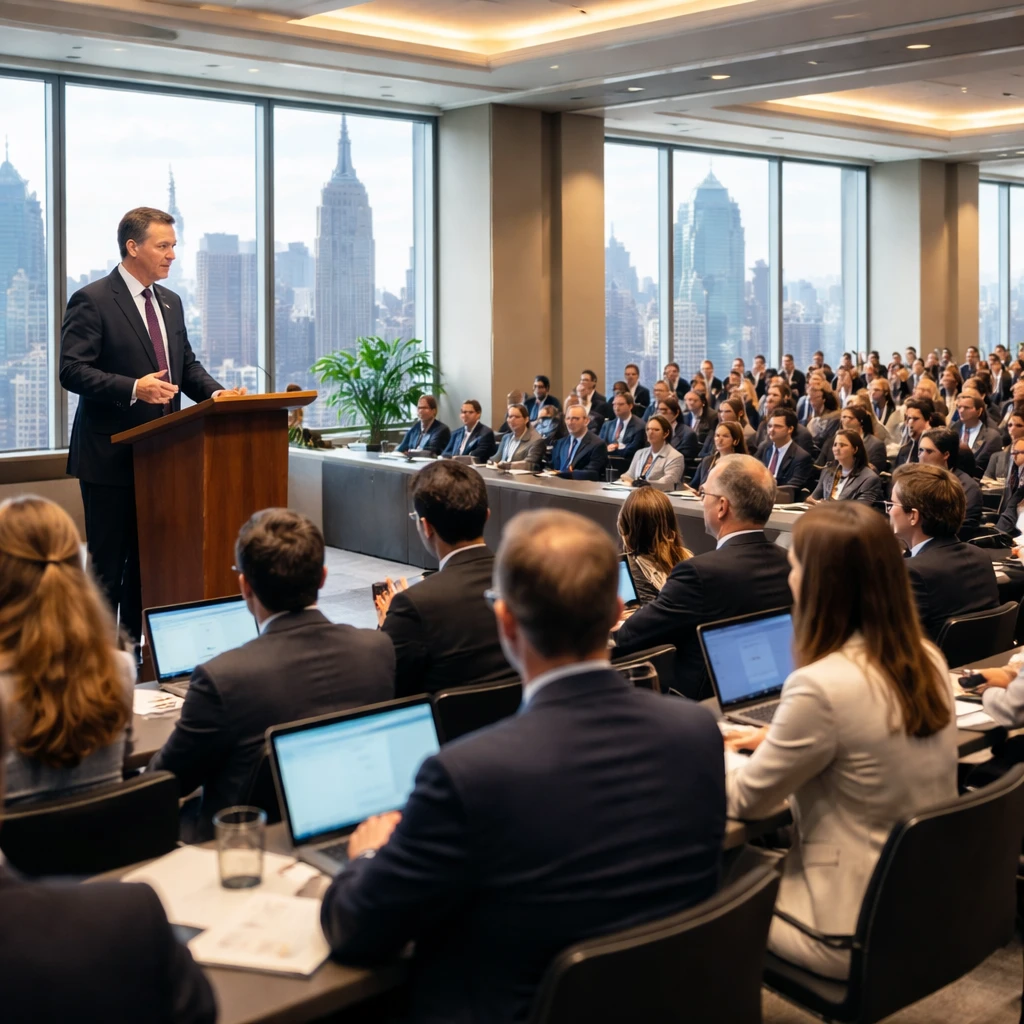
Goldman Sachs is reporting a brisk merger and acquisition environment that, according to President John Waldron, could bring the firm's deal volumes close to the one set in 2021. Speaking on Thursday at a financial conference in New York, Waldron said the bank is "on track to be near the record, if not breaching the record of 2021. Our backlogs feel good. Activity is remaining strong."
Waldron emphasized the nature of the pipeline, adding that "interestingly, it’s really a corporate-led market." For a firm that has been the world's top merger and acquisition adviser for over two decades, strong corporate engagement has been a key driver of recent activity.
Goldman Sachs has participated in multiple large transactions this year. Among the assignments the bank has advised on is Unilever's planned merger of its food business with McCormick, a deal that the companies say would create a $65 billion company. Such sizable mandates have contributed to the firm's active deal calendar.
Market turbulence linked to the war in Iran, together with swings in valuations, has not stopped corporate dealmaking, according to Waldron. Broader indicators of deal flow show robust first-quarter volume: transactions in the first quarter exceeded $1.2 trillion, according to LSEG data. Dealmakers cited in the market say much more remains in the pipeline.
The overall value of mergers and acquisitions reached a record $5.8 trillion in 2021. Goldman Sachs' current trajectory suggests this year could approach that level, driven by sustained corporate participation and several large mandates.
On the initial public offering front, Waldron said the bank is constructive about the market. He noted that the likelihood of success for some large IPOs could spur additional transactions, implying that positive IPO outcomes may act as a catalyst for further M&A activity.
In sum, Goldman Sachs' leadership points to a deal landscape where corporate-led transactions and a tangible backlog are underpinning near-record volumes, even as geopolitical and valuation pressures introduce uncertainty.