
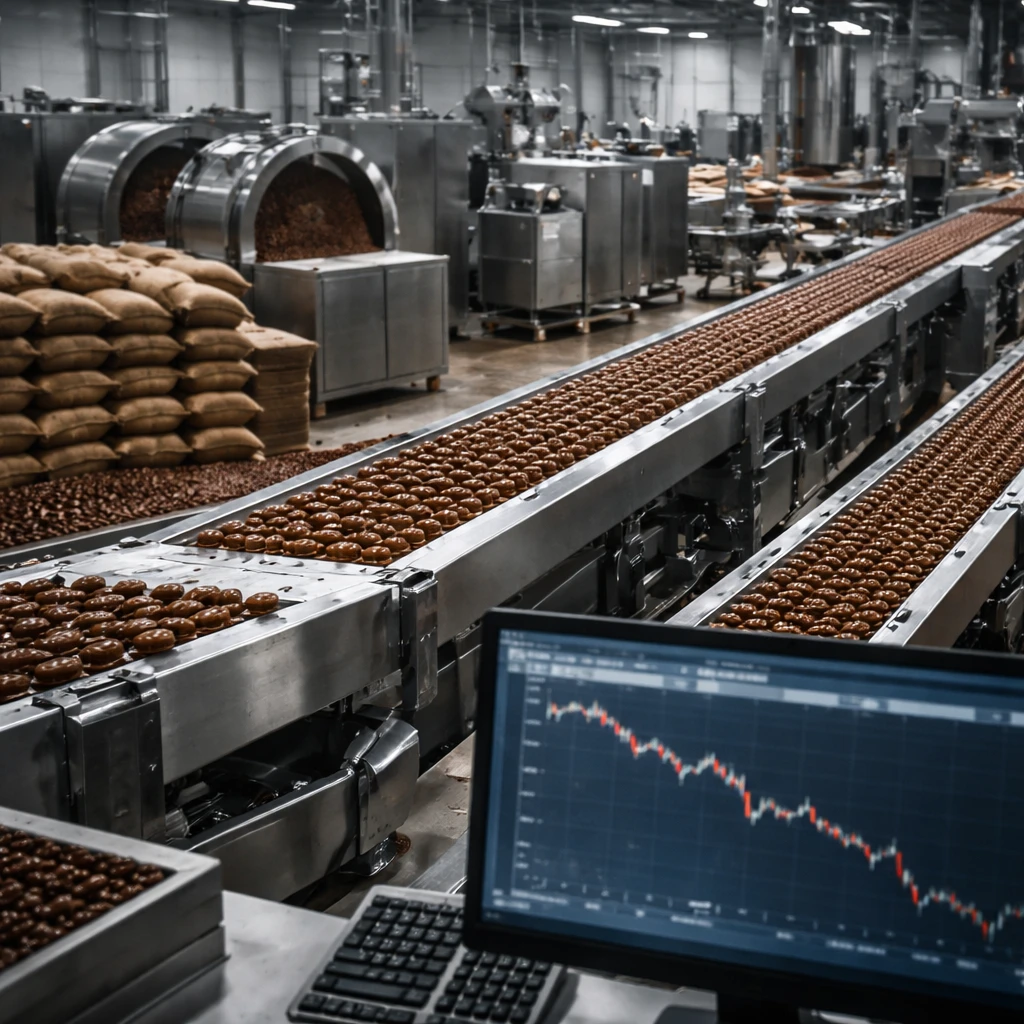
Goldman Sachs cut Barry Callebaut to Neutral on Thursday, lowering its 12-month price target for the Swiss chocolate manufacturer to 1,210 Swiss francs from 1,280. Shares of Barry Callebaut fell 2.1% by 07:41 GMT following the move.
Analyst Sam Darbyshire attributed the downgrade to two principal developments: revised mid-term guidance from company management that implies a slower earnings trajectory, and a recent rise in cocoa prices that reduces the benefit previously expected from falling financing costs as cocoa-linked working capital unwinds.
Goldman reduced its earnings-per-share forecasts for fiscal 2027 and 2028 by 9% and 11%, respectively. Despite these cuts, Darbyshire still projects a recurring EPS compound annual growth rate of 23% for fiscal 2026-28 and remains above management guidance, but he said he "no longer sees material upside risk to consensus." He added that "with the stock already on 26x 12m P/E, we see limited upside on a 12-month basis."
What the strategy entails
Barry Callebaut's recently announced "Focus for Growth" plan concentrates on three pillars: expanding relationships with key global accounts, leveraging premiumisation in Gourmet and Specialties, and raising customer-service standards. The company has acknowledged that service levels in some segments fell below 80% on-time-in-full delivery last year.
Darbyshire described the strategic direction as positive in principle but cautioned that the benefits are unlikely to be quickly realised. He highlighted continued industry overcapacity pressures, which Goldman expects to persist through the end of 2027, as a factor that will slow the conversion of strategic initiatives into earnings and margin improvement.
Near-term drivers and management guidance
For fiscal 2027, management set a volume-growth target of 1-3%, notably lower than the company-compiled consensus of 4.1%. Goldman retained its own volume-growth assumption of 3.6%, noting confidence that lower cocoa prices will help underpin a recovery in demand.
Goldman flagged volume growth as the principal near-term determinant of market sentiment. That emphasis is amplified by management's stated approach to avoid major restructuring and to apply productivity savings to offset inflation rather than to expand margins. These choices, Goldman argues, mean margin expansion should not be expected imminently absent stronger-than-forecast demand or faster market-share gains.
Conditions for a more positive outlook
Darbyshire set out clear triggers that would prompt a more constructive stance on the stock: either demonstrable evidence that the new strategy is driving market-share gains faster than anticipated, or a quicker recovery in end-market demand than currently expected. Until one of those conditions is met, Goldman believes upside is constrained given current valuation and the revised earnings profile.
The downgrade and price-target reduction come amid a backdrop of elevated cocoa prices and management's tempered volume guidance, factors that together have led Goldman to rebalance expectations for the company's near- to mid-term performance.