
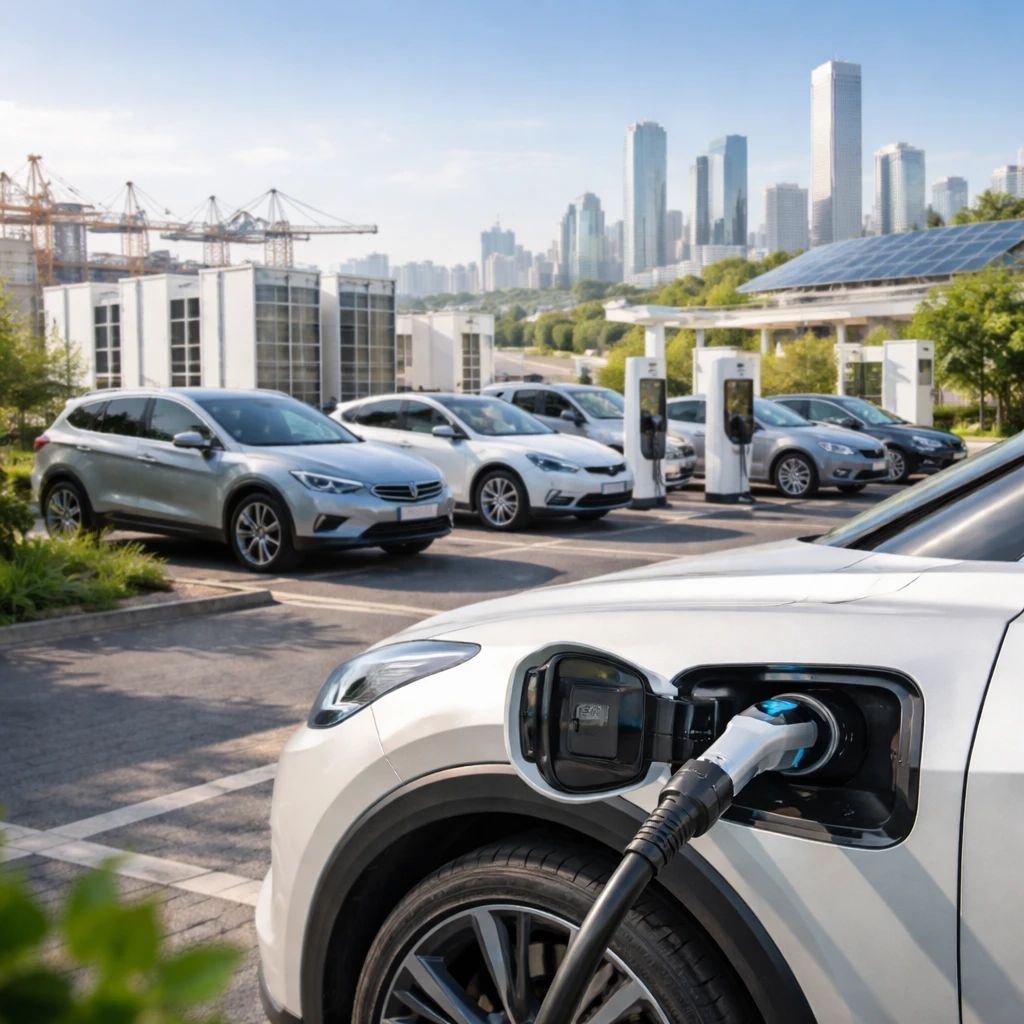
Morgan Stanley’s Global EV Tracker reports that global battery electric vehicle sales reached 1,228,773 units in April 2026, an increase of 16% compared with April 2025. The April total, however, marks a 7% decline from March 2026, when sales were 1,320,686 units.
Among manufacturers, BYD led global BEV deliveries in April with 163,100 units. Tesla followed with 98,400 units and Geely with 80,600 units. At the model level, the Tesla Model Y was the best-selling BEV worldwide in April with 70,600 units. Unspecified light commercial vehicles collectively recorded 58,700 sales during the month.
Tesla’s share of the global BEV market stood at 8.0% in April 2026, down from 13.8% in March and slightly above 7.7% in April 2025. In the United States, Tesla accounted for 45.0% of BEV market share in April 2026, up from 40.0% a year earlier. Separately, Motor Intelligence reported Tesla’s U.S. BEV market share rose to 46.9% in May 2026 from 45.2% in May 2025.
Regional sales trajectories diverged in April. U.S. BEV deliveries declined 19% year-on-year to 75,349 units, with BEV market penetration at 5.5% versus 6.3% in April 2025. Europe saw stronger growth, with BEV sales up 38% year-on-year to 298,203 units and penetration of 25.9% compared with 20.0% a year earlier. China’s BEV sales dipped 1% year-on-year to 642,317 units, though penetration rose to 30.1% from 28.9% in April 2025.
Ford’s April figures show 3,700 units of the Mustang Mach-E sold globally and 1,575 units of the F-150 Lightning. The Mustang Mach-E ranked as the sixth highest-selling BEV model in the U.S. market during April. Ford’s E-Transit recorded a year-on-year sales increase of 77% to roughly 2,700 units worldwide.
General Motors reported 54,679 global BEV sales in April 2026, a 45% decrease from the same month a year earlier. Excluding China joint ventures and the Wuling HongGuang Mini, GM sold 10,800 EVs in the U.S. during April.
Battery deployment figures for April 2026 totaled 74,134 megawatt-hours (MWh), up 17% from 63,202 MWh in April 2025. Battery chemistry breakdowns show lithium iron phosphate (LFP) accounting for 48% of deployments, nickel manganese cobalt (NMC) representing 43%, and nickel cobalt aluminum (NCA) making up 5%.
Note on market data: The monthly tracker provides a snapshot of deliveries, market shares and battery deployment by chemistry for April 2026. Where available, country-specific shares and month-to-month comparisons are presented to highlight changing regional dynamics.