
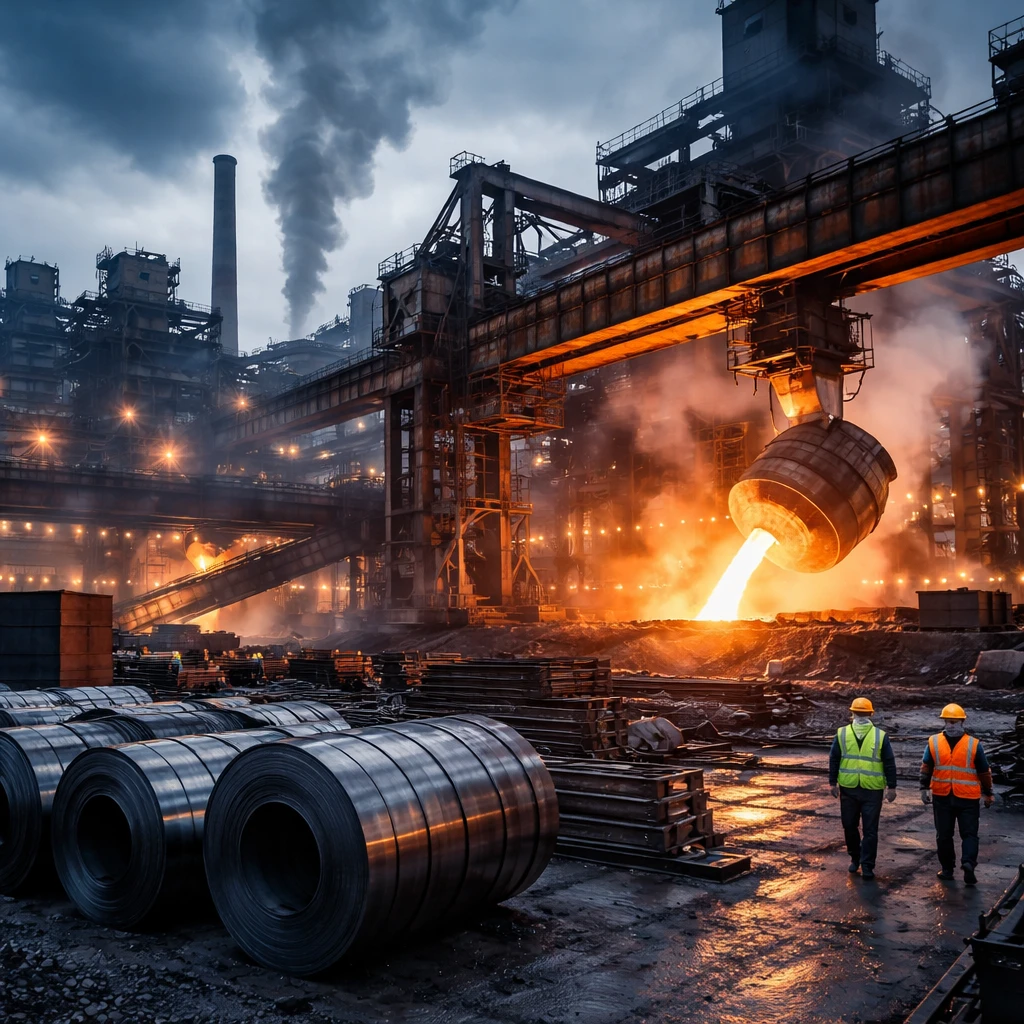
European steel production slipped 2.6% year-over-year in April, according to Morgan Stanley, indicating that a broad-based rebound across the EU27 and UK region has not yet emerged.
On a global basis, steel production fell 2% year-on-year in April, with China reporting a 3% decline in output for the month. Excluding China, world production was down 1% year-on-year. Year-to-date data showed comparable weakness.
Performance within Europe was uneven. A group of countries recorded notable increases in April: Germany posted a 10% rise in steel output, Austria was up 4%, Belgium increased 7%, Italy climbed 7%, and Sweden reported a 5% gain. By contrast, several other major producers experienced sharp declines: Spain and Poland each saw output fall 22%, while France’s production dropped 11% for the month.
Outside of Europe, growth was concentrated in a few markets. India recorded a 4% increase in steel output, Turkey grew 9%, and the United States rose 9% in April. Conversely, Russia’s production decreased 12% and Ukraine’s output fell 25%.
Chinese finished steel exports reached 9.5 million tonnes in April, up from 9.1 million tonnes in March and well above an implied January-February run rate of roughly 7.8 million tonnes per month. Data from CISA member mills indicated that Chinese output was down 4.5% in early May.
Policy developments in the European Union are set to affect import flows. New EU import regulations, due to take effect on July 1, 2026, will reduce import quotas by approximately 47% compared with 2024 levels and raise the out-of-quota duty to 50%. Separately, the Carbon Border Adjustment Mechanism entered its definitive regime in 2026, increasing compliance obligations for covered imports.
On company-level positioning, Morgan Stanley retains an overweight rating on ArcelorMittal. The bank estimates that every $10 per tonne increase in realized regional prices would add about $0.6 billion to the group’s EBITDA, which it notes is equivalent to roughly 7% of 2026 consensus EBITDA.
Context and implications
The April data underscore a patchwork recovery across Europe’s steel-producing nations: some countries have expanded output while others contracted sharply. Globally, production trends were similarly mixed, with Chinese exports rising in April even as China’s own output eased. Meanwhile, impending EU import rules and the definitive Carbon Border Adjustment Mechanism increase regulatory complexity for imported steel.
Data limitations
Year-to-date figures were described as showing similar weakness but no additional monthly breakdowns were provided beyond the April and early May snapshots referenced above.
Key points
- European steel production fell 2.6% year-on-year in April; the EU27 and UK recovery remains uneven.
- Global steel production declined 2% in April; China’s output was down 3%, while world production excluding China fell 1%.
- New EU import measures coming into force in 2026 will significantly reduce quotas and raise out-of-quota duties, and CBAM’s definitive regime increases compliance obligations.
Sectors likely affected
- Steel producers and integrated metals companies.
- Heavy industry and manufacturing sectors that consume steel.
- Global metals markets and trade flows, given changes in export volumes and EU import rules.
Risks and uncertainties
- Regulatory risk: EU import regulations effective July 1, 2026 reduce import quotas by approximately 47% versus 2024 and raise the out-of-quota duty to 50%, which could alter trade dynamics.
- Compliance burden: The Carbon Border Adjustment Mechanism’s definitive regime in 2026 increases compliance requirements for covered imports.
- Market volatility from export flows: China’s finished steel exports rose to 9.5 million tonnes in April from 9.1 million in March, and CISA member-mill data showed output down 4.5% in early May, signaling variability in supply.
Note: Year-to-date trends were described as similarly weak, but the available material does not include a detailed month-by-month breakdown for the year-to-date period.