
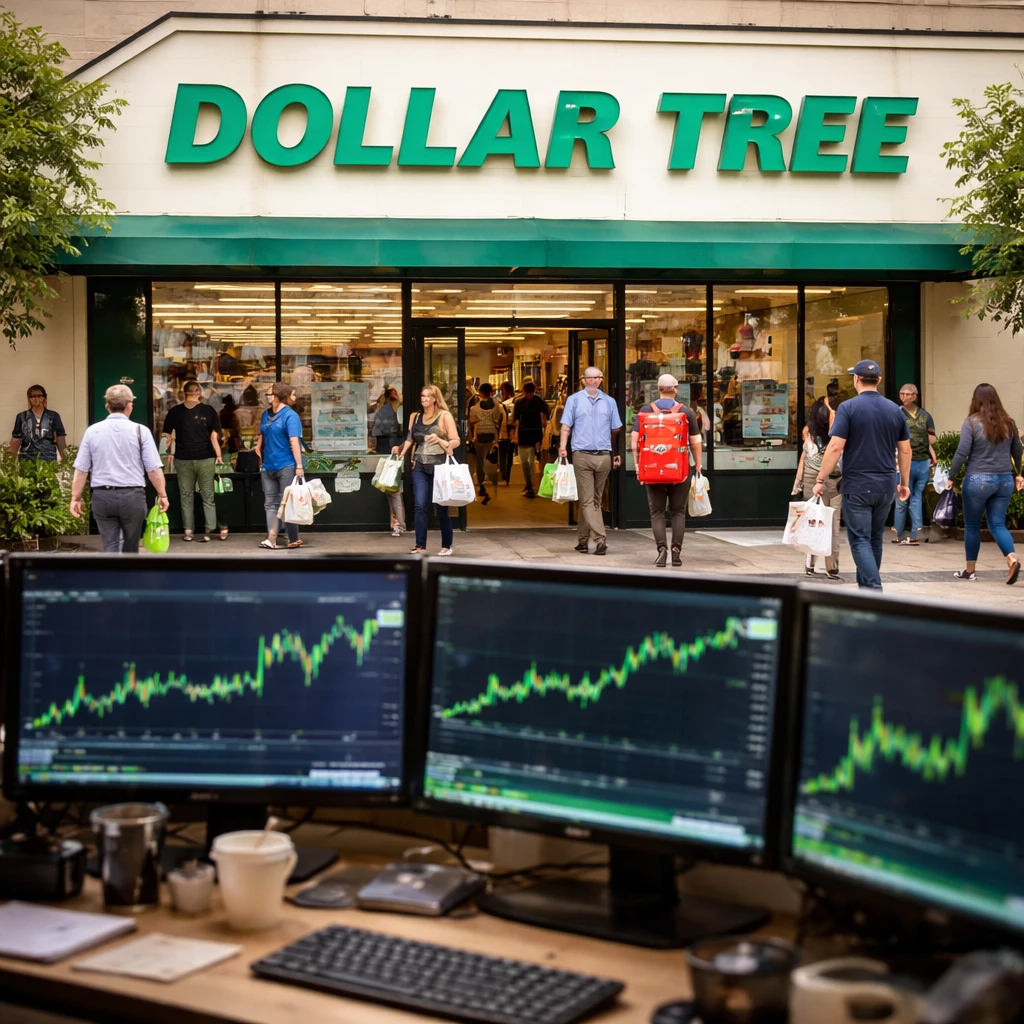
Dollar Tree shares jumped 19.3% in pre-open trading after the discount retailer reported first-quarter results that outpaced expectations and issued a more optimistic full-year outlook.
The company reported diluted earnings per share from continuing operations of $1.76 on a GAAP basis. On an adjusted, non-GAAP basis, diluted EPS came in at $1.74, which was 12.6% above analysts' consensus of $1.55 per share. Dollar Tree recorded revenue of $4.98 billion for the quarter, representing 7.2% year-over-year growth and matching Wall Street's revenue forecast.
Management further boosted investor sentiment by raising its guidance for fiscal 2026. The retailer now expects adjusted diluted EPS in a range of $6.70 to $7.10 for the year, with net sales from continuing operations forecast between $20.5 billion and $20.7 billion. That outlook is based on comparable store net sales growth of 3% to 4%.
Corporate capital allocation actions were also highlighted in the report. Dollar Tree repurchased 5.5 million shares of common stock during the first quarter for $595 million. As of May 2, 2026, the company reported $1.3 billion remaining under its share repurchase authorization, and it held $1.0 billion in cash and cash equivalents.
The company announced a strategic e-commerce arrangement with DoorDash to provide on-demand delivery from Dollar Tree's full U.S. store footprint via the DoorDash platform. On the quarterly results, CEO Mike Creedon stated: "Our first quarter results reflect continued progress across the business and demonstrate the strength of Dollar Tree’s position as the preferred destination for value, convenience, and discovery. We continued advancing our strategic plan - a more relevant assortment, agile cost management, a stronger customer connection, and new store growth coupled with improved store conditions - all driving operating margin expansion and delivering a strong bottom-line performance."
Market context amplified the reaction to the report. In the days before the earnings release, analyst sentiment had been notably pessimistic. Truist reduced its price target to $107 from $142, while Wells Fargo maintained its Buy rating. Barclays trimmed its early-2026 estimates, moving its Q1 and fiscal 2026 EPS projections toward the low end of the company's guidance. Those actions reflected concerns over higher wholesale costs, tariffs, and softer discretionary spending, factors that had pressured the stock and contributed to a roughly 23% year-to-date decline.
Dollar Tree's pre-market pop to $114.33 followed a run that included a 52-week high of $142.40 and recent tests of lows near $84.71. The advance came despite a lack of meaningful tailwinds from the broader market: the S&P 500 rose 0.02%, the Dow Jones Industrial Average gained 0.4%, and the NASDAQ increased 0.1% on the same day, indicating the move was driven by company-specific developments rather than sector-wide momentum.
Analysts and investors reacted to multiple discrete catalysts in the print. The combination of an adjusted EPS beat, an upgraded full-year profit outlook, a substantial buyback program, and the newly announced DoorDash partnership collectively countered the conservative pre-earnings narrative and prompted a sharp repricing of the shares.
Dollar Tree also reported, within its quarterly disclosure, Q1 sales of $5.0 billion with 3.5% same-store sales growth, reiterating the operational momentum referenced by management and reflected in the upgraded guidance. The repurchase activity of $595 million during the quarter was explicitly noted as part of the company’s capital deployment strategy.
Investors and market watchers will likely track near-term indicators such as same-store sales trends, margin trajectories as cost pressures evolve, the pace of share repurchases, and the operational execution of the DoorDash delivery rollout. The market’s reaction suggests a reassessment of the company’s near-term prospects after results cleared the lowered expectations set earlier in the year.