
Stock Markets May 18, 2026 02:53 PM

Dell and Nvidia CEOs Outline Move Toward 'Personal AI' and Distributed Compute

Executives say AI will increasingly run at the point of action, driving higher local compute needs and straining memory and chip supply

By Maya Rios DELL NVDA

At Dell Technologies World 2026 in Las Vegas, Nvidia CEO Jensen Huang and Dell Technologies CEO Michael Dell told Bloomberg TV that computing is shifting from a cloud-centric model to what Huang called "personal AI" - systems that run AI locally where information and action occur. Both executives warned that demand for AI infrastructure already outpaces available supply, with memory and advanced semiconductors particularly constrained. Nvidia announced a new high-performance CPU for agentic AI and collaborated with Dell on a long-term agent memory solution called the Dell AI Data Platform; Dell said PCs will embed the capability to run small local models to support hybrid AI workflows.

Dell and Nvidia CEOs Outline Move Toward 'Personal AI' and Distributed Compute
DELL NVDA

Key Points

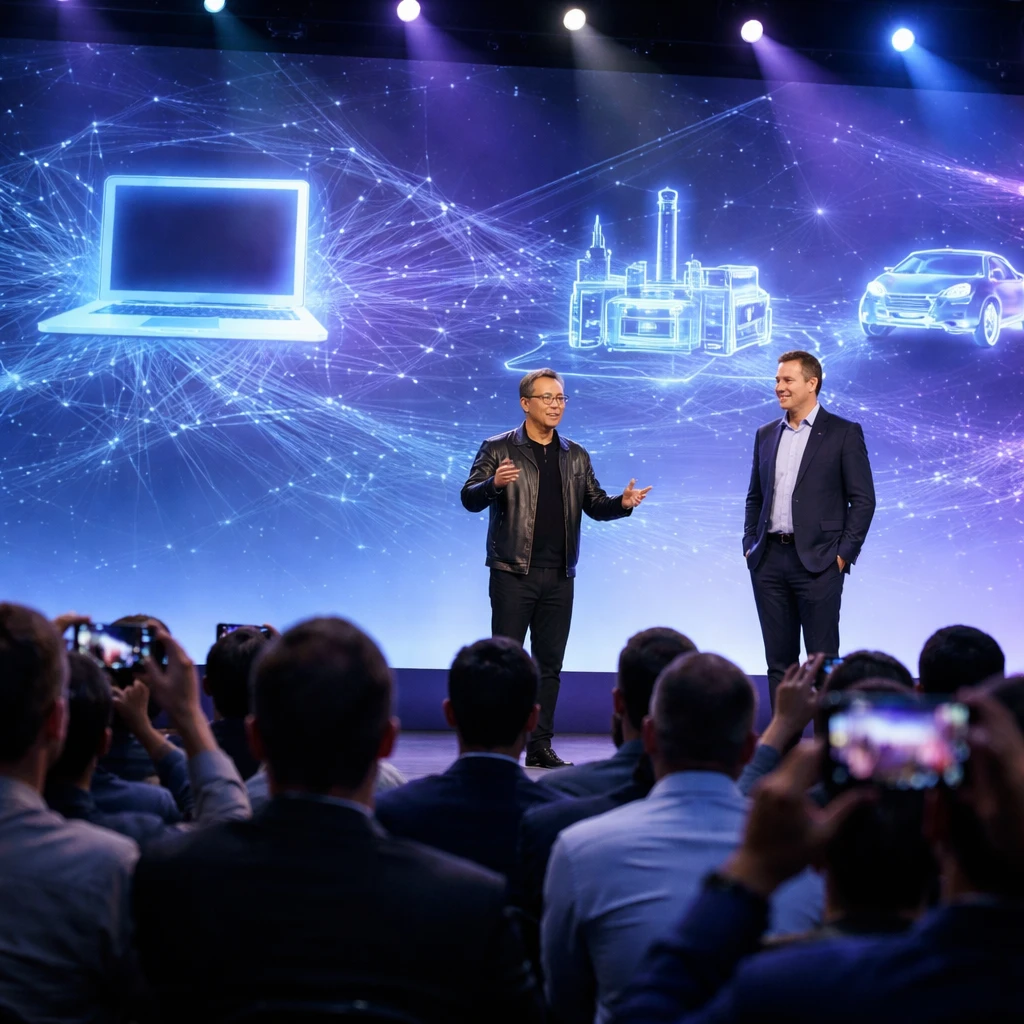
  • Executives described a shift from cloud-centric computing to "personal AI" that runs where information and actions occur - on laptops, factory floors, and in autonomous vehicles; this impacts PC hardware and edge compute deployments.
  • Nvidia announced a new high-performance CPU targeted at agentic AI and worked with Dell on the Dell AI Data Platform, a form of long-term memory for agents; this affects semiconductors, memory suppliers, and OEM partnerships.
  • Both CEOs warned that demand for AI infrastructure currently outstrips supply, with memory and advanced semiconductors constrained, affecting chipmakers, component suppliers, and enterprise IT capital spending.

In a joint Bloomberg TV appearance at Dell Technologies World 2026 in Las Vegas, Nvidia CEO Jensen Huang and Dell Technologies CEO Michael Dell described a vision of distributed computing in which AI is executed at the point of context rather than relying solely on remote cloud servers.

Huang framed the transition as a move from traditional personal computers to what he labeled "personal AI." He argued that artificial intelligence must operate where information and actions intersect - on devices such as laptops, on manufacturing floors, or inside autonomous vehicles - instead of depending exclusively on cloud processing.

Dell emphasized that the PC remains central to knowledge-worker productivity and that customers are asking for machines with stronger performance to accommodate hybrid AI features. He noted that Dell is integrating the ability to run smaller, local AI models directly inside PCs to meet that demand.

Huang said the rise of agentic AI has altered computing architecture. According to his description, the approach involves constructing large language models to function as a "brain," and then adding a "harness" that enables the model to access memory, networks and tools so it can act as a digital agent.

Nvidia is introducing what Huang described as the highest performing CPU in the world, specifically engineered for agentic AI workloads. The company has collaborated with Dell to build a new form of long-term memory for agents that Dell calls the Dell AI Data Platform.

Dell conveyed that companies rethinking workflows around these agent-driven systems have observed productivity improvements measured in multiples - on the order of 10 to 30 times - instead of incremental gains of 10% to 30%.

Both executives said demand for AI infrastructure currently exceeds supply. They identified memory and advanced semiconductors as bottlenecks. Huang observed that, while the semiconductor supply chain is expanding, demand is growing faster.

Dell pointed out that agent frameworks deployed within enterprises require substantially more CPUs than prior computing models. He explained that agents rely on tools constantly and at high speed compared with human users, which drives up compute requirements inside companies.

Market markers in the session reflected near-term stock movement references: DELL -3.51% NVDA -2.28%.


Contextual note: The comments by both executives focused on architectural shifts and infrastructure constraints tied to running AI where decisions and data are created, and on technical partnerships intended to address agent memory and CPU performance for these emerging workloads.

Risks

  • Supply constraints in memory and advanced semiconductors could limit deployment of local AI systems and delay enterprise adoption - this is a risk for semiconductor manufacturers, PC OEMs, and data center operators.
  • Agent frameworks require substantially more CPUs than previous models because agents use tools constantly and at high speed, increasing infrastructure requirements and capital expenditure for businesses adopting these systems - this affects enterprise IT budgets and cloud/on-premise capacity planning.
  • Even as the semiconductor supply chain expands, demand is reported to be growing faster, creating the potential for continued shortages or cost pressures that could impact timelines and margins for hardware vendors and system integrators.

More from Stock Markets

Toronto market ends at fresh record as healthcare, financials and materials lead gains Jun 4, 2026 After-Hours Movers: Lululemon Dips on Guidance as Software and Data Names Show Mixed Reactions Jun 4, 2026 Anthropic Places Engineers Inside NSA to Support Mythos AI for Offensive Cyber Tasks Jun 4, 2026 Trump Directs $700M Toward Coal Industry, Lifting Peabody Shares Jun 4, 2026 Pentagon Poised to Abandon Tomahawk Deployment to Germany Over Escalation Concerns Jun 4, 2026