
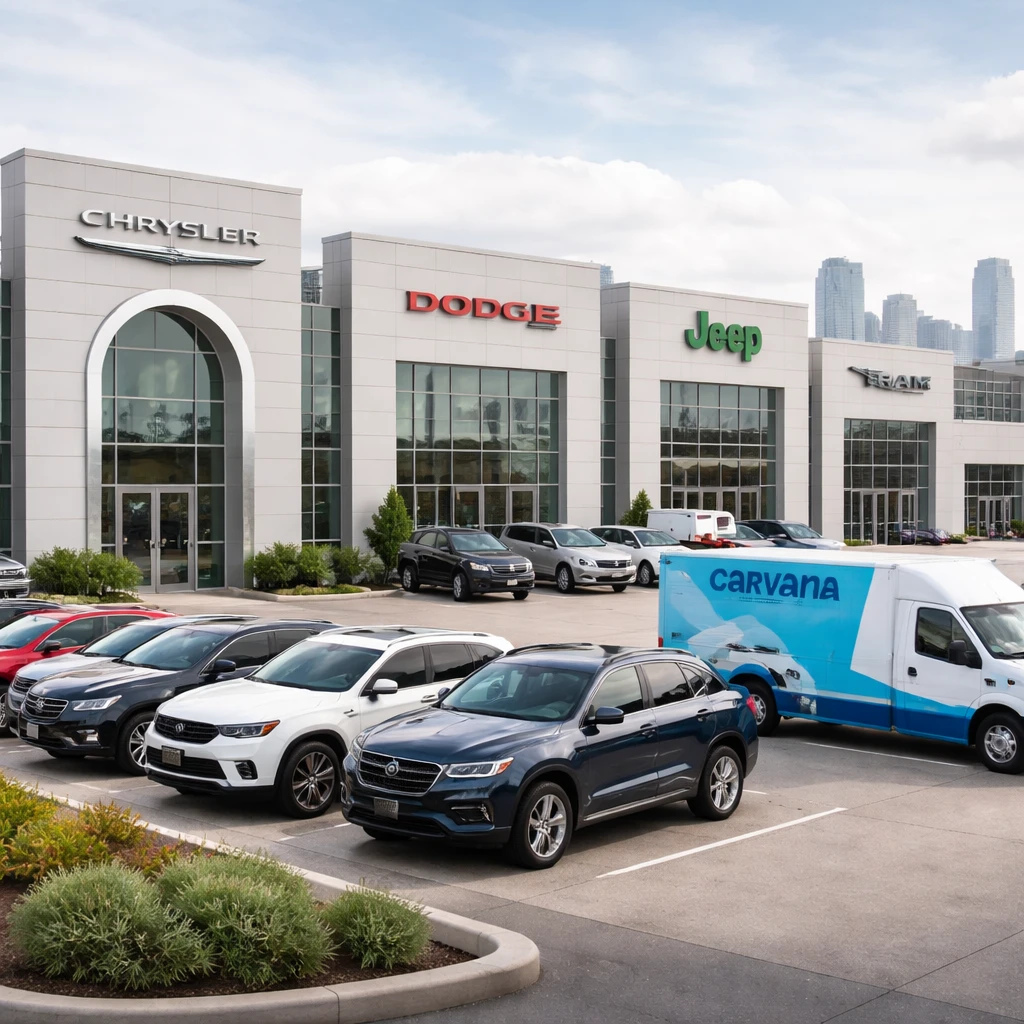
Carvana has begun selling new vehicles to a broad swath of U.S. consumers through a small network of Stellantis-branded dealerships, according to a Friday note from BTIG. The firm concluded that a setup of seven Chrysler, Dodge, Jeep and Ram stores can provide new-car coverage that reaches up to half of the United States population.
The company's new-car retail effort was inaugurated in mid-June at its Dallas, Texas dealership. Carvana also recently added a new-car filter to its website, carvana.com, making it easier for shoppers to find new inventory online. BTIG reported that, in searches across 16 major U.S. metropolitan areas, 15 had new-car inventory available with free shipping from Carvana.
BTIG emphasized the role of Carvana's logistics network in achieving this reach. The note argued that the combination of centralized logistics and delivery capability allows seven stores to provide geographic coverage that would normally require between 100 and 150 traditional franchised dealerships.
But the expansion is not without limits. Stellantis holds about 8% of the new-car market, and the automaker has placed restrictions on how many dealerships Carvana may acquire in any rolling 12-month period. BTIG also flagged open questions about Carvana's ability to sell new cars to buyers who live inside other dealers' Primary Market Areas.
Internally, Carvana's data indicate that roughly 75% of its new-vehicle buyers originally came to the site looking for used cars. BTIG interprets that pattern as evidence the company is enlarging the total market by converting used-car shoppers into new-car purchasers rather than simply capturing share from other new-car sellers.
On profitability, BTIG estimates new-car gross profit per unit will range between $5,500 and $7,500. Of that amount, the firm expects $1,500 to $2,000 to derive from parts and service operations tied to the dealership footprint. Even under a relatively high-volume scenario, BTIG projects new vehicles will account for less than 10% of Carvana's unit sales and will modestly dilute company-wide gross profit per unit by under 3%.
BTIG also highlighted several strategic benefits of owning the dealerships beyond new-vehicle sales. Dealership ownership is expected to supply additional used-vehicle inventory, produce operating cash flow through parts and service, and create a physical consumer touchpoint that could support future demand for used cars.
Contextual note: The information above reflects the details and estimates presented by BTIG and Carvana's internal data as cited in the BTIG note. It does not add or modify the numeric estimates or claims provided in that analysis.