
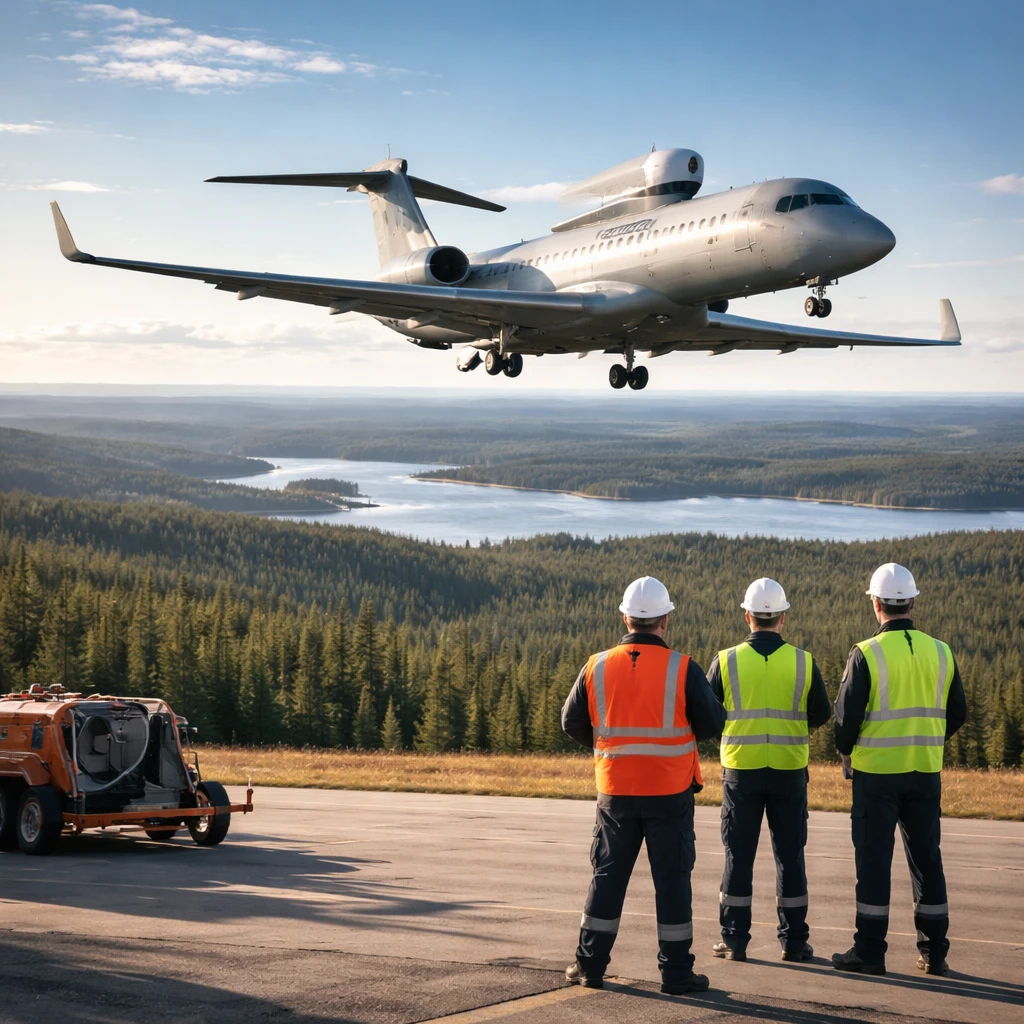
Canada has entered formal negotiations to procure Saab AB's GlobalEye airborne early warning and control (AEW&C) aircraft, Prime Minister Mark Carney announced at the CANSEC defence trade show. Government officials project the acquisition will sustain about 3,000 positions across the Canadian aerospace and defence supply chain.
The procurement outlines a significant Canadian industrial component. Officials said that at least one-third of the planned fleet will be manufactured in Canada over the next 15 years, and that at least 40 aircraft - including orders from allied partners - will be built by Canadian workers under the terms being discussed.
The GlobalEye platform merges airborne early warning and control functions with long-range air, sea, and land surveillance capabilities. The radar and sensor suite is integrated on the Bombardier Global 6500 airframe, which is described in government statements as Canadian-made. The system is reported to be capable of detecting objects and signals at ranges up to 650 kilometres.
Alongside the announcement on the GlobalEye talks, the Prime Minister's office highlighted recent government investments and structural reforms in defence procurement and industrial policy. Over the past year Canada has invested in excess of $65 billion in defence and security, and the government says it has reached a defence spending level equal to 2% of GDP for the first time since the fall of the Berlin Wall.
To align procurement with domestic industry goals, the government has launched a Defence Investment Agency and published a Defence Industrial Strategy intended to prioritize Canadian suppliers and materials while streamlining acquisition processes. A modernized Industrial and Technological Benefits Policy is now in force and introduces a 90-day approval standard for certain approvals.
The updated policy also incorporates a new Canadian Company Boost. Under this measure, domestic firms that carry out at least 70% of contract work in Canada will be credited as if they had completed 100% of the work domestically. New structures to aid industry collaboration and access to government support are also in effect, including a Strategic Partnership Framework and a Defence Concierge Service aimed at helping small and medium-sized enterprises navigate government programs.
In addition, applications will open on June 1, 2026 for participation in a Defence Advisory Forum that is intended to advise the government on expanding the national defence industrial base. The forum will be co-chaired by the Minister of National Defence, the Minister of Industry, and the Secretary of State for Defence Procurement.
Finally, the government noted an international commitment made at the 2025 NATO Summit in The Hague: Canada agreed to target defence investment equal to 5% of annual GDP by 2035.
Context and implications
The discussions to buy GlobalEye aircraft reflect a combination of planned capability upgrades and explicit industrial policy objectives. The measures announced alongside the procurement talks are designed to steer defence spending toward domestic suppliers, shorten procurement timelines, and provide structured support for industry participants, including smaller firms.