
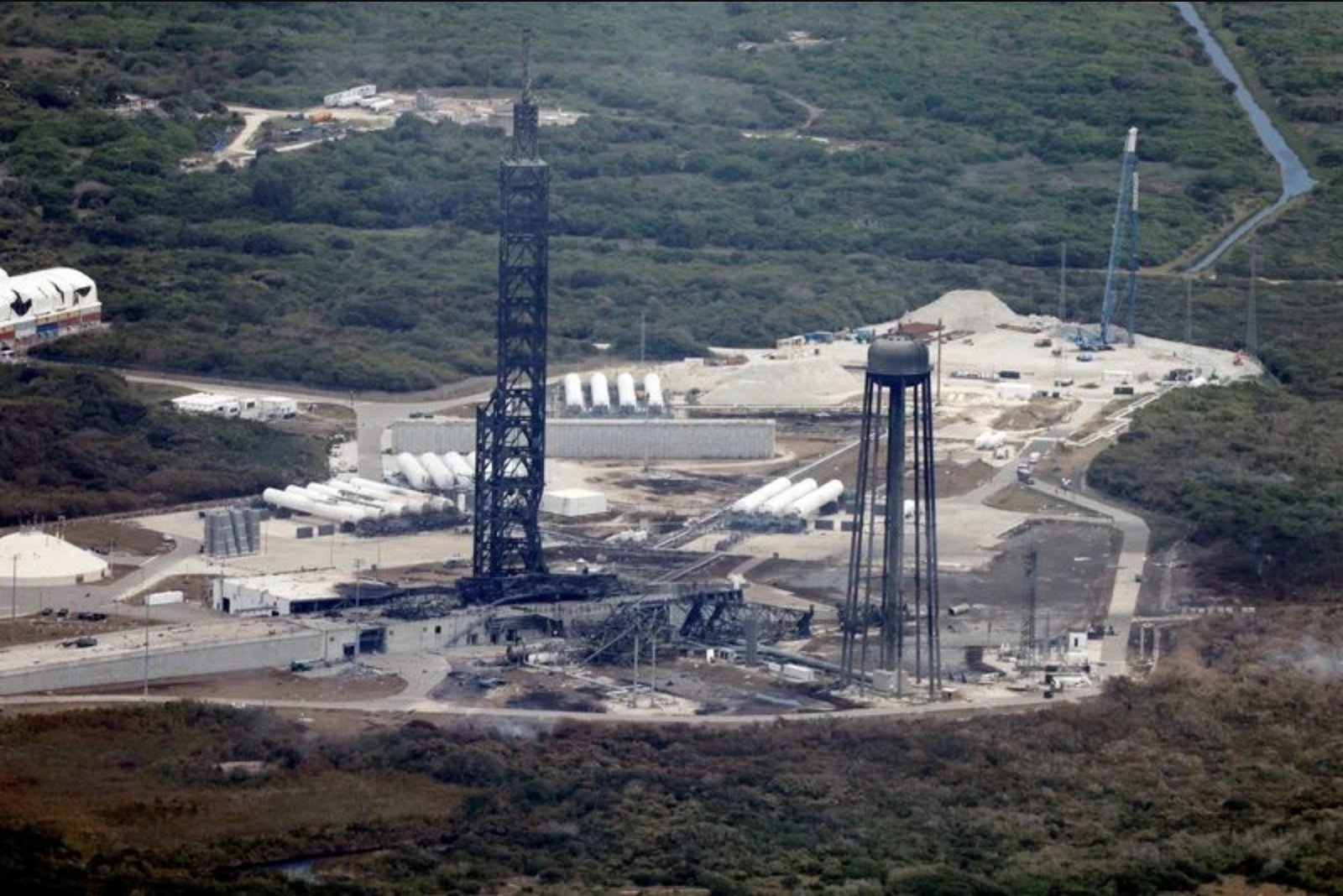
A catastrophic engine test for Blue Origin’s New Glenn rocket left a booster in ruins and the adjacent launch pad severely damaged, company and industry sources said, triggering what engineers expect will be a months-long disruption to operations.
The rocket failure occurred during a pre-launch engine firing meant to prepare the New Glenn vehicle for a scheduled liftoff the following week. A booster, named "No, It’s Necessary" in a nod to a line from the film Interstellar, was wrecked in the incident. A person familiar with the matter, who spoke on condition of anonymity because they were not authorized to discuss the matter, said the launch pad was "practically destroyed" and that rebuilding could take at least six months, if not longer.
Industry analysts and company insiders said the timing of the mishap could have broad consequences across commercial satellite deployment plans and national space programs. Blue Origin and Amazon have been positioning themselves to challenge SpaceX in heavy-lift launches and in the market for global satellite internet services. The destruction of the pad complicates those ambitions just as Amazon’s low Earth orbit (LEO) satellite initiative was depending on New Glenn’s capacity and cadence.
Antoine Grenier, a partner and head of space consulting at Analysys Mason, said recovery is possible but slow. "It’s only been a year since the SpaceX Starship also exploded on the launch pad and Blue Origin can also recover. But it will take months to rebuild," he said.
Operational and commercial consequences
Amazon LEO had planned to use New Glenn to deploy half of its more than 3,200-satellite broadband constellation by July 2026 to meet regulatory deadlines. That deployment strategy relied on New Glenn’s ability to launch many satellites per flight at a rapid tempo. Engineers and analysts warn that any extended grounding by the Federal Aviation Administration (FAA) would pose a severe threat to that schedule.
Amazon’s decision to engage multiple launch partners has reduced dependence on a single vehicle, but the company still faces capacity constraints in the near term. Analysys Mason’s Grenier noted that available near-term capacity from other heavy launch providers had largely been reserved. While SpaceX could accept some additional missions, its Falcon 9 rocket carries roughly half as many Amazon LEO satellites per launch as New Glenn, a discrepancy that would require a substantial increase in mission count if launches shifted materially away from Blue Origin.
The incident also complicates lunar mission plans. Blue Origin had scheduled New Glenn to launch the company’s first Blue Moon lunar lander later this year. Separately, days before the accident NASA awarded Blue Origin a contract to deliver two lunar rovers ahead of the Artemis 4 mission in 2028. The space agency said it would evaluate any near-term impacts on Artemis and Moon Base programs, but made clear it was not yet decided whether missions would need reassignment.
Government and industry reactions
Despite the catastrophic pad damage, the U.S. Space Force and the National Reconnaissance Office affirmed their commitment to Blue Origin, standing by a national security launch contract that had just been awarded to the company hours before the failure. Mark Boggett, chief executive of British space investor Seraphim Space, said the market’s need for multiple viable launch providers remains unchanged even if the incident strengthens SpaceX at the margin. "Long term, the market still needs viable alternatives, so this strengthens SpaceX’s position at the margin, but doesn’t change the broader trajectory toward a multi-provider ecosystem," he said.
The event also drew brief public comments from Elon Musk, who posted, "Sorry to see this, I hope you recover quickly," on the social platform X and later replied to Jeff Bezos with the Latin phrase, "Ad astra per aspera," which speaks to overcoming difficult challenges.
Outlook and remaining uncertainties
It remains unclear how much long-term damage the incident will do to Blue Origin’s competitive position or how broadly the disruption will advantage SpaceX, which has a crowded backlog of its own Starlink satellite deployments along with commercial and government missions. Analysts caution that shifting missions between vehicles is not straightforward: lunar payloads are often designed around specific launch configurations, making an urgent change of launch vehicle both complex and time consuming.
Company engineers and industry observers expect a lengthy recovery. Space history provides precedents for protracted repair efforts at damaged pads, including past incidents in which operators redirected activity to alternate facilities to resume launches sooner. How quickly Blue Origin can repair or replace the damaged pad - and whether regulators will clear the site for launches - will determine the near-term trajectory for the company’s satellite and lunar programs.
For Amazon, which has diversified its launch lineup, the immediate concern is that the loss of New Glenn’s capacity will force either a significant increase in the number of launches required from alternate providers or a delay in meeting regulatory deployment milestones. For NASA and for national security customers, the central questions are whether any contracts or mission assignments will be reassigned and how much delay the organization-backed programs may experience.
Summary
The destruction of a New Glenn booster and heavy damage to Blue Origin’s launch pad during an engine test is expected to cause at least a six-month disruption to the company’s operations. The setback threatens Amazon’s satellite deployment schedule, complicates planned lunar missions, and may bolster SpaceX’s market position, although government agencies have reaffirmed commitments to Blue Origin and the broader multi-provider market structure remains intact.