
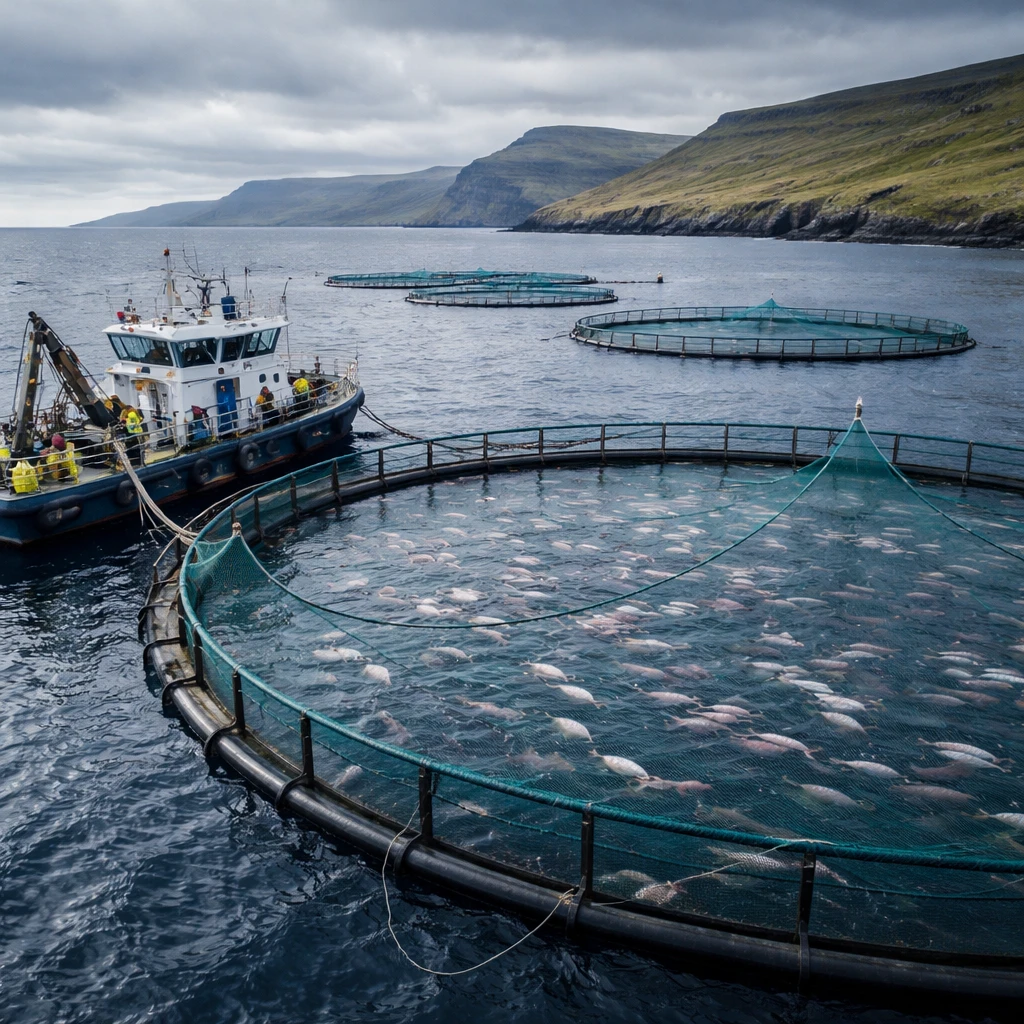
Bakkafrost said it swung back to net profit in the January-March quarter, reporting improved operating earnings and a boost from larger harvests in the Faroe Islands.
Operational earnings before interest and taxes (EBIT) for the quarter amounted to 544 million Danish crowns, up from 505 million crowns in the same period a year earlier. Net profit returned to positive territory at 307 million crowns, compared with a net loss of 6 million crowns a year ago.
Revenue for the quarter climbed 11% to 2.11 billion crowns. The top-line increase was supported by a 24% rise in total harvested volumes, which reached 31,337 tonnes gutted weight. Faroe Islands harvests contributed the bulk of the gain, increasing 33% to 25,139 tonnes, which helped offset weaker results in Scotland.
Despite robust demand in certain markets, Bakkafrost noted that lower global salmon prices had a negative impact on results. Reference prices for 4-5 kilogram superior salmon were around 5% lower than a year earlier, even as demand remained strong—particularly from China.
The company provided segment detail showing the Faroese farming operation delivered operational EBIT of 386 million crowns, up from 287 million crowns a year earlier. Management attributed the improvement in the Faroes to stronger fish health, reduced mortality and better operational efficiency.
By contrast, the Scottish farming business recorded an operational loss of 63 million crowns, versus an operational profit of 16 million crowns in the prior-year quarter. The Scottish performance was hurt by biological challenges and costs related to incidents.
Alongside the quarterly results, Bakkafrost raised its harvest guidance for 2026 in the Faroe Islands to about 97,000 tonnes, up from the previous forecast of 92,000 tonnes. The firm kept its Scotland guidance unchanged at roughly 20,000 tonnes, leaving the total expected harvest for 2026 at around 117,000 tonnes.
Summary of quarterly figures and outlook:
- Operational EBIT: 544 million crowns (January-March), up from 505 million crowns year-on-year.
- Net profit: 307 million crowns vs a loss of 6 million crowns a year earlier.
- Revenue: 2.11 billion crowns, an 11% increase.
- Total harvested volumes: 31,337 tonnes gutted weight, a 24% rise.
- Faroes harvests: 25,139 tonnes, up 33%.
- Faroes operational EBIT: 386 million crowns (up from 287 million).
- Scotland operational result: loss of 63 million crowns (from a profit of 16 million).
- 2026 harvest guidance: Faroe Islands ~97,000 tonnes (previously 92,000); Scotland ~20,000 tonnes; total ~117,000 tonnes.