
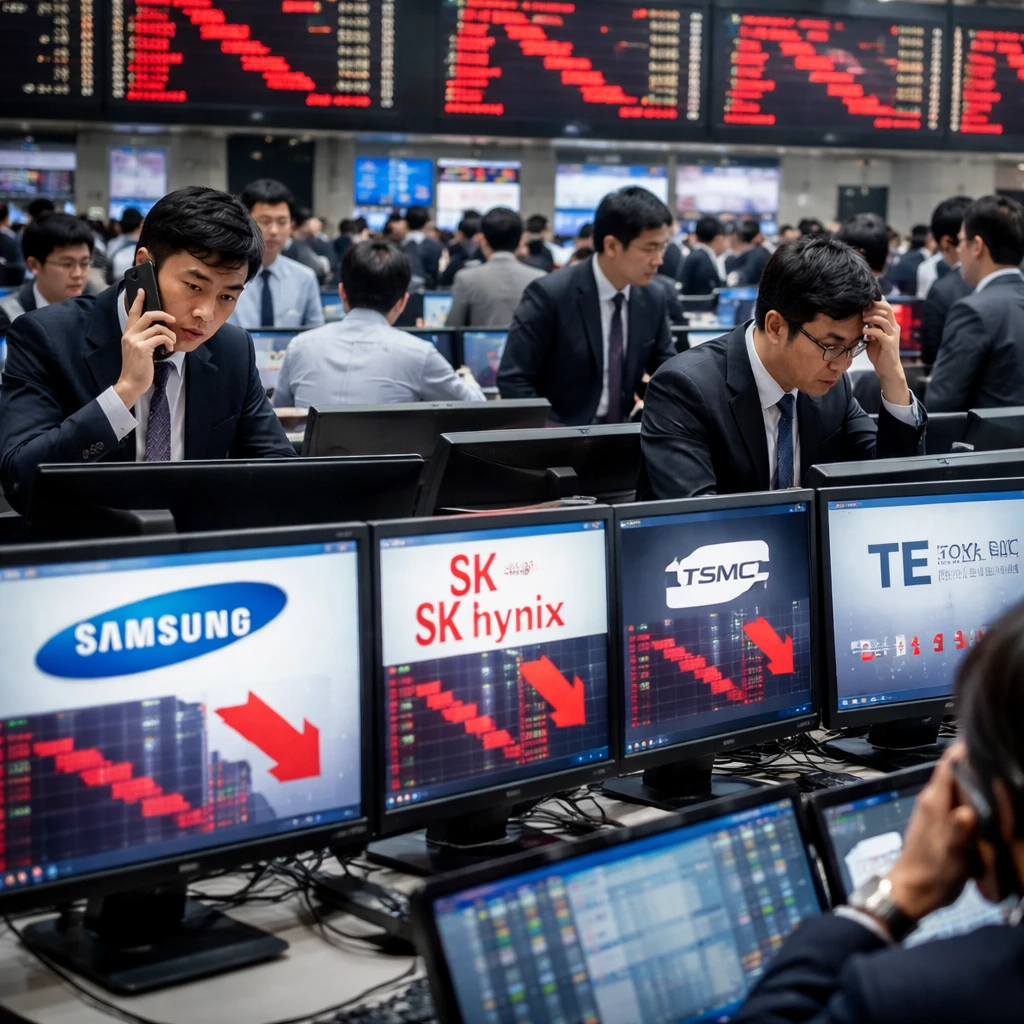
Asian chipmakers suffered widespread losses on Monday as the recent upswing tied to artificial intelligence demand cooled off. South Korean memory giants, several Japanese technology and semiconductor firms, and contract manufacturers across the region all moved lower as investors pared back exposure to names that had led the rally.
In South Korea, SK Hynix Inc (KS:000660) dropped 5.4% and Samsung Electronics Co Ltd (KS:005930) slid 2%. Electronics group LG Electronics, which had also benefited from the AI enthusiasm, fell 6.9%. The aggregate selling pressure pushed the KOSPI index down as much as 8.8% intraday before the index recovered some ground later in the session. SK Hynix's losses were partly tempered by the company announcing a new partnership with NVIDIA Corporation (NASDAQ:NVDA).
Japan saw notable weakness among large, AI-linked names. SoftBank Group Corp. (TYO:9984), which holds exposure to AI through its investment in OpenAI and ownership of chip designer Arm Holdings, declined 6.8%. A group of Japanese chipmakers and related technology stocks - Tokyo Electron Ltd. (TYO:8035), Kioxia Holdings Corp (TYO:285A), Ibiden Co Ltd (TYO:4062), and Advantest Corp. (TYO:6857) - fell in a range between 5.7% and 8%, contributing to a near 4% drop in the Nikkei 225 index.
Elsewhere in the region, Taiwan Semiconductor Manufacturing Co Ltd (TW:2330), the largest contract chipmaker globally, eased by a little more than 2% in Taiwan trading. In mainland China and Hong Kong markets, Semiconductor Manufacturing International Corp (HK:0981) and Hua Hong Semiconductor Ltd (HK:1347) each slid nearly 4%.
Market participants linked the Asian declines to a combination of factors that prompted profit-taking at the end of last week on Wall Street. A mix of rising geopolitical tensions in the Middle East and disappointing results from server maker Broadcom Inc (NASDAQ:AVGO) helped trigger heavy sales of names that had climbed sharply during the AI-themed rally. Additionally, a surge in U.S. Treasury yields following stronger-than-expected U.S. nonfarm payrolls data exerted downward pressure on technology shares.
The recent pullback follows a period in which semiconductor stocks had posted strong gains, reaching multiple record highs across several markets as investors chased potential outsized demand related to AI. Memory-chip producers, firms with exposure to AI server and data-center demand, and contract foundries had been among the primary beneficiaries of that advance.
Monday's moves reflect a reversal of that momentum rather than new company-specific developments in most cases. Where firms announced discrete items - for example, the SK Hynix-NVIDIA agreement - markets sometimes limited losses, but the broader retraction was driven by cross-market dynamics highlighted above.
Market context
- Regional indexes and large-cap chip names declined as investors trimmed positions in AI-exposed stocks.
- Profit-taking followed U.S. market weakness tied to geopolitical concerns and mixed corporate earnings.
- Rising U.S. yields after stronger jobs data added pressure on growth- and tech-focused equities.