
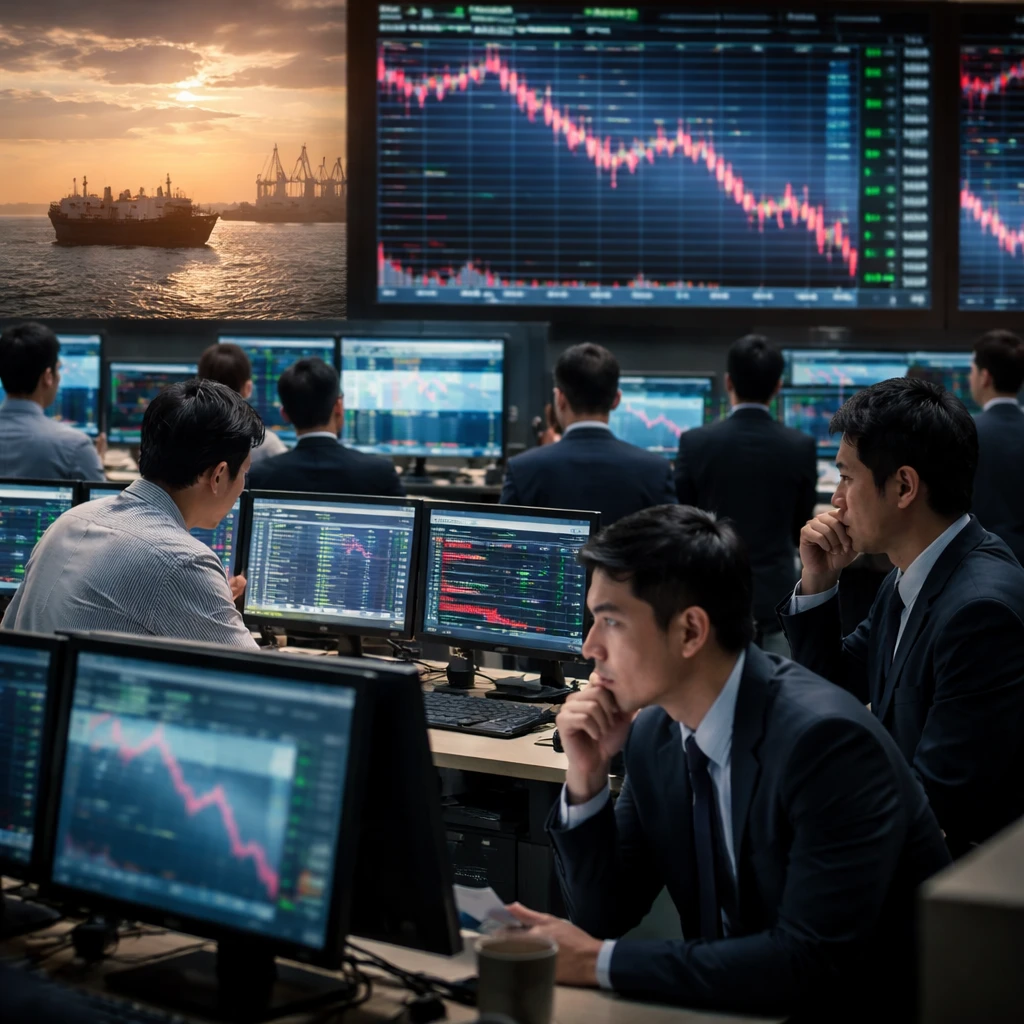
Asian share indices were broadly lower on Monday as losses in technology stocks set the tone for trading and geopolitical developments pushed oil prices higher. Market participants also entered the week watching for Nvidia’s quarterly report, due Wednesday, for clues about the sustainability of the AI-led rally in equities.
Japan’s Nikkei 225 fell 1%, and the TOPIX index declined 0.8%. Hong Kong’s Hang Seng lost 1.7%, while the Hang Seng TECH sub-index dropped 2.5%. In mainland China, the blue-chip Shanghai Shenzhen CSI 300 slipped 1%, and the Shanghai Composite edged down 0.5%.
In Australia, the S&P/ASX 200 retreated 1.6%. Singapore’s Straits Times Index dipped 0.6%. Futures tied to India’s Nifty 50 were down about 1% in Asian trading. U.S. stock index futures also moved lower during Asian hours after Wall Street ended the previous session lower on Friday amid inflation worries tied to surging oil prices.
Oil movements and regional tensions weighed on sentiment. The United Arab Emirates reported a drone strike that sparked a fire at a nuclear facility, and Saudi Arabia said it intercepted three drones over the weekend. U.S. President Donald Trump issued a warning to Iran, saying, "they better get moving, FAST, or there won’t be anything left of them." The Strait of Hormuz remained largely closed, and crude oil prices rose on Monday.
Market-level figures referenced intraday moves reported by exchanges and brokers: the ASX 200 was down 1.47%, JP225 down 0.87%, HK50 down 1.41%, NVDA quoted -4.42%, CL up 2.14%, NSEI down 0.68%, KS11 up 1.00%, STI down 0.53%, SSEC down 0.22%, TOPX down 0.77%, Samsung Electronics (005930) up 4.16%, CSI300 down 0.69%, and HSTECH down 2.48%.
South Korea’s KOSPI outperformed regional peers, gaining 0.2% as Samsung Electronics shares rebounded. The uplift in Samsung stock came after a new round of labour negotiations between the company and its South Korean labour union began on Monday, with government mediation in place. A South Korean court warned that it would fine the union about 100 million won per day if it failed to comply with court orders related to strike activities.
Investors also digested official Chinese activity data for April, which showed industrial production up 4.1% year-on-year, missing expectations of 6.0% growth. Retail sales rose just 0.2%, well below forecasts for a 2.0% increase, a sign of persistent consumer demand weakness.
Nvidia’s upcoming earnings are receiving heightened attention from market participants. The company is viewed as a bellwether for AI-related demand, and its results, due Wednesday, are being watched for indications about whether the AI-driven rally in global equities can continue.
Overall, the market backdrop combined technology-sector weakness, energy-driven inflation concerns and geopolitical risk, producing a cautious tone across Asian trading floors. Traders monitored commodity moves and regional developments while positioning ahead of key corporate results and further macroeconomic updates.