
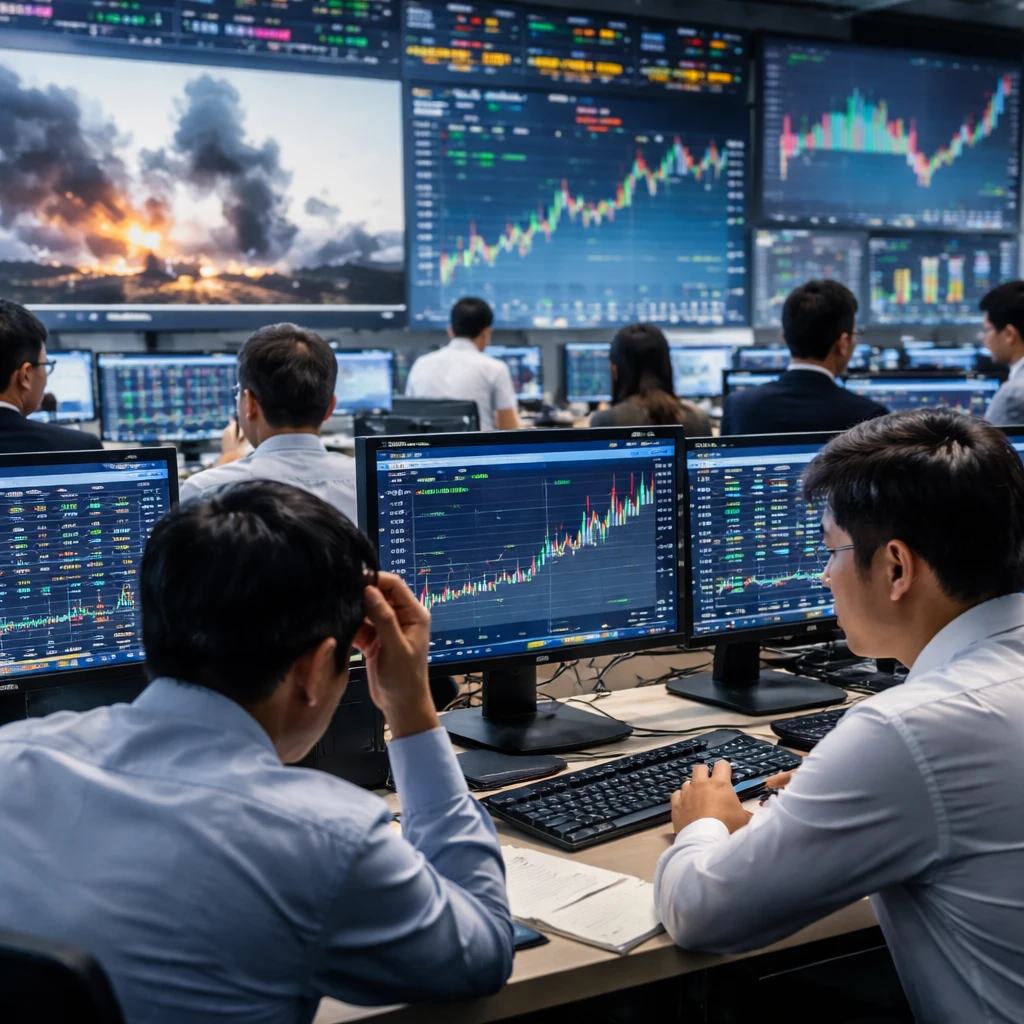
Most Asian equity markets ticked lower on Tuesday as renewed U.S. military strikes in Iran cooled hopes that negotiations might yield a swift end to the regional conflict. At the same time, pockets of strength persisted, particularly among technology and semiconductor stocks, which remained relatively resilient after a strong showing on Wall Street last week.
U.S. stock futures were trading modestly higher during Asian trade after Wall Street was closed on Monday for the Memorial Day holiday. Investor sentiment, however, was fragile amid reports that the U.S. conducted what it described as defensive strikes on missile launch sites and vessels in southern Iran while diplomatic talks aimed at ending the conflict continued in Doha.
Energy markets reacted to the renewed tensions. Oil rebounded after a steep decline on Monday, when hopes had risen that a deal could reopen the Strait of Hormuz, a vital route for global crude shipments. Brent crude recovered toward $98 a barrel, while U.S. crude was trading near $92.
Despite the military action, there was some guarded optimism. U.S. President Donald Trump said negotiations with Iran were "proceeding nicely," while also noting there was no rush to finalize an agreement. Nevertheless, the strikes contributed to a cautious tone among investors across the region.
Regional market moves were uneven:
- Japan’s Nikkei 225 slipped 0.3% to 64,994.4 points after reaching all-time highs in the prior session. The broader TOPIX index edged down 0.1%. The Nikkei had hit a record 65,408.7 points on Monday, supported by gains in chipmakers.
- China’s Shanghai Composite fell 0.8%, while the blue-chip Shanghai Shenzhen CSI 300 edged 0.3% lower.
- Australia’s S&P/ASX 200 dipped 0.4%, and Singapore’s Straits Times Index inched down 0.3%.
- India’s Nifty 50 traded largely flat through the session.
By contrast, South Korea’s market surged after a holiday break. The KOSPI jumped more than 3% to a record 8,131.15 points, driven by strength in chipmakers and AI-linked shares as trading resumed following Monday’s closure.
Major South Korean semiconductor names outperformed. Samsung Electronics (ticker 005930) climbed around 3%, while SK Hynix (ticker 000660) surged nearly 7% amid continuing enthusiasm for AI-related demand and semiconductor stocks.
Hong Kong’s Hang Seng index also rose, gaining about 0.5% as chipmakers rallied in catch-up trading. Sentiment in the city’s tech segment was bolstered by Huawei Technologies’ announcement of a significant semiconductor design advance, which lifted hopes about China’s ability to reduce dependence on U.S. technology.
Specific moves in Hong Kong included Hua Hong Semiconductor (ticker 1347) jumping more than 14% and Semiconductor Manufacturing International Corp (ticker 0981) climbing around 10%.
Across the region, technology shares generally showed resilience after last week’s Wall Street gains, even as geopolitical risks pushed some investors toward caution. Oil’s recovery reflected concerns that renewed hostilities could tighten crude supply flows, while mixed equity performance highlighted the market’s sensitivity to developments on both the geopolitical and technology fronts.