
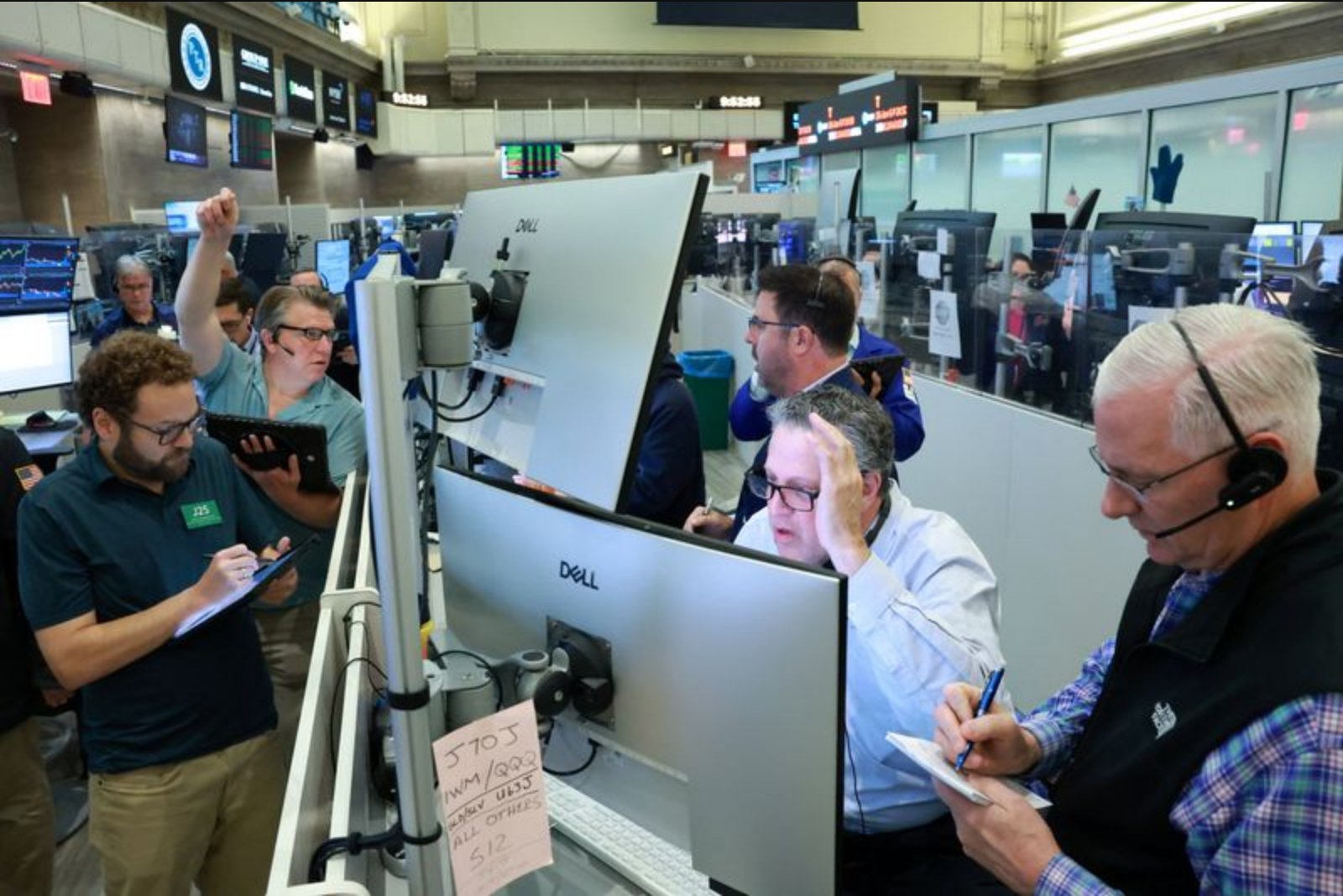
U.S. equity indexes traded close to record territory on Tuesday as investor enthusiasm around artificial intelligence and positive corporate news countered renewed geopolitical uncertainty tied to the Middle East. Semiconductor stocks were among the biggest beneficiaries of the rally, led by Micron Technology, which jumped more than 19% and reached a $1 trillion market value for the first time after UBS raised its price target on the stock to $1,625 from $535.
Market participants said strong profit reports and a wave of renewed confidence in AI-related trades have supported gains across technology names, even as tensions persisted after recent U.S. strikes on Iran. Attention is also shifting toward potential public listings from several of the largest private AI companies, including SpaceX, which investors see as a future source of liquidity for tech-focused portfolios.
Reflecting on the character of the rally, Chris Zaccarelli, chief investment officer for Northlight Asset Management, compared the current technology-led gains to past episodes. "For those of us that have been working that long, the tech rallies we’ve been seeing this year are reminiscent of the boom at the end of the 1990s," he said. He added that lessons from the tech bubble that burst over 25 years ago could help prevent a repeat of that outcome.
Some policy noise offered tentative signs of a possible resolution to the conflict. U.S. Secretary of State Marco Rubio commented that a deal with Tehran to halt hostilities could "take a few days," while Iran’s Tasnim news agency reported Tehran was seeking the release of $24 billion of Iranian funds frozen overseas. Those remarks appeared to provide some market comfort, even as uncertainty remained.
Market moves at mid-afternoon showed a mixed picture across indexes. At 2:13 p.m. EDT, the Dow Jones Industrial Average was down 175.28 points, or 0.35%, at 50,404.42. The S&P 500 was up 40.23 points, or 0.54%, at 7,513.70, and the Nasdaq Composite had gained 265.39 points, or 1.01%, to 26,609.36. The S&P 500, the Nasdaq and the Russell 2000 each touched intraday record highs during the session, underscoring the strength of the recent rally.
Energy prices climbed in response to the heightened geopolitical risk. Brent crude futures rose about 4% after the U.S. military carried out strikes in Iran, adding to questions about how quickly any deal to end the conflict could be achieved and whether shipping through the Strait of Hormuz would be affected.
Within the technology and chip sectors, several notable moves were reported. Qualcomm rose 3.6% after a media report said it reached a deal with ByteDance, owner of TikTok, to supply chips. Marvell Technology advanced 6%. The Philadelphia SE Semiconductor Index climbed 5% to an all-time high, and the S&P 500 information technology subindex led sector gains with a 1.5% increase.
Investors monitoring earnings trends have also been encouraged by revisions to growth expectations. With the bulk of the earnings season winding down, first-quarter earnings growth is now expected to be 29% year-on-year, compared with a 16.1% estimate from a month earlier, according to LSEG data released on Friday.
Market breadth favored advancers on both major exchanges. On the New York Stock Exchange, advancing issues outnumbered decliners by a 2.27-to-1 ratio, and there were 504 new highs and 82 new lows. On the Nasdaq, 3,040 stocks rose and 1,761 fell, giving advancing issues a 1.73-to-1 edge. The S&P 500 recorded 40 new 52-week highs and one new low, while the Nasdaq Composite posted 174 new highs and 65 new lows.
Some market participants noted the resilience of earnings expectations in the face of persistent inflation pressures. Adam Sarhan, chief executive of 50 Park Investments, said the market was reflecting continued economic growth and the expectation that earnings would expand even with elevated inflation. "Even though we don’t have an end of the war yet, there’s a very high likelihood the situation will resolve itself in a peaceful fashion sooner rather than later," he added.
Context and near-term focus
Investors are balancing the stimulative narrative from AI-driven demand and improved earnings outlooks against geopolitical developments that have pushed energy prices higher. Semiconductor names and broader information technology exposure have benefited the most from this dynamic so far, while energy and shipping-related concerns remain key risk factors to monitor.