
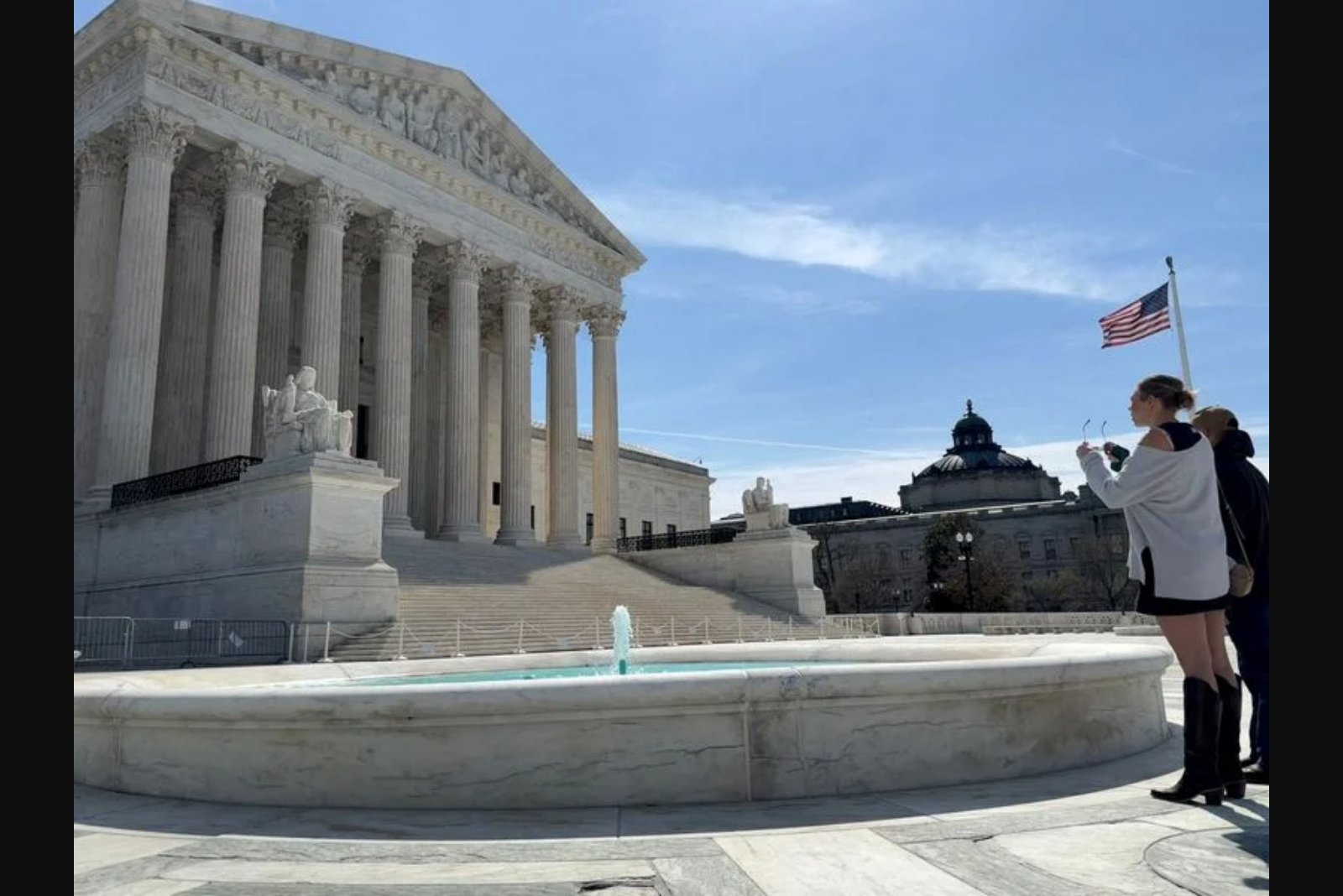
The U.S. Supreme Court will issue a ruling on a Republican-led challenge to federal restrictions on coordinated spending between political parties and candidates, touching on fundamental First Amendment questions about political speech and campaign finance.
The dispute, advanced by Vice President JD Vance and other Republican plaintiffs, asks whether the present ceiling on funds that parties can spend on campaigns when those expenditures are made with input from candidates runs afoul of the Constitution's protection against government abridgment of free speech. The case was first filed in 2022 while Vance was running for the U.S. Senate in Ohio.
Tuesday marks the final day of rulings for the Supreme Court's current term, which began in October. The decision arrives with November's midterm elections looming and as Republicans allied with President Donald Trump seek to keep control of Congress.
Financial positions of the major party committees form an important factual backdrop to the legal contest. As of the end of May, the three principal Republican committees - the Republican National Committee, the National Republican Congressional Committee and the National Republican Senatorial Committee - reported $256 million in cash and no debt. By comparison, their Democratic counterparts held approximately $126 million in cash and carried more than $18 million in debt.
The legal question presented to the court concerns a category of political spending formally known as coordinated party expenditures. Under the 1971 Federal Election Campaign Act - the statute governing fundraising and spending in federal elections - expenditures by a political party intended to advocate for or against a candidate are treated differently depending on whether they are coordinated with the candidate's campaign.
When a party's advocacy is conducted independently of a campaign, it is considered an independent expenditure and is not subject to a statutory cap. When the spending is coordinated with a campaign - meaning the party and candidate have input or communication about the expenditure - the law imposes limits. Those caps vary by the population of the state where a candidate runs, with lower limits in less populous states and higher limits in more populous ones. In 2025, for example, the statutory restrictions for Senate candidates ranged from around $127,000 to $3.9 million, while limits for House candidates ranged from about $63,000 to $127,000.
The challenge to those limits was brought in 2022 by two Republican committees, the former Republican congressman Steve Chabot of Ohio, and JD Vance, who at the time was a Senate candidate in Ohio. The Trump administration formally backed the legal challenge. After the Federal Election Commission under the Trump administration declined to defend the statutory provision challenged by the plaintiffs, the Supreme Court appointed attorney Roman Martinez to defend it. The court also allowed the Democratic National Committee, the Democratic Senatorial Campaign Committee and the Democratic Congressional Campaign Committee to intervene in defense of the spending limits.
On appeal, the plaintiffs urged the high court to revisit an earlier Supreme Court ruling issued in 2001 that arose from Colorado and addressed the same issue. In 2024 the U.S. Court of Appeals for the Sixth Circuit, based in Cincinnati, upheld the limits and stated that it was bound by the 2001 decision. The plaintiffs have argued that changes in campaign finance practice and shifts in Supreme Court jurisprudence over intervening decades have eroded the foundations of that prior ruling, and they asked the justices to consider overruling it.
The Supreme Court now hears the case against a judicial backdrop in which the court - holding a 6-3 conservative majority - has in recent years narrowed several campaign finance restrictions. Since 2010, the court has issued decisions that removed federal limits on independent expenditures by corporations and unions and struck down overall caps on how much an individual may contribute to federal political causes, each time citing First Amendment protections.
Rulings issued during this term of the court have included several decisions with direct election implications. The justices recently upheld state laws that permit mail-in ballots received after Election Day to be counted if received within a short grace period, rejecting a Republican-led challenge to a five-day extension in Mississippi. The court in April also invalidated a core provision of the 1965 Voting Rights Act, a decision that opened the possibility for Republican-led Southern states to redraw districts that had been majority-Black or majority-Latino, ahead of the midterms. The court's action on the Voting Rights Act prompted several Republican-led states to pursue new electoral maps to potentially place at risk U.S. House districts that had been considered safely Democratic.
The Sixth Circuit's 2024 ruling that sustained the coordinated spending limits concluded that the statutory framework comported with the Constitution, relying on precedent. The high court's decision could either affirm that outcome or depart from the 2001 Colorado-era precedent if the justices accept the plaintiffs' argument that legal developments require a fresh interpretation.
More broadly, the Supreme Court's forthcoming ruling will determine whether parties can expand the amount they spend in coordination with campaigns, or whether statutory caps on such coordinated expenditures will continue to be enforced. The legal resolution will take on heightened significance because of the current resource gap between the main party committees as they enter a competitive electoral period.
Key context:
- The case centers on whether caps on coordinated party expenditures violate the First Amendment.
- The Republican party committees held a larger cash position than Democratic counterparts at the end of May - $256 million versus roughly $126 million, with Democrats carrying over $18 million in debt.
- The Sixth Circuit in 2024 upheld the limits based on a 2001 Supreme Court precedent; plaintiffs urged the current court to reconsider that precedent.