
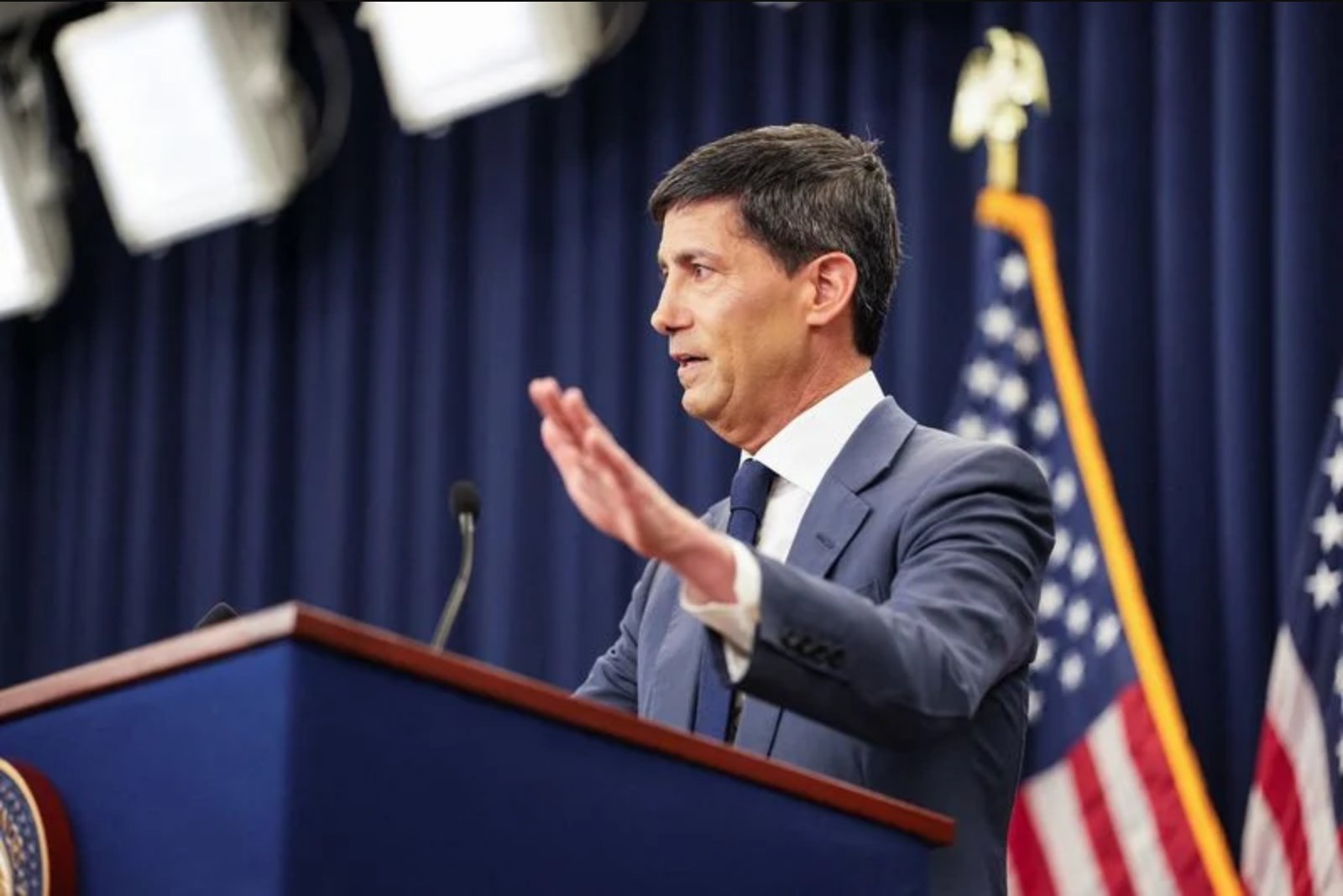
Kevin Warsh, the Federal Reserve's newest chair, will appear before lawmakers on Tuesday and Wednesday in his first extended public engagement with Congress since his May swearing-in ceremony. The sessions - before the House Financial Services Committee and the Senate Banking Committee - will be closely watched for signals about how he plans to run monetary policy and how he will balance the often-competing pressures of economic management and political expectations.
At his May ceremony, President Donald Trump offered effusive public praise, pumping his fist and encouraging Warsh with the words "Go get 'em" as Warsh took the podium for a brief address. The president also told Warsh at the swearing-in to "be totally independent. ... Don't look at me." Those public moments underscore the dual narrative facing the new Fed chief: a presidential endorsement that could be an asset in managing relations with the White House, and a reminder that questions persist about how lasting that support will be as economic conditions evolve.
Warsh's two days of testimony - scheduled for 10 a.m. EDT (1400 GMT) on Tuesday before the Republican-controlled House Financial Services Committee and at 10 a.m. EDT on Wednesday before the Senate Banking Committee - will be his first extended opportunity to set out his plans to lawmakers and to respond to inquiries about his independence and policy intentions. The Senate Banking Committee recommended his approval to the full Senate in late April on a party-line vote, with Democrats having voiced specific concerns about his relationship with the president and whether he would be truly independent after a nomination process in which the president said he would only pick someone he was certain would cut rates.
Observers have been parsing Warsh's early actions for signs of how closely aligned he will remain with the president's preferences. At the outset, his moves have been read by some as tilting away from the most partisan options. His appointments to a set of task forces were notable for the level of expertise among the members and the absence of overtly ideological figures of the sort sometimes installed at other agencies. The appointees include well-known economists, corporate executives and central bankers who, according to supporters, are likely to function as neutral arbiters on both long-standing and newly emerging issues facing the Fed.
"If people were concerned he would be a 'sock puppet,' those fears should have been gone after the first press conference" following the Fed's decision to hold rates steady, said Jon Faust, a former top adviser to Jerome Powell and now an economics professor at Johns Hopkins University. Faust added that the task force appointments "really cement that view," suggesting the composition of the groups reinforces Warsh's stated intention to have them function as impartial participants in key debates.
Still, skepticism remains. Some critics note that Warsh secured the president's support, in part, by signaling a dovish inclination prior to his nomination. "I agree that he got the president's support by giving him dovish signals," said Samuel Tombs, chief U.S. economist at Pantheon Macroeconomics. The counterargument, Tombs said, is that once installed Warsh has the latitude to take a longer, more neutral view of policy, pointing to how his predecessor demonstrated the Fed chair's capacity to act with independence.
Warsh's early public policy language has also shown more conditionality than some of his pre-nomination statements suggested. He previously argued that artificial intelligence could reduce inflation and pave the way for lower rates. Since taking office, however, the monetary policy report submitted to Congress ahead of his testimony noted that AI investment is pushing up some prices. Other Fed officials have observed that AI may be contributing to a jump in software costs, adding inflationary pressure from a new direction. Warsh has acknowledged uncertainty about the timing of supply-side and productivity improvements from AI while also noting that AI-related demand for capital, skilled construction labor and infrastructure is occurring now.
Those observations stand in contrast with the posture taken by Stephen Miran, a Trump-appointed former Fed governor who temporarily filled a board seat and advocated either a rate cut or a larger rate cut at each of the six Fed meetings he attended during his roughly eight-month tenure, dissenting every time. Warsh, by contrast, did not submit an interest rate projection at the Fed's June 16-17 meeting and has said he opposes that sort of forward guidance. At his first press conference as Fed chair he indicated that there was only a single policy proposal on the table at that meeting - and that there had been no discussion of a rate cut.
Warsh's early staffing decisions have also been scrutinized for signals about ideological leanings. The hires and contract advisers include figures with a range of past affiliations. Paul Winfree, an adviser Warsh hired on contract, had written a chapter for a controversial Project 2025 document that included proposals such as abolishing the Fed or removing its full employment mandate; Winfree later distanced himself from those proposals, saying they reflected a synthesis of other scholars' thoughts. Daniel Heil, a conservative policy analyst who worked with Warsh at Stanford University's Hoover Institution, was named as an interim policy adviser. John McConnell, a speechwriter brought on by Warsh, is described as a "pre-Trump" Republican who served as a top adviser and writer for former President George W. Bush and Vice President Dick Cheney. From within the Federal Reserve System itself, Warsh recruited veteran economists Daniel Covitz, who had worked with Warsh during his earlier service as a Fed governor from 2006 to 2011, and Eric Engstrom.
Those personnel choices, together with the task force slate, have led some observers to conclude that Warsh's inner circle does not reflect a strong tether to the president's immediate policy ambitions. "So far so good," said former Cleveland Fed President Loretta Mester, describing the composition of the new Fed task forces as "very promising." Mester added that while Trump publicly urged Warsh to be independent, "I don't know if you can say how long that will last."
Still, the durability of Warsh's apparent independence may be tested in coming months if inflation remains persistent or if a majority of his colleagues inclines toward rate hikes that the president opposes. The Trump administration could also continue moves to replace Democratic appointees on the Fed board, including efforts to remove Jerome Powell, putting Warsh in the position of either defending institutional independence - as his predecessor did - or incurring the president's displeasure.
Warsh's hearings before the House and Senate will give members of Congress an opportunity to probe these tensions directly: to press him on how he assesses inflation dynamics, including new sources of price pressure related to AI and software; to ask how he plans to use the Fed's review processes to address long-standing questions about the central bank's role; and to seek clarity on how he balances political pressures with the Fed's statutory mandate.
The coming testimony will also likely illuminate how Warsh views the sequence and timing of potential supply-side gains from AI versus the more immediate demands it appears to be generating. Those distinctions - between potential longer-term productivity benefits and nearer-term price and demand effects - have implications for how quickly the Fed may feel compelled to tighten policy if inflation proves more durable than expected.
For now, Warsh's early weeks in office have produced actions read by many as building institutional distance from the president's immediate rate-cut ambitions, but questions remain about how that posture will hold up over time. The hearings will offer the first extended, public accounting of his priorities before the body that oversees the central bank, and provide markets and policymakers additional information on how Warsh intends to steer a central bank operating amid political scrutiny and evolving inflationary forces.
Key points
- Warsh will testify before the House Financial Services Committee and the Senate Banking Committee over two days, giving his first extended public account of policy intentions as Fed chair.
- Early task force appointments and staffing hires have been interpreted by some observers as signaling a degree of distance from President Trump's immediate rate-cut preferences.
- AI-related investment is noted in the Fed's report to Congress as pushing up some prices, particularly software costs, complicating the inflation outlook and the timing of potential supply-side gains.
Risks and uncertainties
- Persistence of inflation could force Warsh and his colleagues toward rate hikes that may conflict with the president's preferences - a development that would affect interest-rate-sensitive sectors such as housing, consumer credit and capital markets.
- Political pressure from the administration to replace Democratic Fed board members, including possible actions against Powell, could create institutional strain and risk undermining the Fed's perceived independence, with implications for financial market confidence.
- Uncertainty about the timing of productivity gains from AI versus near-term demand and price effects - especially in software - leaves the policy outlook unclear for technology-related firms and for sectors competing for skilled labor and infrastructure investment.