
Economy June 22, 2026 12:25 PM

Treasury Yields Climb as Markets Brace for Possible Fed Rate Increases

Two-year note hits a 16-month peak while futures price a strong chance of rate hikes by September

By Ajmal Hussain
Share
Twitter Reddit Facebook LinkedIn

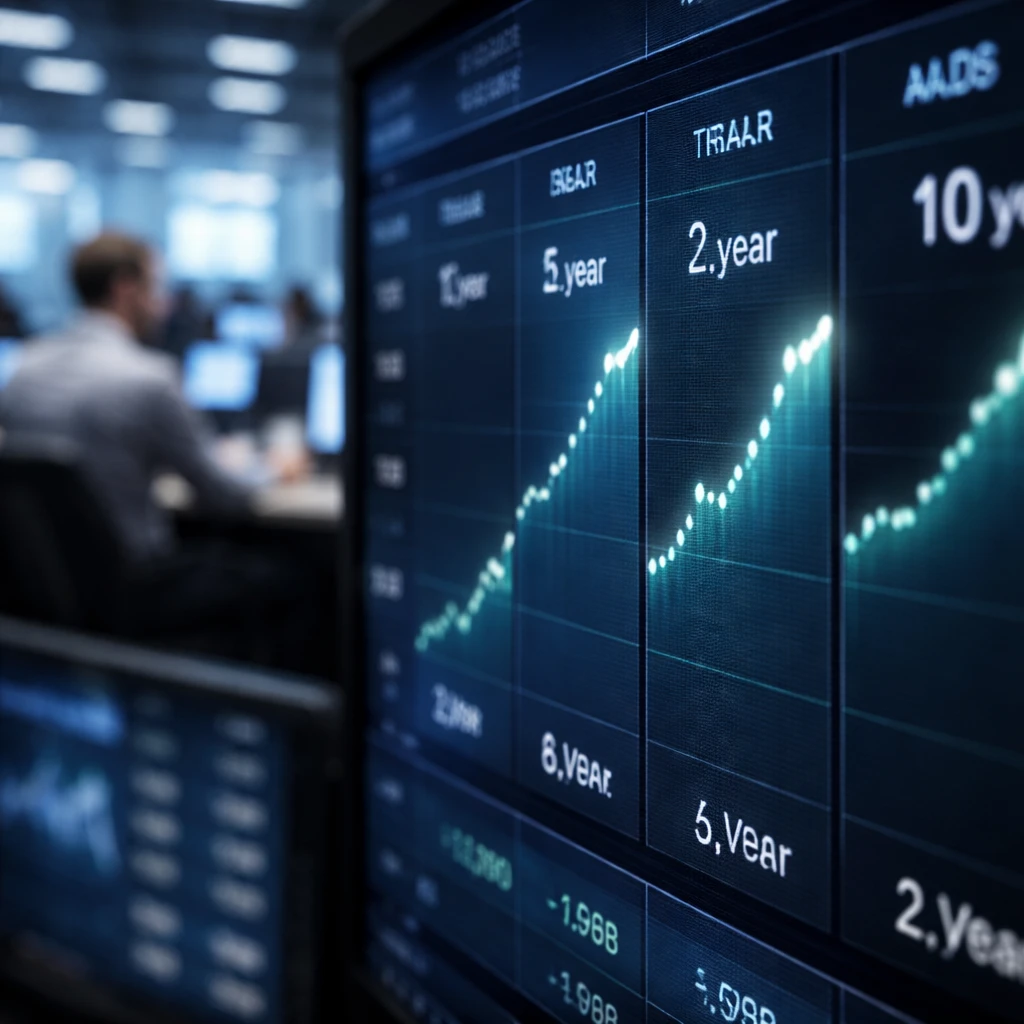
U.S. Treasury yields rose on Monday, led by the 2-year note which reached a 16-month high, as markets adjusted to signs the Federal Reserve may raise interest rates later this year. Shorter-dated yields, which closely track expectations for Fed policy, moved higher after the central bank dropped forward guidance and signaled readiness to tighten if inflation remains above its 2% target. Bank of America revised its outlook to three hikes this year, while fed funds futures put the odds of a September move at about 73%.

Treasury Yields Climb as Markets Brace for Possible Fed Rate Increases
Summarize with
ChatGPT Perplexity Claude Grok Gemini

Key Points

  • 2-year Treasury yield rose 3.61 basis points to 4.215% and touched 4.236%, reaching a 16-month high and its highest level since February 2025.
  • 10-year Treasury yield increased 4.19 basis points to 4.493%.
  • Fed left rates unchanged last Wednesday but signaled potential further hikes if inflation stays above its 2% target; forward guidance was removed from the statement.
  • Bank of America revised its outlook to predict three Fed rate hikes this year, after previously expecting no change; fed funds futures imply about a 73% chance of a hike by September.

U.S. Treasury yields moved higher on Monday as traders priced in a more hawkish path for Federal Reserve policy. The 2-year Treasury yield climbed 3.61 basis points to 4.215% and briefly touched 4.236%, marking the highest level since February 2025 and a 16-month high. The benchmark 10-year note also rose, gaining 4.19 basis points to reach 4.493%.

The moves followed the Federal Reserve's decision last Wednesday to hold interest rates steady while indicating that further increases could be appropriate later in the year if inflation remains above the central bank's 2% target. The statement from the Fed removed prior forward guidance about future rate moves and limited itself to announcing the decision on current rates while reiterating a commitment to maintain ample reserves within the banking system.

Market participants have reacted to those signals by shifting expectations for policy. Bank of America updated its forecast, now projecting three rate hikes this year after previously expecting no change. That reassessment was mirrored in market pricing: fed funds futures traders are assigning roughly a 73% probability to at least one rate increase by September.

Short-maturity Treasury yields, particularly the 2-year, tend to move in step with expectations for the Fed's policy path, which helps explain the pronounced rise in that segment of the curve. The Fed's omission of forward guidance in its statement has left traders to interpret the central bank's future moves based on economic data and commentary, contributing to the re-pricing observed in recent sessions.

The developments underline the degree of uncertainty facing markets as participants weigh the persistence of inflation relative to the Fed's 2% goal and the central bank's willingness to tighten again. The updated forecasts from a major bank and the probabilities implied by futures markets indicate that investors are taking the Fed's message about potential further action seriously.


Context and market mechanics

Because the 2-year Treasury yield is closely tied to expectations for short-term interest rates set by the Fed, changes in that yield are often among the most sensitive indicators of market sentiment about central bank policy. The 10-year yield, while also responsive, incorporates longer-term growth and inflation expectations.

With the Fed leaving the door open to additional hikes, both the immediate path for policy and the interpretation of future statements will remain key inputs for traders and analysts monitoring Treasury yields.

Risks

  • Removal of forward guidance introduces greater uncertainty about the timing and magnitude of future Fed moves - this uncertainty can affect fixed-income markets and interest-rate-sensitive sectors.
  • Persistence of inflation above the Fed's 2% target increases the risk that the central bank will raise borrowing costs later in the year - this may influence borrowing costs across the economy.
  • Diverging forecasts among market participants and institutions, illustrated by Bank of America's revised projection, reflect unsettled expectations which could lead to heightened market volatility.

More from Economy

Ottawa lays out plan for as many as 10 new large-scale nuclear reactors Jun 22, 2026 Rubio Heads to Gulf to Review U.S.-Iran Memorandum with Arab Allies Jun 22, 2026 Doval and Wang Meet at BRICS Security Talks in New Delhi Jun 22, 2026 Argentina authorizes up to $5 billion in loans backed by multilateral credit guarantees Jun 22, 2026 Argentina Approves Up to $5 Billion in Multilaterally-Backed Loans Jun 22, 2026