
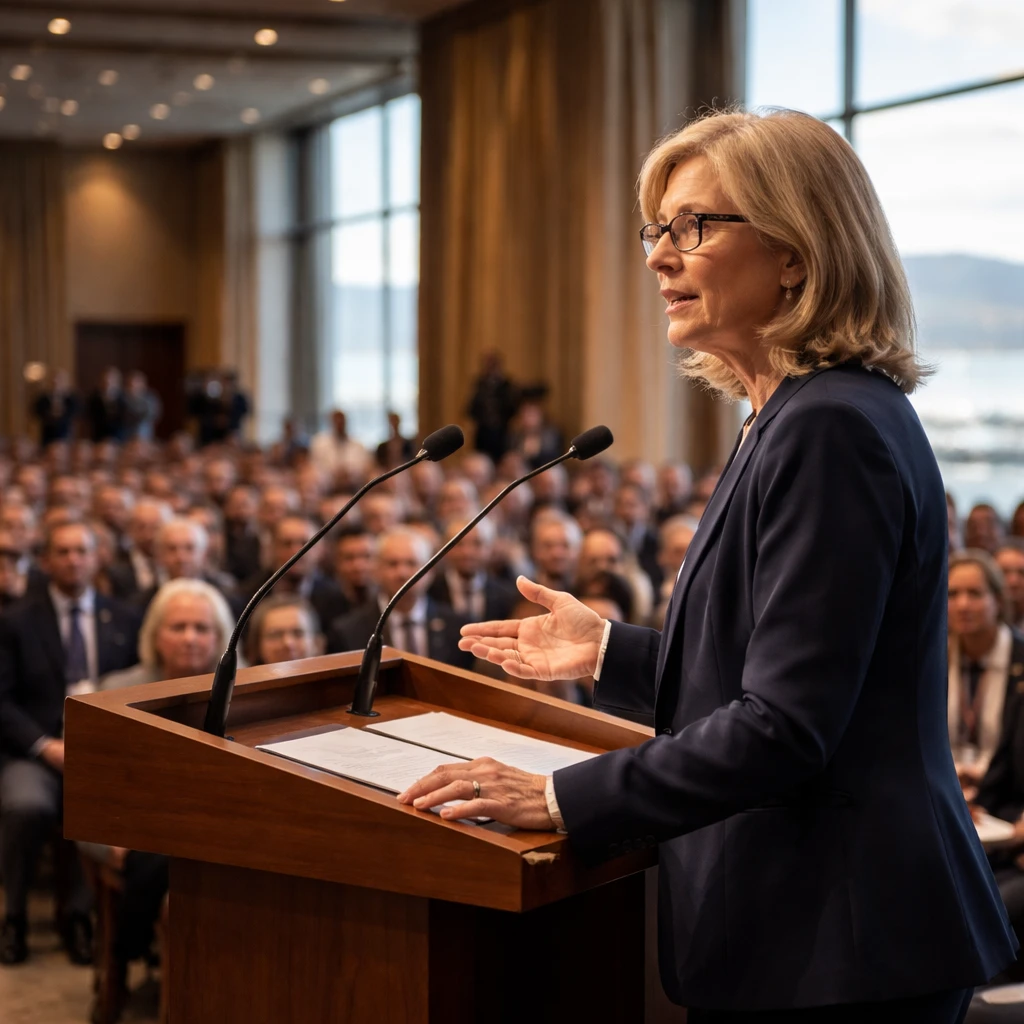
San Francisco Federal Reserve President Mary Daly said on Thursday that U.S. monetary policy is currently slightly restrictive, and she emphasized that the central bank's next policy step is unclear because of strong investment in artificial intelligence and a stable labor market.
Daly made her remarks at a Banco de España conference in Santander, Spain. She laid out two alternative scenarios confronting the Fed: one in which inflation proves more persistent than anticipated, and another in which economic expansion falters or investment diminishes because returns become less attractive.
She also noted that the recent decline in oil prices, which followed a ceasefire in the Iran war, is constructive for both the broader economy and for consumers.
Daly's comments arrived as the U.S. Bureau of Labor Statistics released figures indicating that job growth slowed sharply last month. That evidence of cooling labor-market momentum prompted traders to scale back their chances of a rate increase this month and in September.
Earlier, Daly had attended a global central banking conference in Sintra, Portugal, where Fed Chairman Kevin Warsh addressed the challenge of keeping inflation under control and said he would disappoint anyone expecting the U.S. central bank to fail in containing inflation. Warsh noted that inflation has remained above the Fed's 2% target for six years.
Warsh also discussed the economic effects of artificial intelligence, saying that AI is presently lifting demand but ultimately should raise supply, creating countervailing pressures on inflation.
Daly returned to that theme in Santander, saying the uncertainty around AI's net economic impact makes it difficult for her to move quickly on interest rates.
Context and implications
- The combination of strong AI-related investment and a steady labor market leaves the Fed weighing whether inflation risks or growth risks will dominate.
- A fall in oil prices after the Iran war ceasefire offers relief to consumers and could ease inflationary pressure.
- Recent labor-market data showing a sharp slowdown in job gains has already altered market expectations for near-term policy moves.