
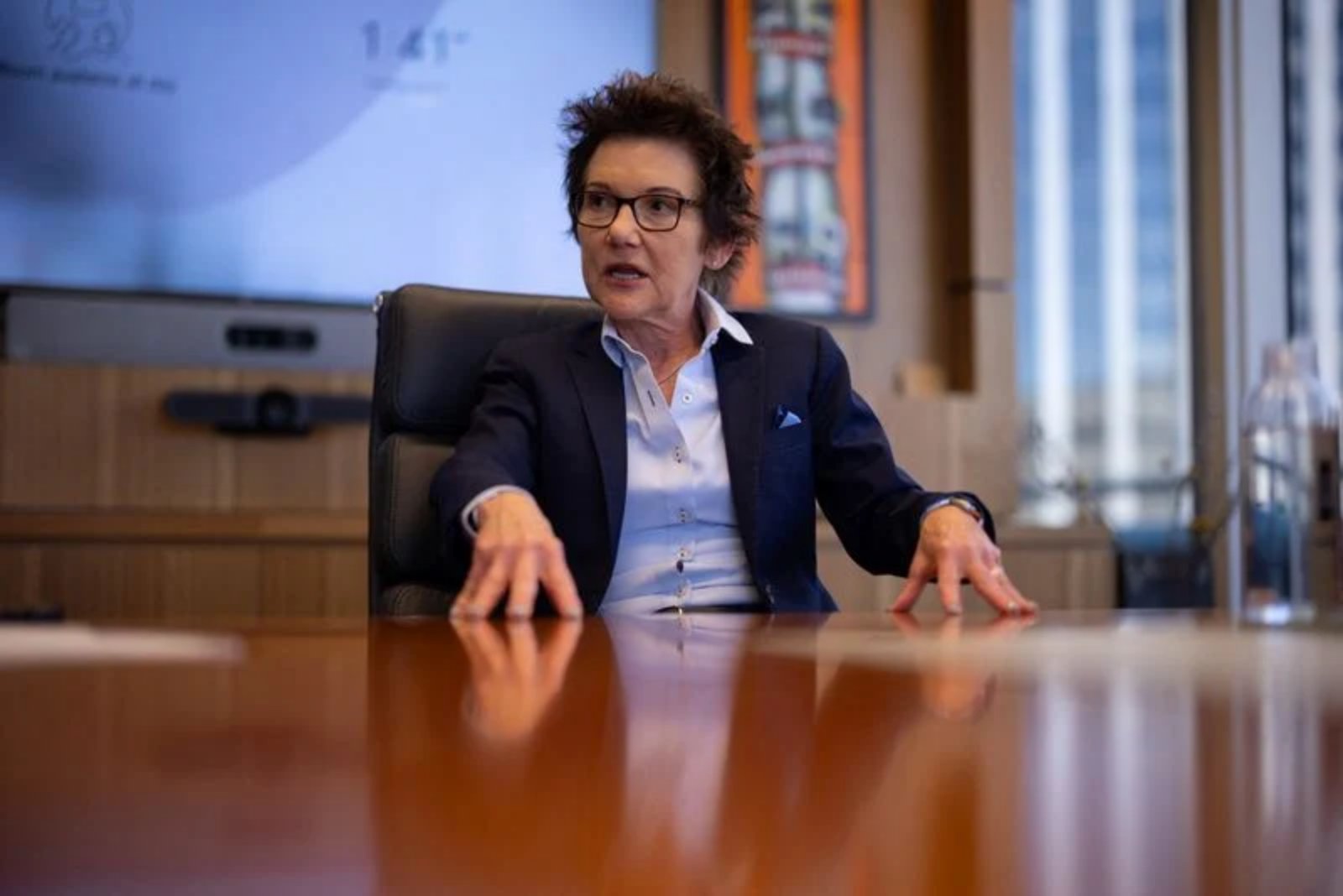
San Francisco Federal Reserve President Mary Daly said at a Banco de Espaa1a conference in Santander, Spain that U.S. monetary policy is "slightly restrictive," but that the path forward for interest rates is uncertain given strong AI-related investment and a still-solid labor market.
Daly described investment in artificial intelligence technologies as "exceedingly strong," and said that combination with a resilient labor market leaves the Fed weighing multiple scenarios. She noted that the fall in oil prices since the Iran war ceasefire is a positive development for both the economy and consumers.
Outlining alternate outcomes, Daly said there is "a scenario where we have to fight inflation that turns out to be more persistent." She contrasted that with another possibility "where the growth just doesna7t continue to sustain itself ... or the investment slows because people are worried they havena7t seen the gains yet."
Her remarks came as the U.S. Bureau of Labor Statistics released data showing U.S. job growth slowed sharply last month. Financial markets responded by unwinding wagers on a Fed rate rise later this month and trimming expectations for a hike in September.
Daly emphasized the need for careful assessment before acting on interest rates, saying: "You dona7t want to react quickly when the world is changing quickly. You want to assess before you jump or act because youa7ll make better decisions." She said uncertainty about how AI will influence the economy is a reason for caution rather than rapid moves.
Earlier, Daly had taken part in a global central banking meeting in Sintra, Portugal where Fed Chairman Kevin Warsh said he would "disappoint" anyone expecting the U.S. central bank to fail to contain inflation, which he noted has been running above the Fed's 2% objective for six years. At that gathering, Warsh also stressed that AI is already having a substantial effect on the economy - boosting demand in the near term while eventually increasing supply, forces that work in opposite directions on inflation.
The combination of elevated AI-driven investment, mixed signals from labor data, and recent oil price declines leaves policymakers with competing pressures. Dalya7s statements underscore why some Fed officials prefer to gather more evidence before changing the policy stance.
Key points
- Mary Daly calls policy "slightly restrictive" and highlights uncertainty over the Fed's next step due to strong AI investment and a steady labor market - impacts financials, tech and labor-sensitive sectors.
- Recent drop in oil prices since the Iran war ceasefire is viewed as beneficial for consumers and the broader economy - relevant for energy and consumer-facing sectors.
- Market reaction to slower job growth included reduced odds of a rate hike this month and lower chances of a September increase - affecting interest-rate-sensitive markets and banks.
Risks and uncertainties
- Inflation could prove more persistent, prompting a need for tighter policy - risk to interest-rate-sensitive sectors such as banking and fixed income.
- Economic growth or investment could slow if AI spending loses momentum or firms hesitate because returns are not yet realized - risk to technology and capital goods sectors.
- Unclear near-term impact of AI, with opposing forces on demand and supply, complicates the Fed's timing for rate moves - uncertainty for markets that price monetary policy expectations.