
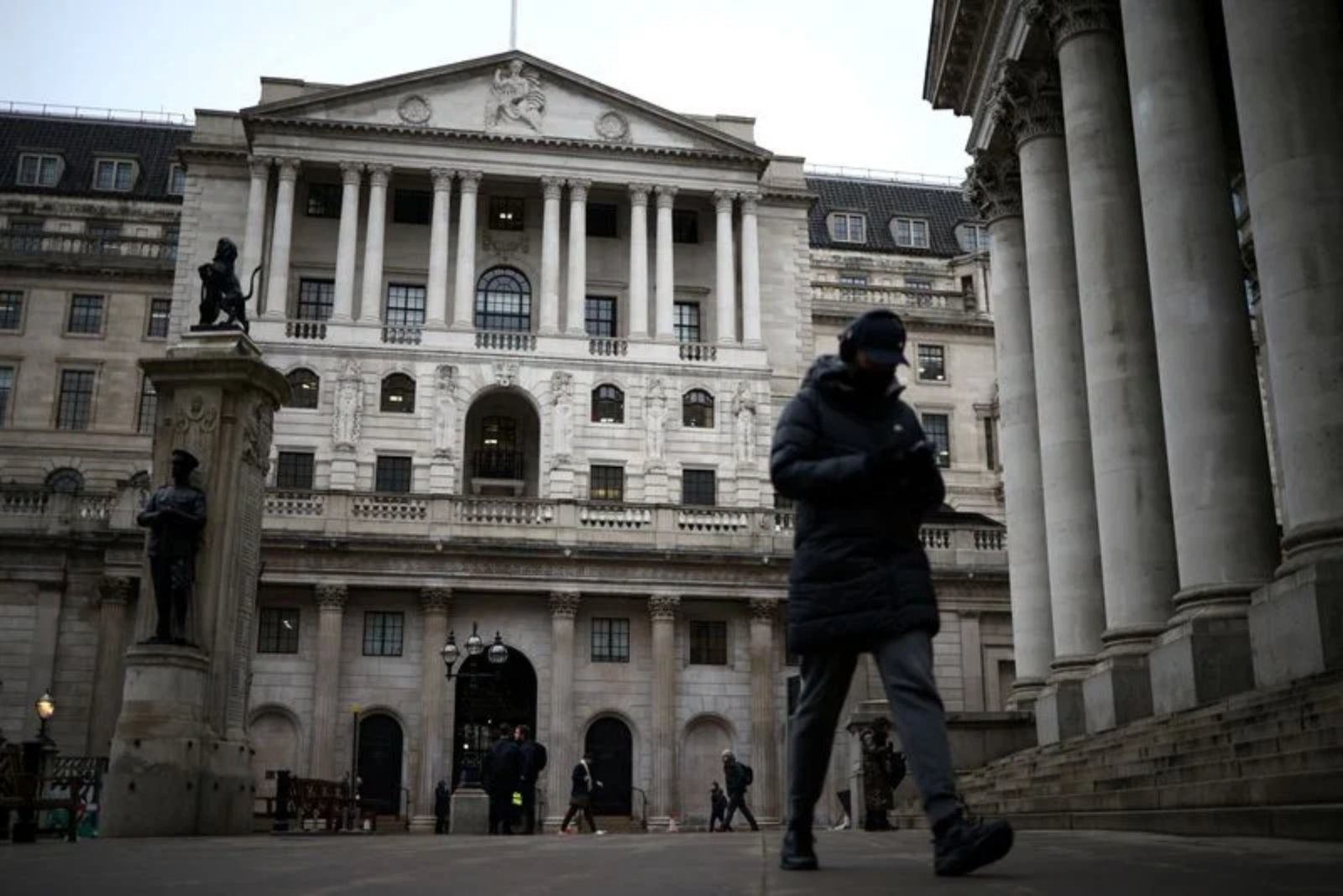
The Bank of England's Monetary Policy Committee (MPC) chose to keep the Bank Rate unchanged at 3.75% in its June decision, with seven members voting to maintain policy and two dissenting in favour of a 0.25 percentage point increase. The vote aligns with market expectations and a Reuters poll of economists that anticipated a hold.
External member Megan Greene joined Chief Economist Huw Pill in advocating for a rate rise at the meeting, arguing that a proactive increase would help anchor household inflation expectations. Most other MPC members, however, remained unconvinced that current conditions warranted tightening and preferred to continue what Governor Andrew Bailey has characterized as an "active hold" - an approach the BoE believes amounts to an effective tightening relative to market expectations of imminent cuts prior to recent geopolitical developments.
The committee's stance was framed against a backdrop of recent global central bank moves that diverge from the BoE's decision. Both the European Central Bank and the Bank of Japan raised rates in the week prior to the meeting. Meanwhile, projections released after the U.S. Federal Reserve's first gathering under its new chair, Kevin Warsh, signalled that Federal Reserve policymakers expected further rate increases later in the year.
Energy market developments influenced the BoE's deliberations. In the run-up to the MPC meeting a tentative truce between the United States and Iran raised expectations that the Strait of Hormuz could reopen, a development likely to reduce oil prices and, if the agreement holds, would be beneficial for Britain given its reliance on imported natural gas. Nevertheless, the BoE judged it too early to regard the inflationary risk as resolved.
Governor Bailey emphasised the transmission of recent energy cost moves into the inflation outlook, stating that higher energy prices over the prior four months have already created some inflationary pressure in the pipeline. Against that backdrop, the BoE now projects CPI inflation to rise above 3.25% in the final quarter of the year, up from 2.8% in May. That upward revision is nevertheless smaller than the earlier April projection, where two of the bank's three principal scenarios implied inflation climbing to between 3.6% and 3.7%.
On growth, the central bank was slightly more optimistic. The BoE estimated that the economy is expanding at an underlying rate of 0.2% per quarter, up from the 0.1% quarterly rate it assumed in its prior forecasts. This marginally firmer underlying momentum comes despite a small decline in output in April.
Members of the MPC emphasised differing priorities. Both Pill and Greene underscored the importance of curbing elevated households' expectations for future inflation, which the quarterly BoE survey shows at their highest levels since at least 2009. The Bank also noted that a more frequent monthly survey indicates those expectations are beginning to ease, however.
Greene argued, "A proactive hike now in Bank Rate should help anchor inflation expectations," reflecting her view that immediate tightening would forestall de-anchoring of expectations. Catherine Mann was identified as the policymaker who came closest to joining Pill and Greene; while she judged upside inflation risks to be more prominent, she agreed in the minutes that there remained time to wait because a forceful Bank Rate decision can have a rapid impact on inflation and inflation expectations.
Deputy Governor Clare Lombardelli warned that the risk of damaging second-round effects on inflation was rising as elevated energy prices persisted, although she observed that current evidence pointed to a standard pass-through of higher energy costs rather than more persistent second-round effects.
The BoE also reiterated the broader context in which its decisions are being made: inflation has remained above the 2% target for most of the past five years, driven by a sequence of upward shocks since the COVID-19 pandemic, most notably Russia's 2022 invasion of Ukraine that pushed British inflation to levels above 11%. The rising cost of living has been a strong contributor to public dissatisfaction with mainstream politicians. Prime Minister Keir Starmer's popularity has declined since his decisive electoral victory two years ago, and political pressure could increase if Greater Manchester Mayor Andy Burnham wins a parliamentary seat in a forthcoming by-election.
The committee's final assessment balanced these inflation risks and the potential for renewed downward pressure from stabilising energy markets. While two members favoured an immediate policy response, the majority judged that the available evidence did not yet justify a quarter-point increase. The BoE's position leaves open the possibility of future action should inflation pressures prove more persistent than anticipated.
Key takeaways:
- The Bank Rate remains at 3.75% after a 7-2 MPC vote; two members sought a 25 basis-point rise.
- Inflation is forecast to rise above 3.25% in the final quarter of the year, up from 2.8% in May, while growth estimates were nudged slightly higher to 0.2% a quarter.
- Energy market developments and household inflation expectations were central to the debate; the BoE judged it too soon to declare the inflation threat over.