
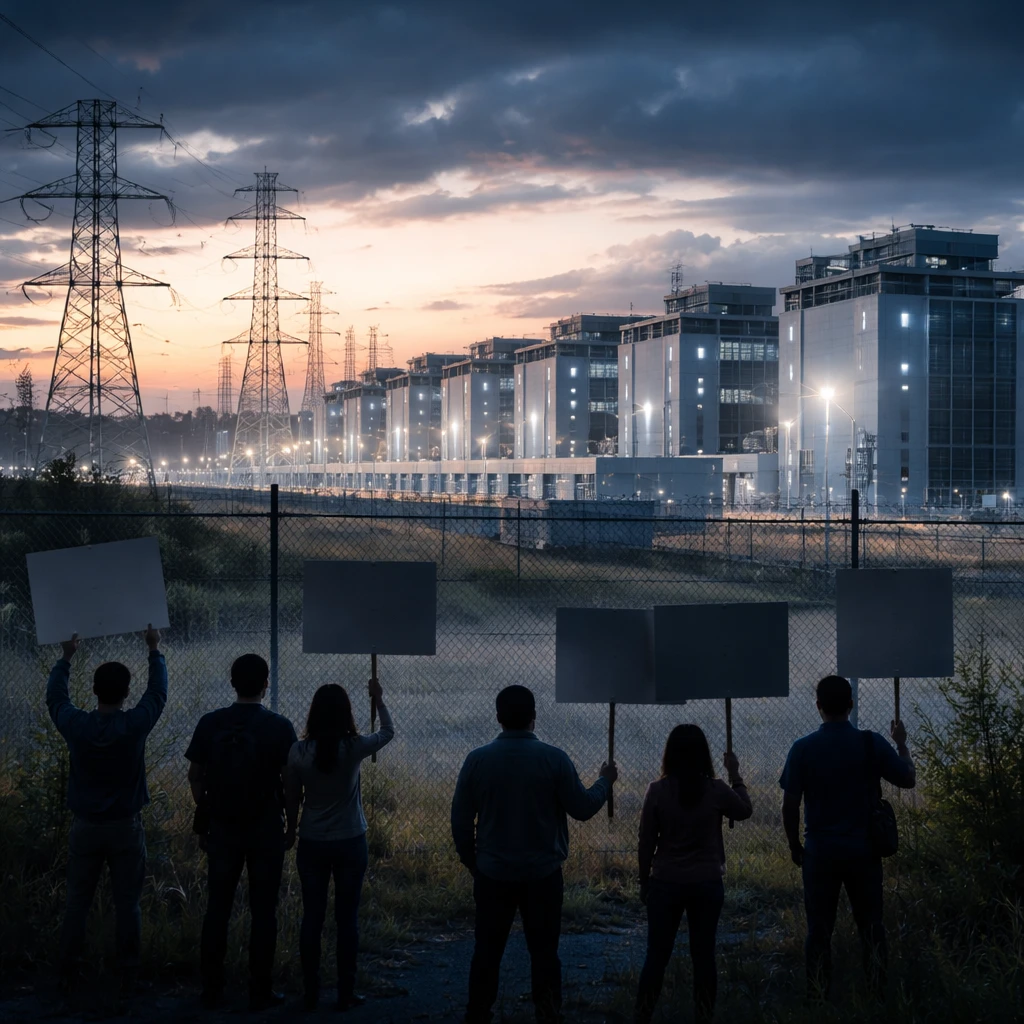
Public resistance to data center construction has increased markedly, with 53% of respondents now blaming these facilities for higher electricity prices - up from 28% nine months earlier - a shift that has translated into tangible policy actions at both state and federal levels. Wolfe Research identifies two principal near-term policy risks to the AI-driven capital spending boom: state permit freezes and federal limits on frontier AI model releases.
The polling, conducted by Heatmap and Embold Research and cited in Wolfe Research's analysis, shows data centers have become the single most-cited source of rising electricity costs among voters, surpassing other potential culprits such as oil and gas, the war with Iran, the current federal administration, aging grid infrastructure, and utilities.
State-level developments
At the state level, New York's governor implemented a one-year moratorium on permits for large new data centers through an executive order. That order directs the state Department of Environmental Conservation not to issue permits for data centers of 50 megawatts or larger. Wolfe Research notes that an executive-order mechanism could permit faster replication of similar actions in other states than would legislative processes.
Legislative efforts to impose moratoria have appeared in at least 15 state capitols, according to the analysts, but none of those measures has become law. One bill in Maine was vetoed by the governor, several proposals in New Hampshire and South Dakota were defeated in votes, and the remaining legislative initiatives have stalled without action.
Even if additional moratoria are enacted or imposed, Wolfe Research argues that development would likely relocate rather than stop. The analysts point to states actively courting data center projects - Texas is cited as an example - suggesting that capital and construction could shift geographically in response to restrictive state policies.
Federal posture and model controls
On the federal front, Wolfe Research describes a transition from an initially hands-off approach by the White House to a more interventionist stance as advanced AI models have emerged. The analysts highlight several concrete actions.
The White House obtained early access from Anthropic to prepare federal systems for cybersecurity risks posed by the company's Mythos model, and subsequently applied what the analysts describe as de facto export controls on Mythos and the Fable class of models. They characterize this process as ad hoc, noting an absence of clear, legible rules governing the use of government authority in these cases.
Separately, OpenAI agreed - at the government's request - to limit rollout of its GPT-5.6 models to a small set of trusted partners before broader access was permitted.
An executive order signed by the president requires that covered frontier models be made available to the government 30 days before release to trusted partners. Wolfe Research notes a framework for implementing that order was scheduled to be finalized by August 1.
The analysts also say the administration is likely to seek ways to dissuade U.S. customers from using Chinese open-weight models, referencing concerns about Kimi's K3 model and allegations it relied on distillation from U.S. frontier models. Wolfe Research suggests any such measures would push demand toward U.S. closed-model providers, which could extend the existing capital expenditure cycle supporting data center demand.
Analysts' assessment and near-term outlook
Wolfe Research concludes that while these policy moves represent the clearest immediate threats to AI-related capital spending, they are unlikely to halt the capex cycle in the near term. However, the analysts warn restrictions could become increasingly constraining as model capabilities continue to advance.
The combination of heightened voter concern, state executive authority, and a federal approach that has so far relied on case-by-case interventions creates an environment of policy uncertainty. That uncertainty is already influencing where projects are pursued and how technology providers and customers plan model rollouts.
Key takeaways
- Public opposition to data center construction has risen to 53% from 28% nine months ago, with voters increasingly citing data centers as a cause of higher electricity prices.
- State-level permit freezes - exemplified by New York's one-year moratorium on centers of 50 megawatts or larger - and federal constraints on frontier AI models are identified as the two clearest near-term policy threats to AI capital spending.
- Analysts do not foresee a nationwide wave of state bans; legislative moratoria introduced in about 15 states have not become law and several were rejected or vetoed.
Impacted sectors
- Data center development and related construction activity.
- Electricity generation and transmission sectors, given voter concern over power costs.
- AI model providers and cloud services, due to federal model-access controls.