
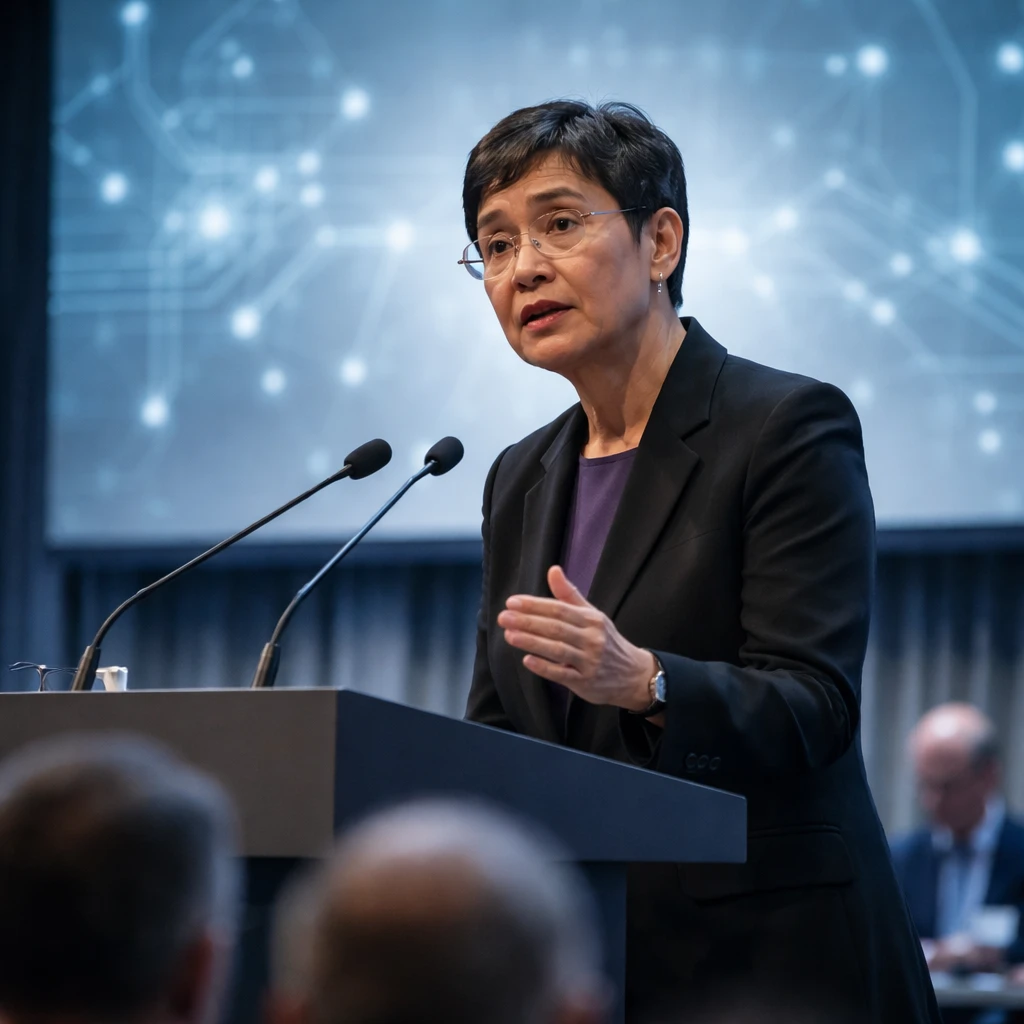
Maria Ressa, the journalist who shared the 2021 Nobel Peace Prize in part for documenting the influence of large technology companies, told audiences in Oslo that artificial intelligence has already seized humanity's attention and altered our social instincts. Serving as co-chair of a United Nations scientific panel charged with evaluating AI's global effects, she warned that without prompt legislation to limit AI the technology risks eliminating human agency.
Ressa framed the problem as one that has unfolded in three distinct waves. The first wave, she said, involved social media platforms that capture and monopolize attention, polarize communities, and isolate individuals. That phase, according to Ressa, set the stage for deeper incursions into human behavior.
The second wave, she continued, targeted our biology - specifically the human need for intimacy - through conversational bots and chat systems that simulate human interaction. These tools, Ressa argued, exploit emotional drivers to reinforce engagement.
The third and most consequential wave is now emerging, Ressa warned: agentic and multi-agent AI models that can act on behalf of people. These frontier systems do not simply imitate humans, she said; they perform actions for us, which she described as a direct threat to agency.
Ressa emphasized that this is not a matter of abstract principle but a public safety concern. She urged citizens to organize and pressure political leaders to enact regulation, saying that calls for regulation should not be conflated with restrictions on free speech. She cautioned that if legislators do not intervene soon, society could reach a tipping point beyond the ability of the public to control these technologies.
Some critics, including former U.S. President Donald Trump, have objected to industry pleas for regulation on the grounds that slowing AI development could compromise competitiveness, particularly versus China. Ressa dismissed such arguments as spin. She observed that China imposes more regulatory safeguards for its citizens in some respects than Silicon Valley does for users elsewhere, citing, for example, age restrictions in the Chinese version of TikTok.
Before a separate appeal from Anthropic's chief executive, Dario Amodei, urging AI companies to slow the pace of capability development, Ressa outlined what she sees as the initial steps toward remedy. The first and fundamental step, she said, is to hold technology companies accountable for the harms they have caused. She welcomed U.S. litigation outcomes that led to substantial penalties for platform operators - noting that courts resulted in Meta agreeing to pay up to $18 billion over the next decade and to impose strict limits on how teenagers use Facebook and Instagram - and described such outcomes as an important move toward responsibility.
Ressa praised regulatory steps taken by jurisdictions like the European Union and countries led by Australia to impose age-based limits on social media access. But she maintained that age limits do not address a deeper structural problem: the tools developed by major tech firms are engineered to be addictive for adults as well. Given evidence of harm, she argued, companies should remove addictive features across the user base rather than implementing protections only for younger users.
To reduce dependency on Big Tech platforms, Ressa suggested the development of public-interest communication platforms built outside the control of dominant corporations - analogous to public works such as parks. She pointed to Rappler's own initiative, Rappler Communities, which launched in 2023. Built on Matrix, an open-source, secure, decentralized protocol, the mobile app created a channel for the Rappler newsroom to engage directly with readers and for readers to converse with one another. Ressa described the platform as a digital space where safer, more constructive conversations can take place and where listening is prioritized, enabling civic exchange that supports democratic processes.
Rappler has invited other Filipino media organizations to join the model and is extending the approach to news outlets across Southeast Asia, she said. Ressa framed these efforts as part of a broader remedy: when citizens, media and regulators act together to limit the most harmful design choices and demand accountability from companies, it may be possible to preserve the conditions for democratic decision-making even as AI capabilities advance.
Summary
Maria Ressa, co-chair of the U.N. scientific panel on AI and a Nobel Peace Prize laureate, warns that AI has progressed through attention-capturing platforms and intimacy-hacking chatbots to now threaten human agency with agentic models. She calls for immediate legislation, corporate accountability for harms, removal of addictive platform features for all users, and the creation of public-interest communication tools built outside Big Tech.
Key points
- AI's evolution has followed three waves - attention capture via social platforms, intimacy-hacking through chatbots, and now agentic models that can act on behalf of people - raising the prospect of lost agency. - Impacting sectors: technology platforms, social media, AI developers.
- Ressa advocates citizen-led campaigns to push lawmakers to regulate AI as a public safety issue, not merely a free speech question. - Impacting sectors: public policy, regulatory affairs, technology.
- Legal accountability and alternative public-interest communication platforms are proposed remedies; recent U.S. litigation imposing up to $18 billion in penalties on Meta and restrictions on teen use of services demonstrates legal mechanisms at work. - Impacting sectors: legal, social media platforms, digital advertising.
Risks and uncertainties
- Regulatory inaction could let agentic AI systems develop beyond public control, creating broad societal risks. - Sectors affected: AI development, consumer-facing tech services.
- Arguments that regulation could undermine national competitiveness - particularly in relation to China - complicate the political feasibility of limits on AI. - Sectors affected: geopolitics of technology, AI industry.
- Age-based restrictions, while helpful, may not resolve the core issue of platform design that induces addictive behavior among adults as well as youth. - Sectors affected: social media platforms, advertising, digital content monetization.