
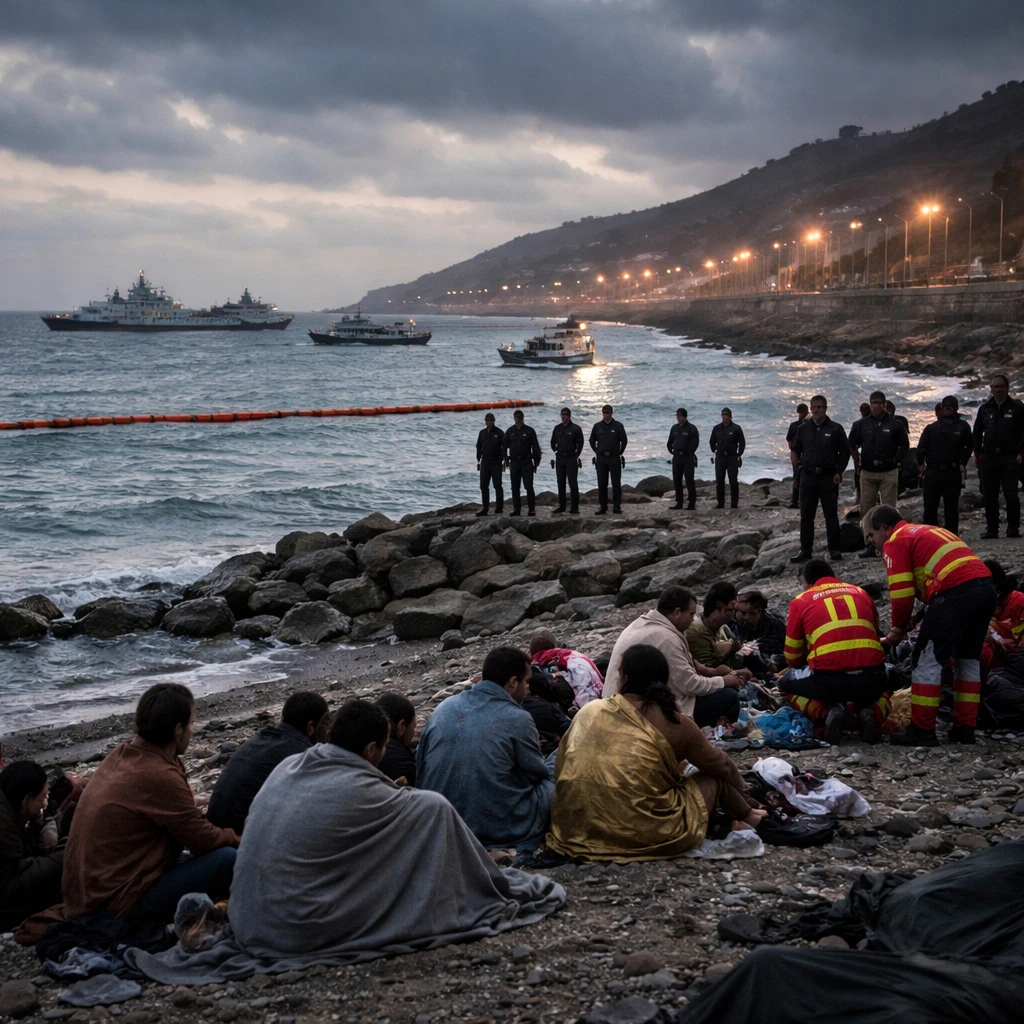
The death toll from the mass movement into Spain's North African enclave of Ceuta rose to at least 72 on Sunday after authorities discovered five additional bodies along the coast, officials reported.
The surge, which began on Thursday, saw an extraordinary flow of people into one of the European Union's only two land borders with Africa. Spanish authorities said more than 50,000 people entered Ceuta by land and sea in the unprecedented episode.
Officials reported extensive returns to Morocco in the immediate aftermath. More than 48,000 people were returned within 48 hours, and additional departures followed over the weekend, Spanish authorities said.
Miguel Angel Perez, the Spanish government representative in Ceuta, told reporters on Sunday that health services had treated over 1,000 people since Thursday. He said the situation in the city had improved significantly but cautioned that work remained to re-establish normality.
Accounts from the scene described multiple causes of death. Some migrants drowned in the sea, while others were crushed as they tried to scale a breakwater and the border fence. Those involved in the movement were described as driven by economic hardship and, in some cases, encouraged by rumours circulating on social media.
"It pains me deeply that young people are dying at sea. It’s not right that, in the year 2026, women with children as young as two months old should be crossing the sea only to die," said Karima Abenaz, a French national in Ceuta with family in Morocco, pausing to hold back tears. "In Morocco, there’s food, there’s everything we need. If we don’t have a decent job, we should go on strike and demand our rights from the government. We shouldn’t be dying at sea, it’s not right."
Local authorities in Ceuta have faced a large number of deceased. The city's leader, Juan Jesus Vivas, told the newspaper El Pais that the morgue had received 88 corpses. He said this total included some who had perished in earlier, smaller attempts to reach the territory during dangerous night-time swims over the previous two weeks. Vivas also said Moroccan authorities were recovering bodies from the sea, but that no official information had been released by those authorities.
In response to the surge, Spanish authorities reinforced police and army patrols. On Saturday they installed a 500-metre (1,600-foot) floating barrier off Ceuta's coast as an additional physical measure.
The episode prompted reactions across the EU. Twenty-two member states co-signed a letter seeking coordinated action to protect external borders and to pursue other measures following the Ceuta incident. Italy temporarily suspended passport-free Schengen travel arrangements with Spain for a month.
Spain has taken a comparatively more open approach to migrants than many other European countries. It introduced a programme to grant residency to more than half a million undocumented people. Spanish officials rejected claims that that programme encouraged the rush into Ceuta, stating that those who entered Ceuta irregularly could not travel onward to mainland Spain or elsewhere in the Schengen zone.
The authorities continue to manage returns and to provide medical care and identification services to those affected. Several aspects of the situation remain unresolved, including the full accounting of fatalities in the water and the coordination of cross-border recovery efforts.