
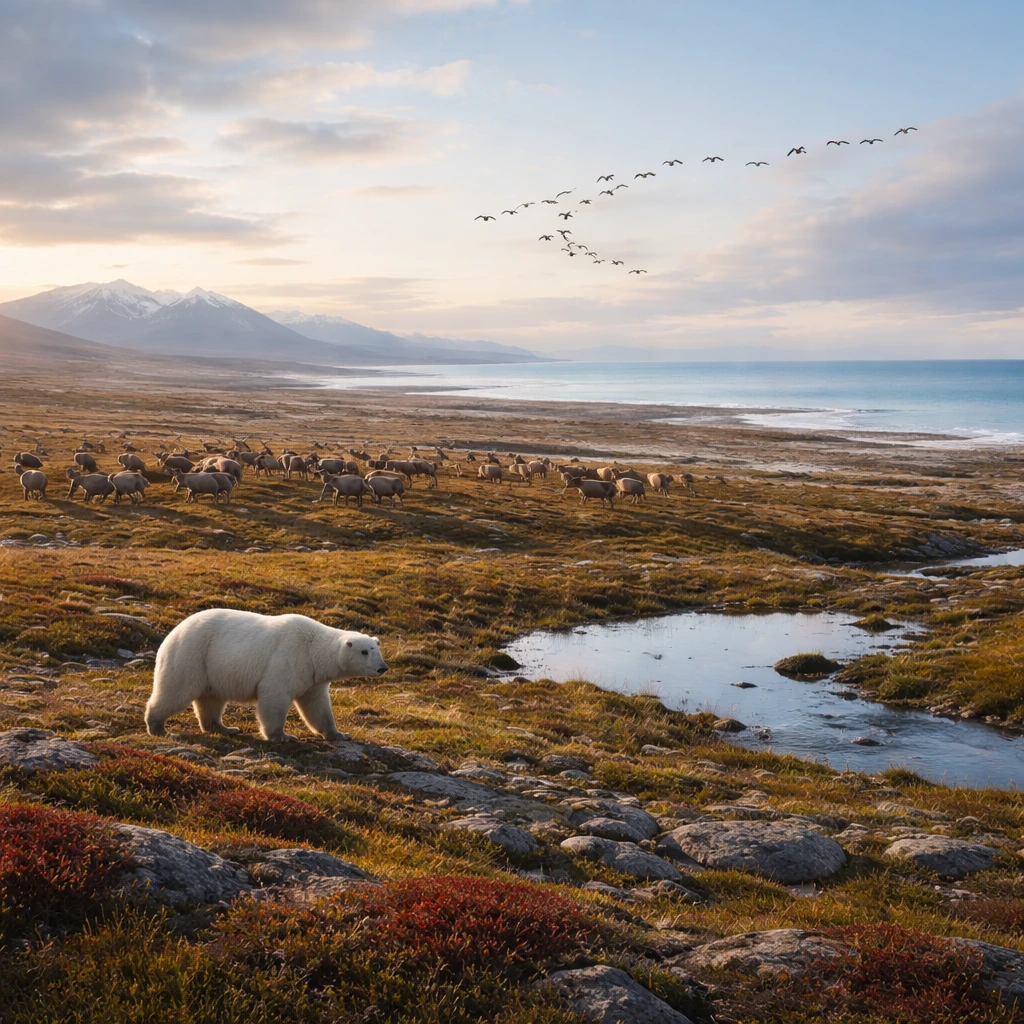
June 5 - The Trump administration is proceeding with a sale of oil and gas leases covering 689,000 acres (278,828 hectares) within the Arctic National Wildlife Refuge, a remote coastal habitat known for species such as polar bear, caribou and migratory birds.
The U.S. Bureau of Land Management, part of the Department of the Interior, made 60 tracts available for bidding. Companies were required to submit their offers by June 3; the submissions will be opened and read during a public livestream scheduled for Friday at 10:00 a.m. (1800 GMT).
This offering is the first of four sales that Congress required under the One Big Beautiful Bill Act signed into law by President Donald Trump last year. The move aligns with the administration's stated objective of expanding domestic energy development. Supporters in Alaska's state government and some native groups have said opening parts of ANWR to drilling could create jobs and help reverse the state's declining oil output.
"Done the right way, in consultation with the Indigenous stewards of these lands, development has been shown to be a force for good for our region," Nagruk Harcahrek, CEO of Voice of the Arctic Iñupiat, said in an emailed statement.
Despite political backing from some quarters, oil and gas companies have so far shown limited appetite for the refuge's coastal plain. The 1.5-million-acre coastal area along the Beaufort Sea is estimated by the U.S. Geological Survey to hold as much as 11.8 billion barrels of technically recoverable oil, but prior sales have yielded little commercial traction.
Most recently, the Biden administration offered 400,000 acres of ANWR in January 2025 and received no bids. The region's first sale in 2021 also drew only a small number of takers. Industry observers note that U.S. crude production is at record levels thanks to activity in more accessible areas such as Texas and New Mexico, and many companies have restrained capital spending on new projects to prioritize returning cash to shareholders.
An industry trade group said Alaska retains strategic importance for domestic energy. "Alaska's resources are key to America's energy security, and we expect to see continued investment throughout the state," a spokesperson for the American Petroleum Institute said in an email.
The Arctic refuge differs sharply from the nearby National Petroleum Reserve-Alaska (NPR-A). Unlike the NPR-A, which is adjacent to ANWR on Alaska's North Slope, the 19-million-acre wildlife refuge has no roads, facilities or other infrastructure, increasing the logistical and financial challenges of exploration and development. By contrast, oil companies paid $163 million to acquire new leases in the NPR-A at an earlier auction this year, and a liquefied natural gas plant is under development in that region.
At present, the Alaska Industrial Development and Export Authority is the only entity holding oil and gas leases inside ANWR, with six tracts under lease. There has been no development on those tracts to date.
ANWR is also the ancestral homeland of the Inupiat and Gwich'in peoples, groups that are not united on the question of development. Some tribal leaders and representatives favor development for its potential economic benefits, while others emphasize cultural and subsistence concerns tied to the land.
"Some places are too important to sacrifice," Kristen Moreland, executive director of the Gwich'in Steering Committee, said on a call with reporters. "Tomorrow's lease sale is about much more than economics or development. It is about whether our voices, our culture, and our way of life matters."
Context and process
The sale underway represents a statutorily mandated step in opening parts of ANWR to oil and gas leasing. The administration's offering of 60 tracts and the public livestream of bid openings are procedural elements intended to complete the first of four required sales. The physical characteristics of the refuge - its size, lack of roads, and sensitive wildlife habitat - shape both the economic calculus and the political debate surrounding resource development.
Market and regional implications
So far, market responses to prior ANWR offerings suggest weak near-term commercial interest from energy companies, particularly as U.S. production from more accessible formations remains strong and capital discipline is emphasized. State officials and some native organizations maintain that development could yield economic benefits for Alaska by providing jobs and supporting production, but past sales and current leasehold status indicate that conversion of leases into producing fields remains uncertain.
This report summarizes the immediate facts about the sale and reflects contrasting local views, industry posture, and logistical realities tied to development in one of the nation's most remote protected landscapes.