
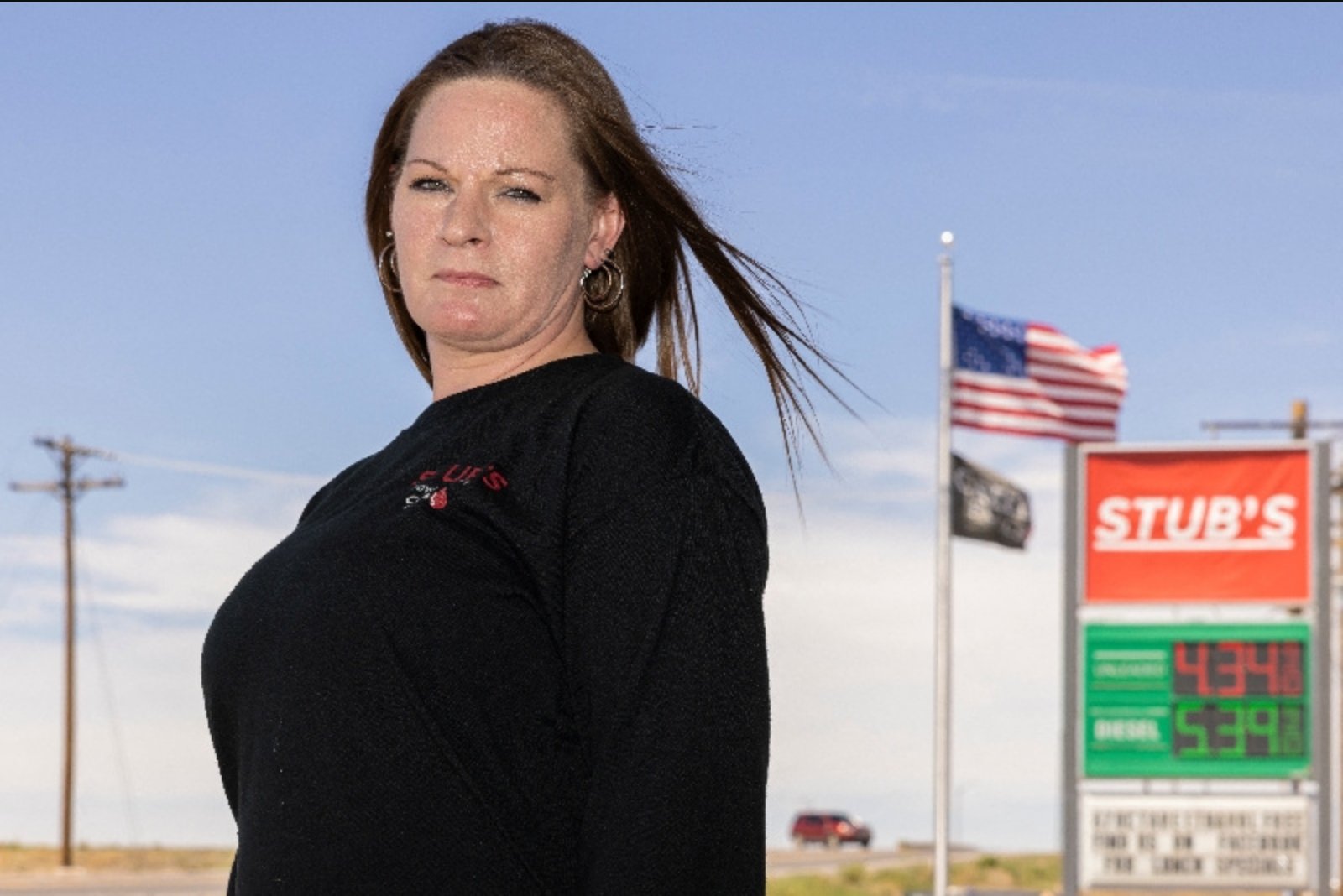
WIGGINS, Colorado, May 16 - At Stubs liquor store in Wiggins, Amy Van Duyn stood behind the register and watched the gasoline price sign outside as it seemed to move upward day by day. The sign read $4.34 per gallon, roughly a 50% increase from levels she recalled when President Donald Trump returned to the White House last year.
"I used to fill my tank for $36," said Van Duyn, 42. "Now $36 gets me half a tank." Her co-worker Tonyah Bruyette described the squeeze at home: when it comes time to buy groceries, she often finds herself asking where the money went. "We’re putting it in the tank rather than on our table," Bruyette said.
Despite the tangible strain from rising energy costs, Van Duyn and Bruyette remain fervent supporters of the president. Trump carried surrounding Morgan County by 49 percentage points in 2024, and their views reflect a broader sentiment among voters in and around Wiggins, a farming town of about 1,400 people in northeast Colorado.
Nationally, political support for Trump appears to be under pressure. A Reuters/Ipsos poll last month found that nearly eight in 10 Americans hold the president responsible for higher gasoline prices, and only 30% of U.S. adults approved of his handling of the economy as of the same poll. The war with Iran has pushed U.S. pump prices above $4.50 per gallon in many places, compounding anxieties about household budgets.
When asked whether domestic economic pain was a factor in negotiations with Tehran, the president offered a pointed response: "I don’t think about Americans’ financial situation," he said. "The only thing that matters when I’m talking about Iran, they can’t have a nuclear weapon." Democrats have used those remarks to argue the administration is out of touch with Americans worried about the economic fallout.
Yet in two dozen interviews conducted along Highway 52 - a rural corridor marked by grain elevators, feedlots and oil pumpjacks - many Trump voters echoed the president’s calculus. Across Morgan and Weld counties, which have not voted for a Democratic presidential candidate since 1964, residents said they would tolerate higher gasoline prices if doing so reduced the threat of an Iranian nuclear capability.
For many, energy prices had also climbed under President Joe Biden, blunting the ability to attribute the rise solely to current policies. Some interviewees voiced reluctant support for Trump because of their distaste for Democrats, while others expressed confidence that the president had a plan to lower costs over time. The persistence of this support underscores the strong personal connection Trump has nurtured with his base, allowing him to remain politically resilient despite crises across his administrations.
"It feels like he hears us," Bruyette said. "That he is fighting for us."
Willing to sacrifice
About 25 miles southwest of Wiggins, Jim Miller worked on his failing Dodge pickup, hands deep in the engine. Miller, 65, is a retired commodities broker who grew up in Boulder but now lives in Prospect Valley. Describing himself as "half-hippie, half-cowboy," he said he was prepared to shoulder the temporary discomfort of high fuel prices if it helped prevent Iran from obtaining a nuclear weapon.
Miller invoked past eras of American sacrifice, saying that during World War II households lived with less and rationed goods. "I struggle, like everybody else does, but I’m willing to sacrifice a little," he said. "That’s been totally lost in this country, people’s willingness to sacrifice."
In Roggen, an unincorporated community nearby, Mike Urbanowicz, 66, described his perspective as a pragmatic one shaped by the needs of his business. A trader with multiple college degrees, Urbanowicz’s farming cooperative moves about 150 truckloads of grain each day. He voted for Trump three times but characterizes himself as a political independent who distrusts both major parties.
Urbanowicz said gas prices were harming his industry and called Trump "naive" to expect a quick fix. He predicted prices could remain high into the fall even if U.S.-Iran talks broke through. Still, he preferred the current situation to what he described as Democrats moving toward "full-blown socialism." "I voted for Trump because the alternative is so bad," he said.
Generational and cultural complexity
In Fort Morgan, 22-year-old Lexys Siebrands lay on a table at the Bad Medicine Inkporium tattoo parlor, grinning through the pain as a tattoo artist inked Western-themed images on her calf. A gay woman who recently embraced Christianity, Siebrands once considered herself a Democrat but began to identify as a Republican around 2022, citing what she described as perceived liberal hypocrisy on identity politics. She voted for Trump in the last cycle.
Siebrands said she regarded a confrontation with Iran as inevitable. "Something was going to happen eventually, whether it was Iran doing something to us or us doing it to them," she said.
Sitting nearby was her mother, 49-year-old Jyl Siebrands, who grew up politically independent before drifting toward Republican positions. She lamented rising gas prices but said the possibility of a nuclear-armed Iran worried her more. "It’s just where we are with this war," she said. "People just have to give it time." When asked whether any issue could shake her confidence in Trump’s handling of the war or the economy, she replied simply: "No. I’m all on board."
The views captured along Highway 52 reflect a mix of economic strain and security-first priorities among voters in these rural Colorado counties. While national polling indicates significant concern about the economic consequences of the administration’s foreign policy, locally many remain aligned with the president’s stated objective of preventing Iran from acquiring a nuclear weapon, even at the expense of higher fuel costs.
These interviews illustrate the interplay between immediate household pressures - particularly on households that rely on vehicles for work and daily life - and broader geopolitical anxieties that voters say shape their choices at the ballot box.