
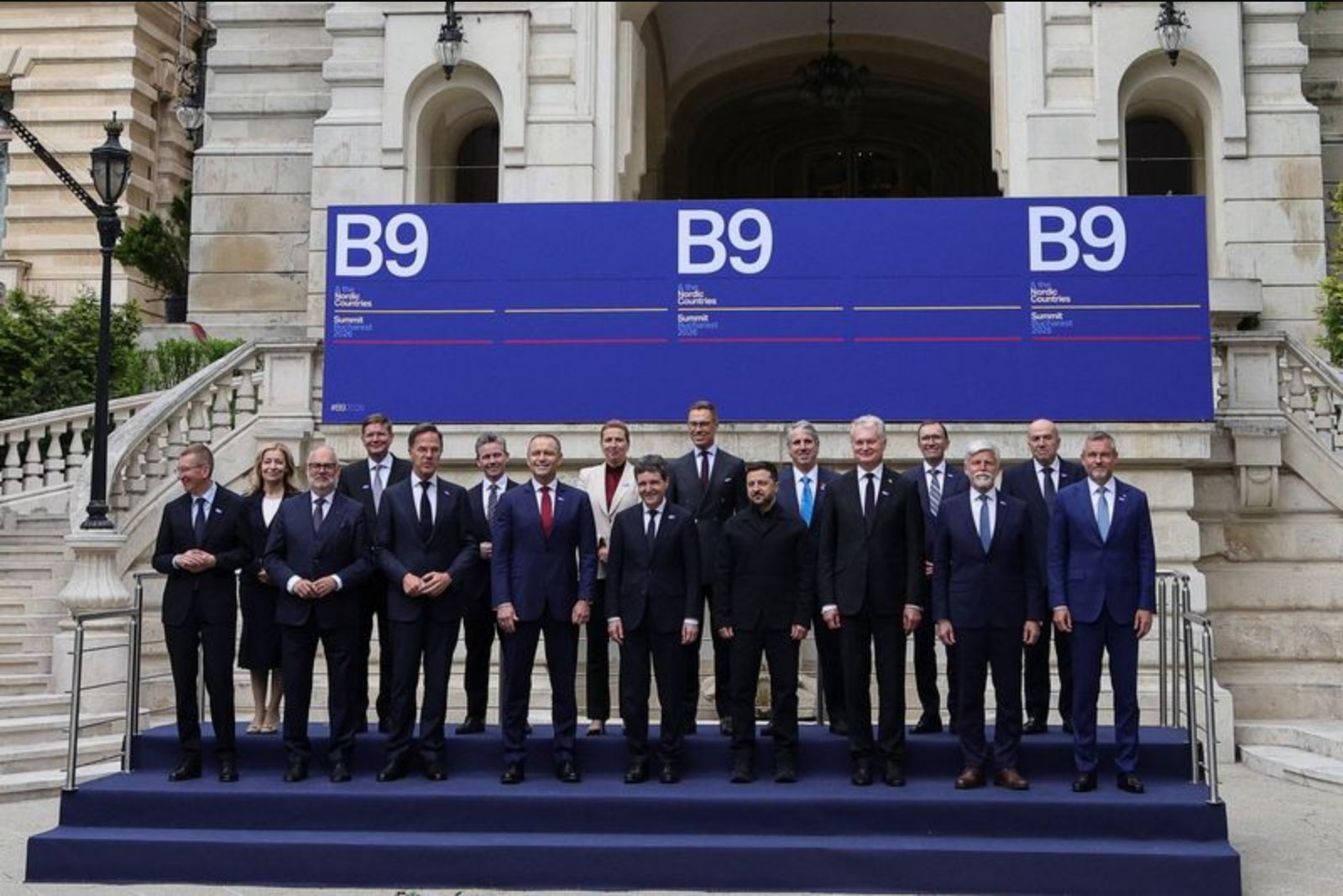
BUCHAREST, May 13 - Leaders from 14 NATO countries meeting in Bucharest said repeated incursions into the alliance's eastern flank airspace highlight an urgent requirement to strengthen air and missile defences, with a particular emphasis on countering unmanned aerial vehicles and other drone threats.
The gathering, hosted by Romania's President Nicusor Dan and Poland's President Karol Nawrocki, produced a joint statement that also called for closer cooperation to expand defence industry capacity. The statement followed a one-day meeting of eastern flank allies and stressed the need to enhance production and procurement capabilities to meet current security demands.
"We condemn Russia’s highly confrontational actions against Allies and partners, including sabotage, cyberattacks, and a wide range of hybrid attacks and destabilising activities,"the leaders wrote in the joint declaration. The statement added: "Repeated airspace violations on the Eastern Flank underscore the urgent need to continue strengthening NATO’s air and missile defence, including against unmanned aerial vehicle threats."
Several of the eastern flank states, including Romania, Poland and the Baltic countries, have reported repeated airspace breaches by Russian drones. The joint statement reiterated the need to close capability gaps to protect allied airspace. Russia has denied targeting NATO states.
Among those attending the Bucharest meeting were Ukraine President Volodymyr Zelenskiy, NATO Secretary General Mark Rutte and U.S. Under Secretary for Arms Control and International Security Thomas DiNanno. The meeting takes place in the lead-up to a NATO summit scheduled for Ankara in July and is intended in part to bridge a growing transatlantic divide.
The leaders linked stronger defence postures with industrial measures, underscoring that battlefield capacity depends on production and logistics. "Further scaling up the transatlantic defence industrial base, including through increased production capacity, more resilient supply chains, effective multinational procurement ... is essential to meeting today’s security challenges," the joint statement said.
The declaration was signed by the "B9" group of nine central and eastern European NATO members - Bulgaria, the Czech Republic, Estonia, Hungary, Latvia, Lithuania, Poland, Romania and Slovakia - which was formed in Bucharest after Russia's annexation of Crimea in 2014. The statement was also endorsed by five Nordic NATO members: Denmark, Finland, Iceland, Norway and Sweden.
Zelenskiy, who is not a NATO member but whose country has received substantial military and financial support from the 32-nation alliance since the full-scale Russian invasion began in February 2022, told the gathering that it was hard to predict what concrete outcomes the Ankara summit might yield. He said, however, that the summit should convey positive signals to the broader Euro-Atlantic community.
He also argued for candid discussion about European defence capacity. "At the same time, we should not be afraid to discuss more united and, in some areas, more self-reliant European military capabilities," Zelenskiy said.
The Bucharest meeting therefore combined immediate operational concerns - airspace breaches and unmanned aerial threats - with industrial-level prescriptions: boosting production capacity, securing supply chains and pursuing effective multinational procurement to ensure that allied militaries have the systems and materiel needed to deter and respond to destabilising actions.
Context limitations: The joint statement and remarks recorded at the Bucharest meeting form the basis of these conclusions. The meeting's attendees, signatories and text cited here are those stated in the joint declaration. Specific operational decisions, procurement timelines or new deployments were not detailed in the public joint statement.