
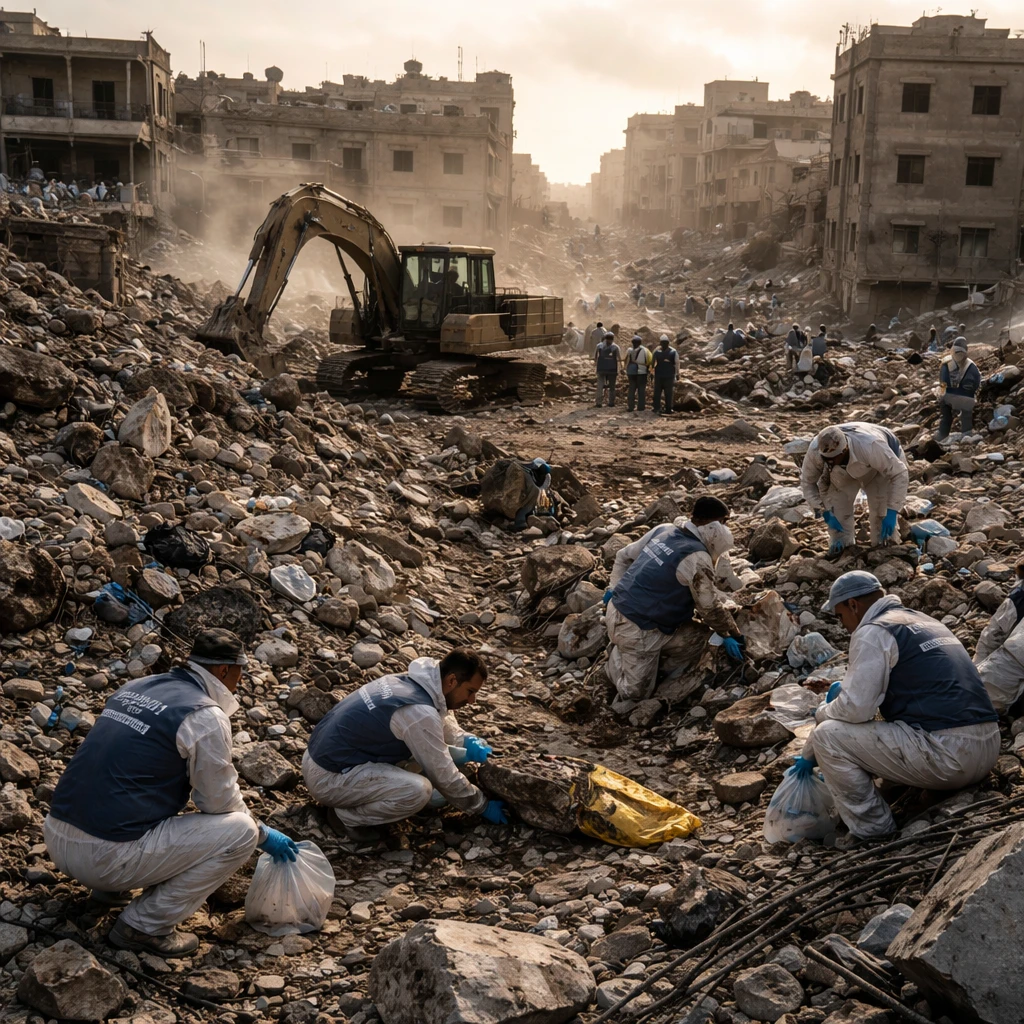
The recovery of hundreds of bodies from sites flattened in Israeli strikes during the nearly three-year war has prompted renewed alarm from the United Nations human rights chief, who said the discoveries raise fresh concerns about possible war crimes.
Volker Turk said remains believed to be those of whole families are being dug out from beneath rubble at locations destroyed during Israeli attacks. He added that many of the victims recovered so far were women and children. "It is heartbreaking that the loved ones of those missing for so long are only now having their worst fears confirmed," Turk said in a statement.
Turk linked the recent findings to concerns documented in a 2024 U.N. report, which concluded that Israeli strikes on residential buildings and other civilian sites in the early weeks of the conflict may have breached international humanitarian law. The human rights chief urged that international investigators be given access to all parts of Gaza to preserve evidence, noting ongoing legal proceedings examining conduct during the war.
Requests for comment sent to the Israeli Prime Minister’s office and the Foreign Ministry received no immediate response, according to the U.N. statement. Israel has repeatedly rejected accusations that it intentionally targets civilians, saying its operations against Hamas militants have been conducted in accordance with international law. Israeli authorities also maintain that Hamas operates within densely populated areas and uses civilians as human shields, an allegation denied by Hamas.
The war that began after Hamas’ October 2023 raid into Israel generated massive destruction across Gaza. The United Nations estimates about 61 million tons of wreckage and debris, which it says could take up to seven years to clear. A U.S.-brokered ceasefire brought an end to full-scale fighting in October 2025, but it has not stopped regular Israeli strikes, and both parties have accused the other of breaching the truce.
The Palestinian Civil Defence reports that more than 630 bodies and human remains have been recovered from under destroyed buildings across Gaza since November 2025. Palestinian authorities estimate that more than 8,000 people remain buried in the wreckage, a figure that underscores the scale of destruction and the challenge of accounting for the missing.
Turk warned that the remains uncovered to date might represent "only the tip of the iceberg," pointing out that vast sections of Gaza have been flattened by bombing or subsequently demolished or cleared. He also said Israel continues to level areas where its forces are deployed and accused bulldozers of operating "with no respect for the dead under the rubble." The U.N. rights chief added that Israel has blocked the entry of heavy machinery needed to remove rubble, complicating recovery efforts.
The U.N. expert on the Palestinian territories, Francesca Albanese, has urged that evidence be collected and human remains identified before large-scale clearance is carried out, calling for careful preservation of forensic material.
Among recent recoveries, the Palestinian Civil Defence said that in one site in the Zeitoun area of Gaza City, teams recovered 96 bodies and human remains, including 58 children and 23 women.
The conflict’s human toll is reflected in figures cited by both sides. Israeli tallies say the October 2023 Hamas-led attacks killed 1,200 people in Israel and resulted in 251 being taken hostage. Gaza health authorities report that more than 73,000 Palestinians have been killed in Israel’s military campaign.
Against that backdrop, Turk called for unfettered access by international investigators to all areas of Gaza so that evidence can be preserved and reviewed as part of legal processes. He framed the recent recoveries of remains as a matter of urgent humanitarian and legal concern while noting practical obstacles to recovery and investigation posed by ongoing demolition, restricted access to heavy equipment, and continuing strikes.
The scale of destruction, the numbers of recovered and still-buried remains, and competing claims about the conduct of hostilities leave grave questions for investigators, humanitarian agencies and legal authorities. The U.N. rights chief’s statement underscores the need for thorough, impartial procedures to identify victims, secure evidence and determine whether actions in the conflict complied with international humanitarian law.