
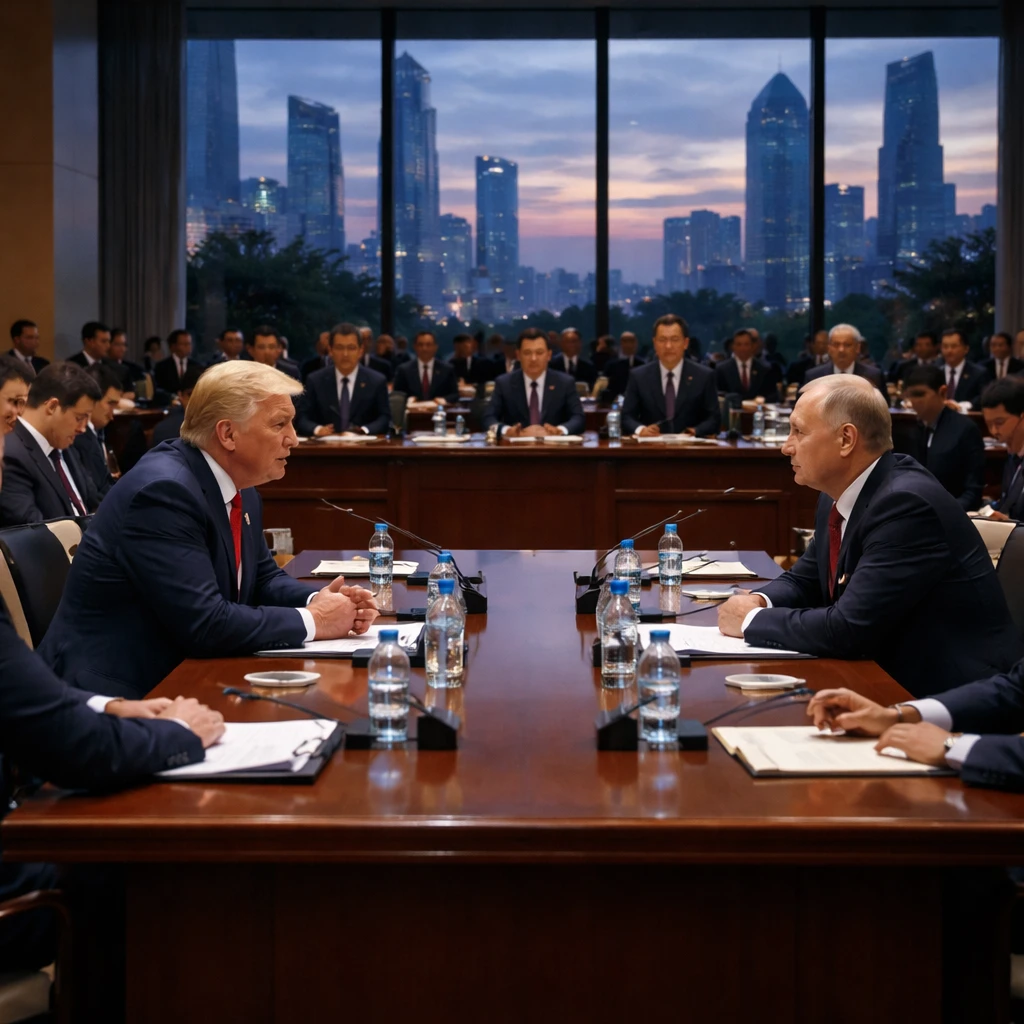
President Donald Trump said on Thursday that in conversations with Russian President Vladimir Putin last week he urged Moscow to pull back its military aggression against territories throughout Europe, expressing the hope that such a move could pave the way for a fast resolution to the conflict in Ukraine.
In a post on his social platform, Truth Social, Trump wrote that "During my conversations in China with President Vladimir Putin, of Russia, I spent a lot of time talking about the fact that I would like to see President Putin pull back all Military aggression against territories throughout Europe, in the hopes that a Deal can be made between Russia and Ukraine, and made quickly."
Trump characterized the humanitarian toll of the war in stark terms, adding: "I really believe this is a strong possibility - Thousands of people are being killed each and every month, A COMPLETE BLOODBATH."
Trump has repeatedly advocated for negotiations to end the fighting in Ukraine. The phrasing he used - "territories throughout Europe" - implies a scope beyond the immediate battlefield in Ukraine, though he did not specify which particular actions or locations he was referring to or what specific conduct he asked Putin to halt.
Since the invasion began in 2022, other nations have at times accused Russia of behavior they viewed as provocative. This week, Poland - a NATO member - accused Russia of deliberately violating Polish airspace. Estonia has publicly linked an arson attack to Russia's military intelligence service, according to recent statements cited by officials.
Trump's encounter with Putin occurred in Shenzhen, China, on the sidelines of the APEC leaders' meeting. The U.S. president also took part in a trilateral summit that included Putin and Chinese President Xi Jinping. The administration has described direct engagement with both leaders as a way to ease global tensions and address the war in Ukraine along with broader security issues.
Notwithstanding that rationale, critics have voiced concern that the United States may not be exerting sufficient pressure on Moscow to end the conflict. The debate over strategy - whether to engage directly with Russia's leadership or to apply more forceful diplomatic and economic pressure - was highlighted by differing public comments from members of the U.S. delegation.
One prominent member of Trump's circle, his son-in-law and diplomatic envoy Jared Kushner, praised Putin in a podcast interview, calling him a "grandmaster of politics" and a "historic figure." Kushner said he believed Putin had shown "restraint" by not resorting to nuclear weapons despite the risk of dramatic escalation in the Ukraine war, and that he thought Putin sought peace and improved relations with the United States.
The Trump administration has framed its approach as a diplomatic push intended to defuse tensions. Opponents and some observers have questioned whether that engagement places adequate pressure on Moscow to change its behavior, leaving uncertainty about whether such diplomacy will produce the rapid settlement Trump described as possible.
Context and next steps
The meetings in Shenzhen were part of a broader diplomatic effort by the administration to address the war in Ukraine and related security concerns through direct talks with both Russia and China. Beyond public statements, the details of what was discussed and the specific commitments, if any, remain limited in the public record based on the administration's posts and remarks.