
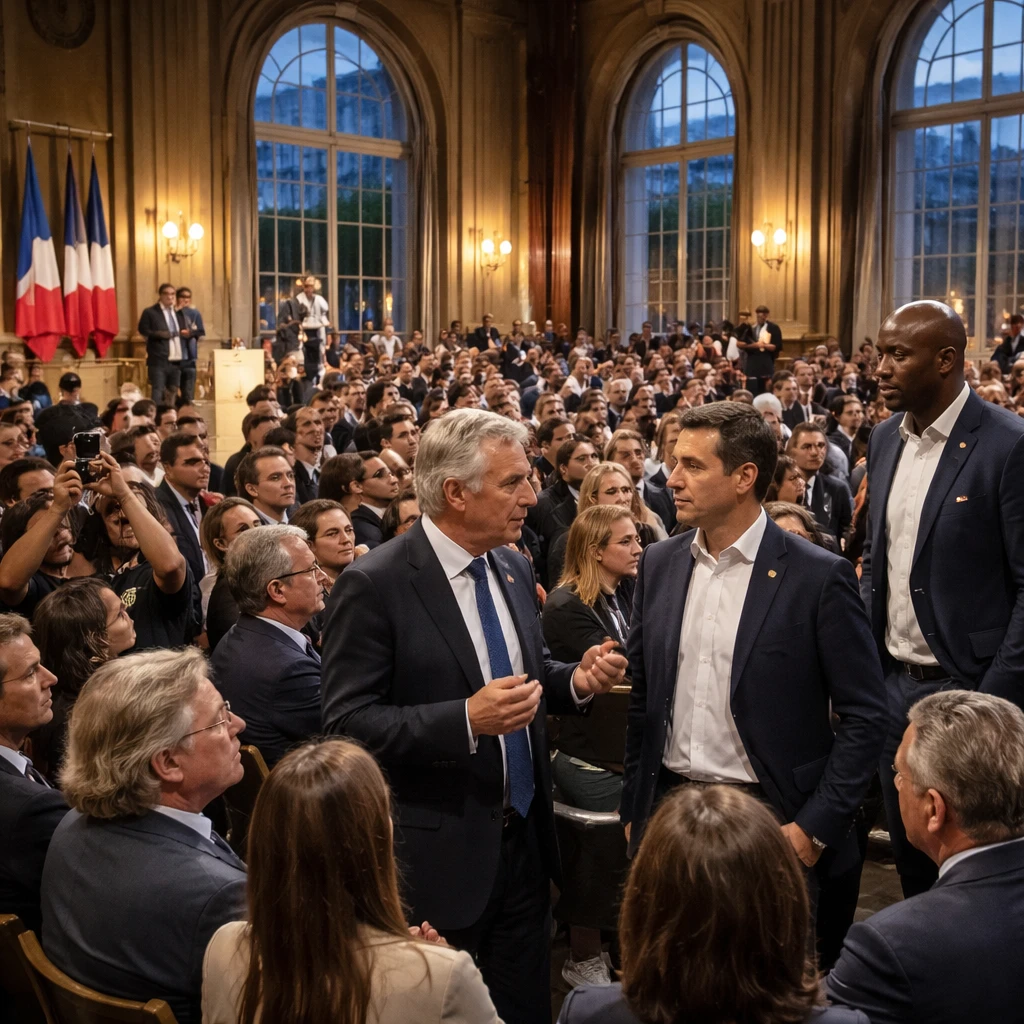
France’s presidential contest has attracted an unusually broad cast of contenders - from a world-class athlete to seasoned politicians and rising municipal figures - yet the two familiar polarised leaders remain at the head of the field.
In recent weeks several high-profile entries have reshaped media attention. Five-time Olympic judo champion Teddy Riner announced his intention to run for the presidency; former Prime Minister Dominique de Villepin launched a long-anticipated bid; and David Lisnard, mayor of Cannes, has climbed in the polls, surpassing former Prime Minister Edouard Philippe in some surveys. Despite the new momentum around these figures, opinion polls continue to show Marine Le Pen on the right and Jean-Luc Melenchon on the left as the main first-round contenders.
Crowded field reflects hollowed-out centre
Nearly a decade ago, the insurgent rise of Emmanuel Macron disrupted France’s traditional party system. Observers say that the political centre has since been eroded, creating space for a wide array of aspirants. More than 30 declared or potential candidates are now under consideration, reflecting a sense among some politicians and public figures that the threshold for entry is lower and that visibility in the media can drive a campaign.
"Governing parties have weakened and candidates increasingly emerge from the media spotlight," Socialist lawmaker Romain Eskenazi told reporters. "People say: 'Why not me?'"
For many voters, the multiplicity of candidacies has not translated into confidence. A November 12 Odoxa poll for Le Figaro found that more than three-quarters of respondents viewed the large number of hopefuls as evidence that "many people have overinflated egos." At a time of protests across France and a mounting budget deficit, the public appears to be critical of the current presidential offerings.
Where the recent entrants stand in the polls
Among the newcomers and re-emerging figures, Lisnard stands out as the most prominent performer behind Le Pen and Melenchon. In a recent RTL-Toluna poll he reached 11%, while Edouard Philippe registered 9% in the same survey. That placement pushed Philippe into fifth place, trailing centre-left candidate Raphael Glucksmann in that snapshot.
Lisnard, who positions himself as a free-market conservative, has been critical of what he characterises as an establishment failure to address debt, crime and administrative red tape. He has sought to symbolise deregulation in a manner that has drawn attention, echoing high-profile gestures made by other international political figures.
Philippe, who for a time was viewed as the strongest contender from France’s pro-business centre, has been the main electoral casualty of Lisnard’s ascent. Campaign observers and some supporters say Philippe’s bid so far lacks momentum and has not laid out a clear programmatic difference. Still, there are voices within Macron’s party who consider Lisnard’s surge temporary. "I think it’s a bubble," Pieyre-Alexandre Anglade, a lawmaker from Macron’s party, said.
Other candidates from diverse backgrounds poll lower but have nevertheless captured attention. Teddy Riner, despite having no prior political experience, polls at around 4%, a performance that places him ahead of several established party leaders such as Greens head Marine Tondelier and Communist figure Fabien Roussel. De Villepin, noted in the campaign for his pro-Palestinian views, polls around 3%.
Riner has presented himself as an outsider with fresh ideas. Asked at an annual gathering of mayors in Paris whether his entry reflected a belief that current politicians were not up to the job, he replied: "I wouldn’t have necessarily phrased it like that, but yes."
Practical hurdles and strategic choices
Prospective candidates and their teams have been actively seeking endorsements from elected officials at the annual mayors’ conference, a key arena for securing the signatures required to qualify for the ballot. That process remains a practical hurdle: a candidate must obtain 500 signatures from elected officials to make the ballot, a requirement that has frustrated past aspirants.
Eric Berlivet, the mayor of Roche-la-Moliere near Lyon, said he remained undecided between Lisnard and Philippe and planned to choose in January. "We’ve been disappointed too often by national leaders," he said. "I want someone who makes everyday life easier."
Talk has circulated about a potential primary between the centrist and right-wing figures, but no agreement has been reached on how to stage such a contest. "Marine Le Pen and Jean-Luc Melenchon may be leading the polls, but our responsibility is to unite the centre and the right, not launch a primary that would sow confusion and deepen divisions," Jeremie Patrier-Leitus, a spokesman for Philippe’s campaign, told reporters.
Legal questions and the front-runners
While the centre fragments, Le Pen and Melenchon remain dominant in first-round polling and in most runoff scenarios. Le Pen continues to be viewed as the candidate to beat in many second-round matchups. Her legal situation has been addressed in court: a Paris appeals court in July upheld an embezzlement conviction but framed the terms of any ban from public office in a way that still permits her to run. She has appealed that ruling to the Court of Cassation, France’s highest court.
Political scientist Christian Le Bart of Sciences Po Rennes observed that being outside the main political parties has become an asset for some candidates but that it also has limits. He noted, for example, that Riner has struggled with some policy questions and has challenged mainstream assumptions by asserting that "Ukraine was not our war." Le Bart also pointed to the difficulties de Villepin faced in 2012 when he attempted a presidential bid and failed to secure the necessary endorsements, underscoring how challenging the simple mechanics of ballot access can be.
Le Bart warned against viewing the current polling as a settled outcome. While Le Pen is favoured in many scenarios and Melenchon remains a persistent force on the left, the field will inevitably tighten as the election approaches, bringing new uncertainty. "The race is far from over," he said.
Outlook
For now, the crowded slate of hopefuls appears to have reinforced the visibility and relative strength of the two polarised leaders by preventing the emergence of a single, well-supported mainstream challenger able to consolidate moderates from both the centre-right and centre-left. With public attention focused on protests and public finances, and with a large number of aspirants looking for traction, the campaign is likely to remain fluid until the pool of candidates narrows and the signature threshold forces clearer choices.
Key developments to watch
- Whether centre and centre-right figures agree on a mechanism - such as a primary - to consolidate support.
- The ability of new entrants to secure the 500 elected-official signatures needed to appear on the ballot.
- Decisions by higher courts regarding pending legal appeals that could affect candidature eligibility.