
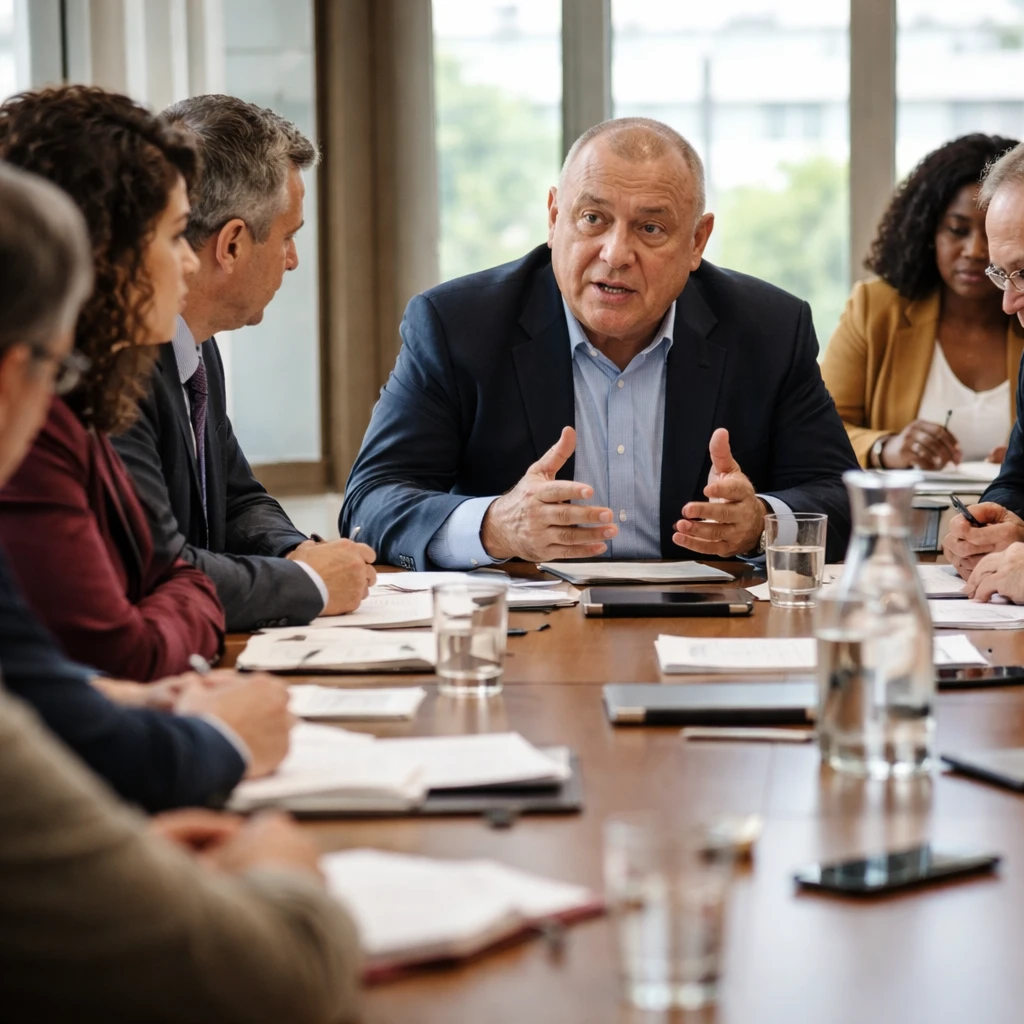
Gadi Eisenkot, the former military chief who was charged by Israel's president with the task of forming a government after last month's inconclusive ballot, said on Nov. 26 that he has settled a dispute with a left-leaning faction whose suspension of talks threatened to complicate his bid to replace Prime Minister Benjamin Netanyahu.
The left-wing Democrats had announced they were pausing negotiations with Eisenkot's centre-right Yashar party earlier this week, expressing frustration over Yashar's ongoing engagement with Netanyahu's right-wing Likud to explore a unity government. In a statement on Thursday morning, Eisenkot said the stalemate had been addressed and that discussions between Yashar and the Democrats were back under way.
"Marathon discussions aimed at finalizing a coalition agreement will continue this morning," Eisenkot said. There was no immediate response from the Democrats or their chair, Yair Golan.
A narrow and complicated path to power
The resumed talks arrive against the backdrop of an electoral outcome on Oct. 27 that left neither Eisenkot nor Netanyahu with a clear route to secure a majority. Eisenkot and his assumed allies currently hold 48 seats in the 120-seat parliament, short of the 61-seat threshold needed to form a government. Netanyahu and his usual coalition partners on the far right and among the ultra-Orthodox together control 53 seats, also below a majority.
Eisenkot has until Dec. 6 to build and present a government, although that period can be extended by 14 days. The slim margins mean that any defection from his presumed bloc would add significant difficulty to his efforts to assemble a ruling coalition.
Deals and shifting positions
Earlier this week Eisenkot announced an agreement in principle with Avigdor Lieberman, the head of the right-wing Israel Our Home party, to sign a deal formally integrating their factions into a coalition. Lieberman has been a prominent critic of the ultra-Orthodox parties and has been reluctant to engage with Israel's two Arab-led parties, whose combined 19 seats would be sufficient to place Eisenkot comfortably over the majority threshold if included.
In recent comments to Israel's Kan public broadcaster, Lieberman appeared to moderate his stance, saying a government including the United Torah Judaism ultra-Orthodox party and backed by a "clear Jewish majority" could be presented by the end of next week. Like Yair Golan, Lieberman has rejected the idea of unity talks with Netanyahu's Likud. "There will be a government with a Jewish majority," Lieberman said.
One potential configuration under discussion could yield a minority government of 55 seats formed by Eisenkot's bloc and United Torah Judaism, supported from outside by the United Arab List, which holds eight seats. Such a structure would rely on cooperation and tacit support from parties not formally in the governing coalition.
Policy trade-offs and sticking points
Negotiating a coalition is likely to require concessions, especially on contentious issues such as the mandatory military draft for ultra-Orthodox seminary students. Eisenkot and his partners campaigned on an agenda to end draft avoidance by ultra-Orthodox Israelis and to ease the military service burden borne by other citizens. Ultra-Orthodox leaders, however, remain strongly opposed to such a draft law, making any compromise a politically sensitive and potentially decisive bargaining point.
The interplay among Eisenkot's centre-right bloc, Lieberman's party, the ultra-Orthodox factions and the outside support of the United Arab List underscores how fractured coalition arithmetic has become since the inconclusive election. With limited time and narrow seat totals, each negotiation, suspension of talks or restored discussion can materially affect whether a stable governing majority is achievable.