
Overview
The U.S. Army detonated 68 barrels containing almost 10,000 pounds (4,536 kg) of a deteriorating lead compound used historically as an explosive initiator at the Iowa Army Ammunition Plant in Middletown, Iowa. The operation came after a week of public protests and legal disputes driven by concerns that the blast could disperse toxic lead dust across nearby towns, farms and residences.
What the substance is
Lead azide is a chemical once used to initiate detonations in military munitions but is now largely considered obsolete. Officials said stockpiles from military installations nationwide were consolidated and moved to the Iowa facility in 2009 for long-term storage.
Why detonation was selected
Army authorities reported discovering in March that the stored lead azide had undergone crystallization. That change, they said, rendered the material unstable and made an uncontrolled explosion a likely eventual outcome. Military assessments concluded that attempts to neutralize the compound chemically or to move the drums would almost certainly provoke an uncontrolled blast, so planners chose a controlled detonation as the mitigation path.
Health and environmental concerns
Public health specialists cautioned that immediate inhalation risks could be reduced if people sheltered from any passing dust plume. Patrick O'Shaughnessy, a public health professor at the University of Iowa, said the most serious long-term concern is lead dust settling onto homes, farmland and other environmental surfaces, because lead does not break down and can persist in the environment.
O'Shaughnessy noted that lead exposure can cause a broad array of health problems in humans and animals, and that young children are particularly vulnerable because lead can impair brain development and cognitive function.
State public health guidance recommended residents in potentially affected zones keep windows and doors closed for 24 to 48 hours after the detonation, and to turn off heating and cooling systems that draw in outside air. Officials advised cleaning surfaces in exposed areas after the event and consulting medical providers about the need for blood testing for lead.
In a federal briefing, Sean Kaufman, an official with the U.S. Department of Health and Human Services, advised that pregnant women, children and people with chronic health conditions "definitely want to be out of" areas exposed to the plume.
Projected reach and monitoring
Army projections released hours before the detonation indicated settled lead dust from the plume could reach as far as 40 miles (64 km) southwest of the blast site, extending through parts of southeastern Iowa and into northern Missouri. Those same projections suggested airborne particles could travel nearly 100 miles within an eight-hour period.
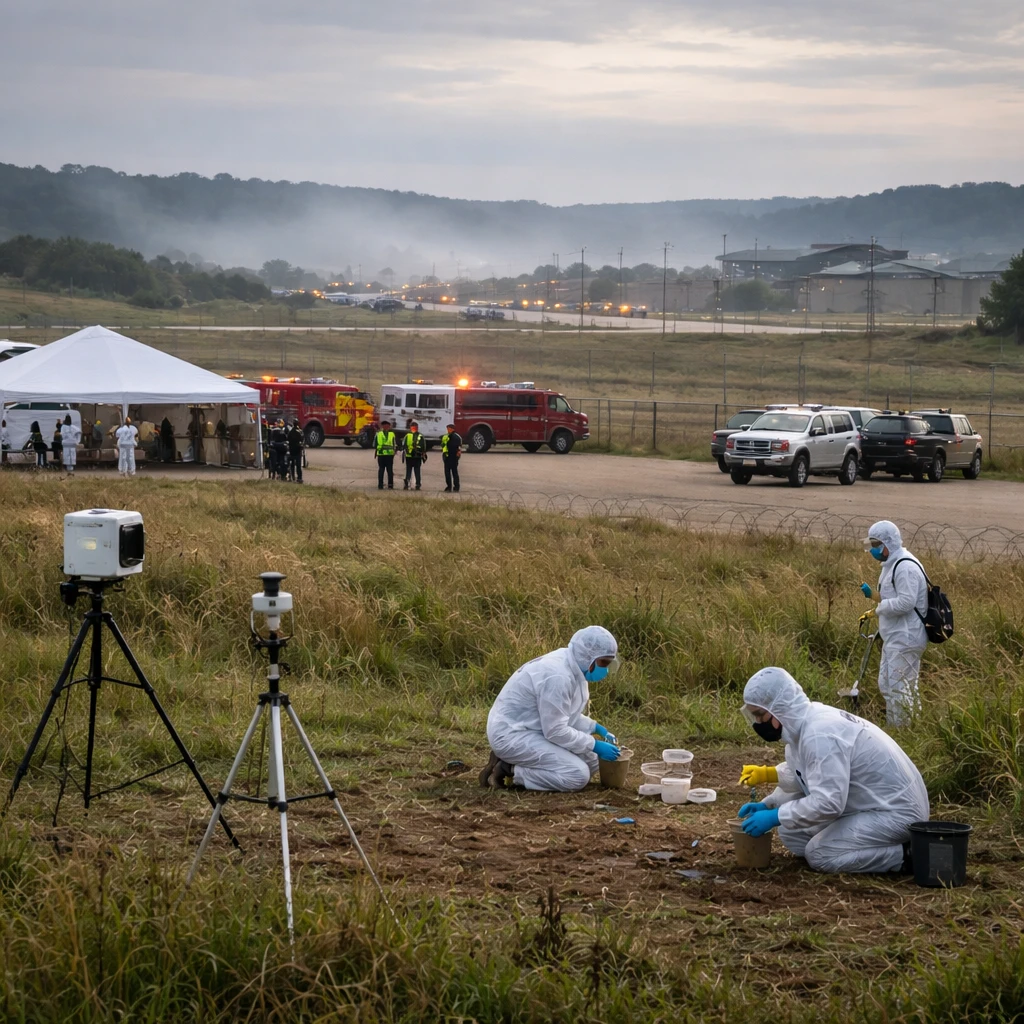
After the demolition, the Environmental Protection Agency said its air monitors reported zero detection of airborne lead across the region. EPA Administrator Lee Zeldin stated that the agency had pre-positioned roughly 300 employees and contractors to perform extensive monitoring of air, land and water and to deploy remediation efforts if they proved necessary.
Some residents said they had gathered soil samples independently to be tested outside of official channels; results from those tests were not specified by authorities in the immediate post-detonation statements.
Outcome and official assessments
In a videotaped public service message posted after the operation, Army Colonel Aaron Teller, the munitions specialist who led the activity, said the demolition achieved its objectives. He reported that the noise-reduction and emission-limiting measures succeeded, and he stated, "All of the lead azide barrels were definitively removed."
How common is this type of operation?
Colonel Teller noted that a detonation of a comparably large quantity of lead azide had last occurred in 1977, when authorities detonated 7,000 pounds (3,175 kg) of the compound in Colorado in an open-air setting without mitigation measures. He said that at that time, roughly 75% of the lead particulate was contained, but he did not provide additional detail about that event.
Local implications
The operation and subsequent monitoring efforts placed public health and environmental protection at the center of local concern. The potential for settled dust to affect residences, agricultural land and livestock underpinned guidance from health authorities and the attention of state and federal monitoring teams. Some community members pursued independent sampling to supplement official testing and to seek confirmation about any contamination.
Ongoing steps
Federal and state agencies indicated they would continue to monitor the area in the minutes, hours and days after the detonation, taking environmental samples and preparing to mount remediation if monitoring indicated that was necessary. Officials reiterated behavioral guidance for nearby residents and encouraged consultations with health providers where appropriate.
This article presents a factual account of the operation and the immediate official responses and public health guidance. It does not introduce events, dates, or findings beyond those provided by the authorities cited above.