
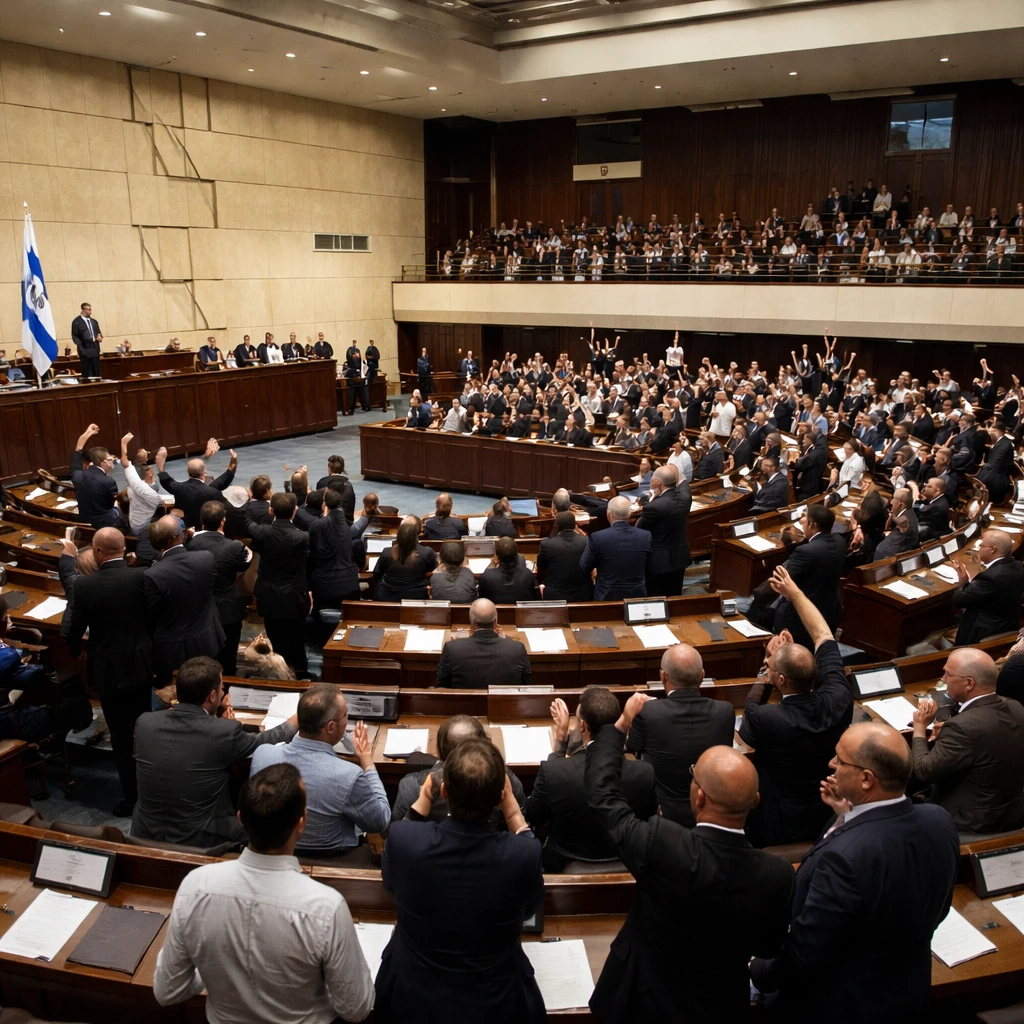
Israel’s opposition-run Knesset on Wednesday approved the first of four required readings for a bill to create an independent state commission to investigate the October 7, 2023 Hamas attack, setting a parliamentary path toward an inquiry that Prime Minister Benjamin Netanyahu has opposed. The vote, which passed 65 to 50, was driven by a bloc of Jewish-led opposition parties together with lawmakers representing the Arab minority.
The legislation now needs three additional Knesset approvals before it can become law. If enacted, the commission would examine what the proponents describe as systemic failures that allowed the deadliest assault in recent memory to unfold.
Netanyahu, who has remained in office in a caretaker role since his coalition lost its parliamentary majority last month, has argued against an outside, state-appointed probe. He has instead pushed for a government-empowered inquiry that would, according to his proposal, give parliament members authority to select panel members while the cabinet would determine its mandate. Critics of that approach, including the opposition figure tapped to form a government, say it risks shielding the truth from a fully independent review.
Political maneuvering and public support
Public opinion polls have shown broad backing for a state commission to probe the security lapses on October 7. Gadi Eisenkot, the opposition leader entrusted with forming a new government, framed the vote as a moral imperative. "For the bereaved families, for the survivors of captivity and those who did not return to us alive, we will uncover the truth and take every step to prevent the next disaster," he wrote on social media following the vote.
Eisenkot’s grouping of Jewish-led opposition parties joined with Arab-led parties to secure passage of the first reading. The coalition of lawmakers supporting the bill totaled 65 votes, while 50 opposed it.
Netanyahu and his allies have criticized the initiative. Transport Minister Miri Regev, a close Netanyahu confidante, said the proposed state commission "will not lead to an examination of the failures that took place," and warned it would instead target Israel’s soldiers and their conduct during the attack.
Scope of the October 7 attack and aftermath
On October 7, 2023, Hamas-led militants launched an assault on southern Israel that killed 1,200 people and resulted in more than 250 hostages being taken. The attack precipitated Israel’s military campaign in Gaza, which the article reports has killed more than 74,000 Palestinians and left nearly the entire population of the Gaza Strip's roughly 2 million people internally displaced.
Electoral arithmetic and a fragmented Knesset
The political landscape after the October 27 election remains fragmented. Netanyahu’s previous coalition, composed of far-right and ultra-Orthodox parties, lost its majority and now holds 53 seats in the 120-seat Knesset, even as his Likud party remains the single largest party. Eisenkot’s bloc, made up of a mix of right-wing, left-wing and centrist Jewish-led parties, controls 48 seats. Arab-led parties achieved a record 19 seats, and most Jewish-led groups in Eisenkot’s bloc have so far refused to form a coalition that includes those Arab-led factions.
Eisenkot has been given until December 6 to assemble a governing coalition, with the option of a 14-day extension. If he cannot secure a majority, Netanyahu would likely be given an opportunity to try to form a government. Failing that, the country could be forced into new elections.
Despite the wider political deadlock, Arab lawmakers have voted with Eisenkot and his allies on several pieces of legislation, enabling the opposition to control the Knesset’s agenda for now. That leverage included electing a member of Eisenkot’s Yashar party to the Knesset speaker’s chair last week.
Next steps
The state commission bill must pass three further readings in the Knesset to be enacted. The parliamentary maneuvering around the inquiry intersects with other legislative initiatives advanced by the opposition, including a bill that would impose term limits on prime ministers and bar individuals from serving while under criminal indictment - measures observers view as directly aimed at Netanyahu, Israel’s longest-serving prime minister, who faces corruption charges he denies.
At present there was no immediate public response from Netanyahu or his office to Wednesday’s vote.
Summary
The opposition-controlled Knesset approved the first reading of a bill to create an independent state commission to investigate the October 7 Hamas attack. The vote passed 65 to 50 and needs three more approvals to become law. Prime Minister Benjamin Netanyahu opposes an independent commission and favors a government-led inquiry; his opponents and some members of the public say his proposal could impede a fully independent review. The political balance in the Knesset remains fragmented after the October 27 election, complicating coalition-building efforts and the path to forming a new government.