
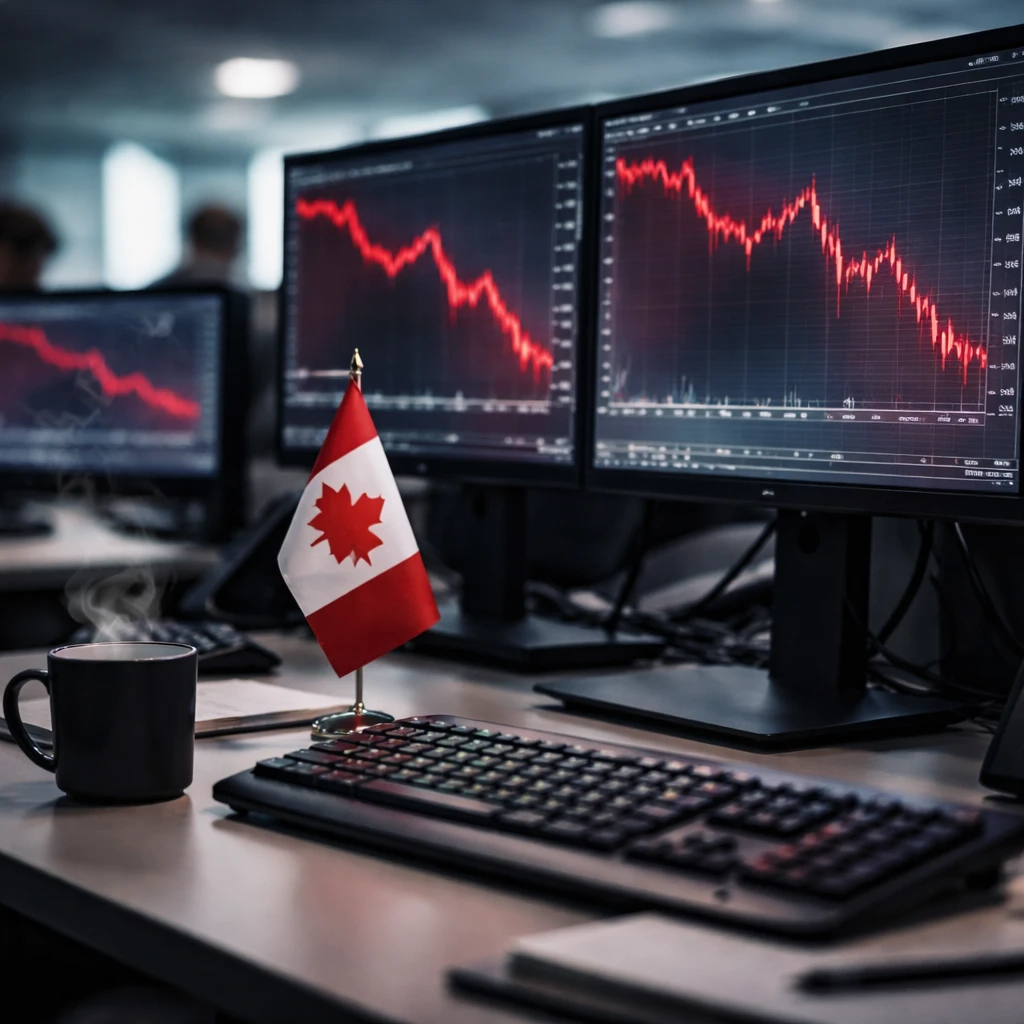
Futures tied to Canada’s primary stock benchmark opened sharply lower on Wednesday as mounting weakness among technology names globally and reports that the U.S. may roll out new import tariffs dampened investor sentiment.
By 08:00 ET (13:00 GMT), the S&P/TSX 60 index standard futures contract had declined by 24 points, a fall of roughly 1.2%.
Near-term market moves
The S&P/TSX composite index closed down 0.4% at 33,962.25 on Tuesday, pulling back after recording its largest single-session gain since 2025 in the prior trading day. Among Canadian technology names, electronic equipment supplier Celestica was one of the hardest hit, sliding by more than 8%.
Across the Atlantic and into the U.S., futures on major Wall Street indexes were also weaker. At 07:13 ET (12:13 GMT), Nasdaq 100 futures were lower by 782 points, or about 3%, S&P 500 futures had slipped 144 points, or 2%, and Dow futures were off 646 points, or 1.3%.
Fixed-income and commodity indicators moved in step with the risk-off tone. The benchmark 10-year U.S. Treasury yield eased to 4.842%, the U.S. dollar strengthened, and gold prices retreated.
Technology and AI-linked stock volatility
Investor caution has centered on richly valued technology and artificial intelligence-related stocks, which have powered much of the recent gains on Wall Street but are increasingly seen as sensitive to higher rates and uncertainty about the durability of AI infrastructure spending.
Equity trading has been volatile in recent days. Late last week, AI-focused names sold off on investor concerns about the sustainability of returns from nascent technologies. Those losses gave way to a sharp rebound on Monday following the unexpected return of Nvidia CEO Jensen Huang, but the relief proved short-lived as worries about the AI outlook and macro risks reemerged.
On Tuesday, the tech-heavy Nasdaq Composite fell 1.5%, while the benchmark S&P 500 dropped 0.5%. In contrast, the Dow Jones Industrial Average advanced 0.9%, reflecting a rotation away from technology and toward more defensive sectors.
Individual names under pressure
Nvidia shares were down nearly 6% in the session. Memory-chip maker Micron Technology and Advanced Micro Devices also recorded sharp losses. All three companies were trading lower by more than 5% in U.S. premarket trading on Wednesday.
Anthropic, the maker of the Claude chatbot, was also trading lower in premarket activity after closing below its $83 initial public offering price in the prior session.
"[W]hile Jensen’s return as Nvidia’s CEO may have eased concerns about financial constraints on the AI buildout, political constraints could intensify," analysts at Yardeni Research said in a research note. "Nevertheless, we continue to view financial, political, and physical constraints as speed bumps for the AI investment boom. They will slow the buildout but won’t brake it, as we expect demand for compute to continue growing."
Dell Technologies shares fell in premarket trading despite the company improving its guidance for the third time this year. The firm has seen robust demand in its server business, but the high expense tied to developing Dell’s AI products is expected to pressure margins in that division during the current quarter.
Tariff reports and macro calendar
Alongside AI-related jitters, traders were digesting media reports that the U.S. is preparing to announce new tariffs on imports from dozens of countries, including China and the European Union. Those reports indicated that the proposed levies would replace earlier broad-based tariffs that the Supreme Court had struck down.
Market attention is also focused on a busy slate of U.S. data due Wednesday. The personal consumption expenditures (PCE) price index - the Federal Reserve's preferred inflation gauge - will be published, serving as the last major inflation reading before the Fed's December policy meeting. The release will be accompanied by a second estimate of third-quarter U.S. gross domestic product, weekly jobless claims, durable goods orders, and personal income and spending figures.
Interest rate expectations
Federal funds futures were pricing in around a 97% probability of a quarter-point rate increase at the Fed’s December meeting, according to CME FedWatch. Traders were also placing roughly a 60% probability on another rate hike in January.
What this means for markets
Early Wednesday moves reflected a broad risk-off impulse, centered on technology and AI-related equities and amplified by tariff headlines and a heavy macro calendar. Market participants will be watching the forthcoming PCE print and accompanying U.S. data for clues about the Fed's next steps and the likely path for demand in technology capital spending.