
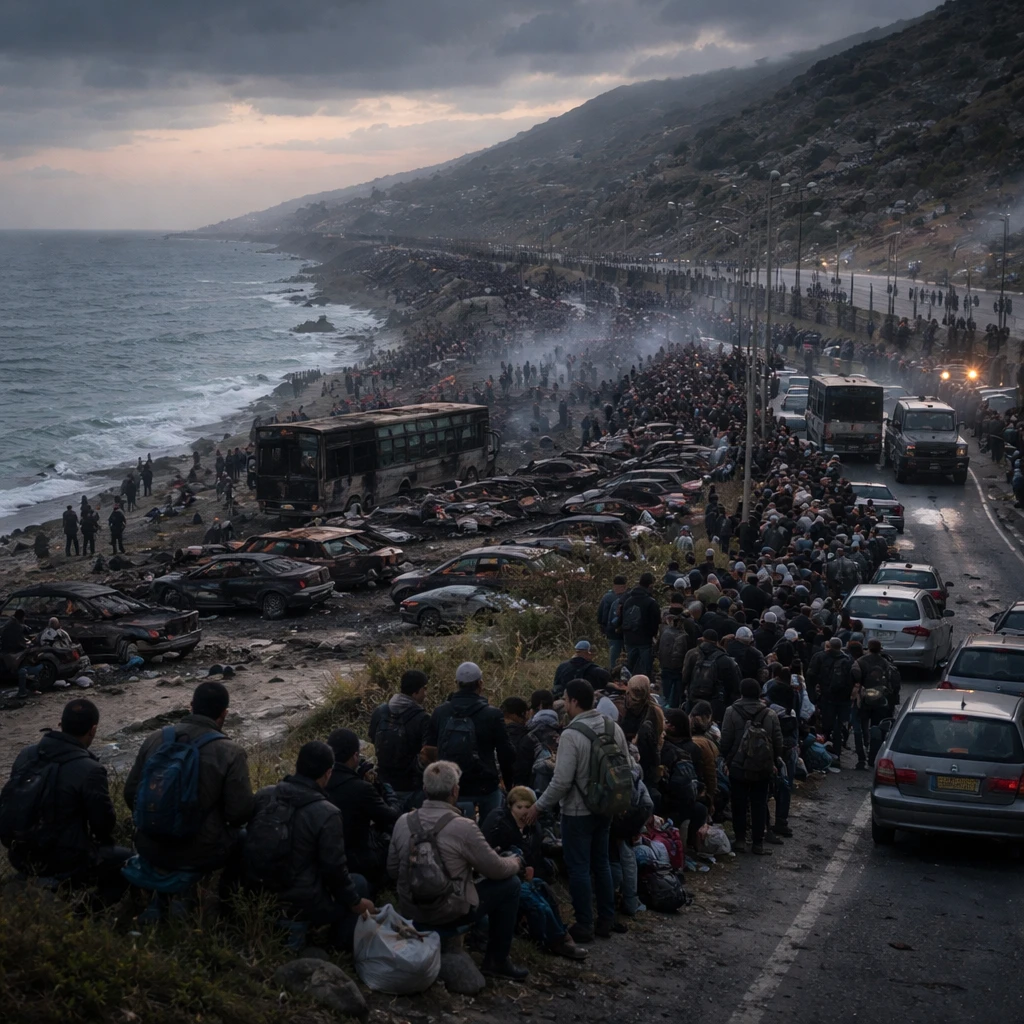
Thousands of migrants arrived in the Moroccan border town of Fnideq during the night and early morning hours, drawn to the crossing with the Spanish autonomous city of Ceuta. Despite strengthened security at the border that blocked most attempts to enter the enclave, Spanish state television TVE reported that between 2,000 and 3,000 people managed to cross into Ceuta on Thursday.
Residents of Fnideq said the majority of those who successfully reached Ceuta appeared to have done so before midday. Ceuta and Melilla - the two Spanish autonomous cities on the Moroccan coast - form the European Union's only land border with Africa and regularly see episodic surges of migrants attempting to reach Europe.
Spanish authorities responded to the recent surge by dispatching both military and police reinforcements to Ceuta. Officials in the enclave reported recovery of nine bodies. At the same time, Moroccan forces strengthened controls at the gates and deployed water cannon trucks to push back crowds seeking to approach the barrier.
Although the main crossing points were largely blocked, groups of migrants moved along the coastline looking for ways to bypass the fence, and some prepared to attempt to swim around the barrier. Witnesses in Fnideq described chaotic scenes as clashes broke out between security forces and crowds. The charred shell of a bus and seven other burned vehicles remained nearby after the confrontations, according to Reuters witnesses.
"I was late," said Brahim, 32, who gave only one name. He said he had traveled from Tangier planning to enter through the gate but found it effectively closed. He was among many who found access blocked by reinforced security measures.
Others described more harrowing experiences. One migrant, who declined to give his name, said he was caught in a stampede during an attempted crossing and feared for his life as people pushed and stepped on each other along a narrow coastal path. Throughout the day and into the night, traffic into Fnideq was congested as additional would-be migrants arrived, including women and children from Morocco and Sub-Saharan Africa.
Some migrants continued on foot along the highway into Fnideq late into the night, while others chose mountain tracks in an effort to evade checkpoints. Security forces repeatedly repelled coordinated rushes on the crossing during the night, and migrants regrouped across roads, hills and open spaces in and around the town.
Local scenes included families awaiting a chance to cross. Early on Friday, 23-year-old Fatima Mahli sat on a patch of grass beside the road to the crossing with her two daughters. A resident of Tetouan, she said her husband left before dawn to try to swim to Ceuta.
"I thought I could cross by foot through the border. But we are stuck here, unable to go back home," she said. "I was hoping to cross as a family but my husband woke up early and went first, swimming."
Spain's Socialist government has recently launched a program intended to provide legal status to some 500,000 undocumented migrants, a policy step that has coincided with an influx of applications reportedly double that number. The government's stance on migration is comparatively pro-migrant within Europe and has been cited as a factor in increased applications for legal status.
As waves of arrivals continued to press into Fnideq and security forces maintained a strong presence at crossing points, the situation remained fluid. Migrants sought alternative routes along the coast and through mountainous approaches, while authorities kept pushing back attempted mass crossings. The presence of burned vehicles, stampede accounts, and the recovery of nine bodies underscored the human and operational strains at the border during this episode.
Key points
- TVE reported that between 2,000 and 3,000 people crossed into Ceuta on Thursday, while reinforced security foiled most other attempts.
- Spanish military and police reinforcements were sent to Ceuta; Moroccan forces deployed water cannon and tightened controls at crossing points.
- Clashes left a bus and seven vehicles burned near Fnideq; authorities in Ceuta said nine bodies were recovered.
Sectors and markets impacted
- Local transportation and road networks - traffic into Fnideq was clogged and migrants used highways, coastal routes and mountain paths.
- Security and public safety operations - increased deployment of police and military personnel and use of crowd-control equipment.
Risks and uncertainties
- Continued attempts to bypass border controls could lead to further clashes and potential casualties, affecting public safety and emergency response resources.
- Disruption to local transportation routes and clogged roads may strain logistics and movement into and out of Fnideq.
- Unclear outcomes for migrants regrouping in open spaces and along coastal routes may prolong instability near the border crossing points.