
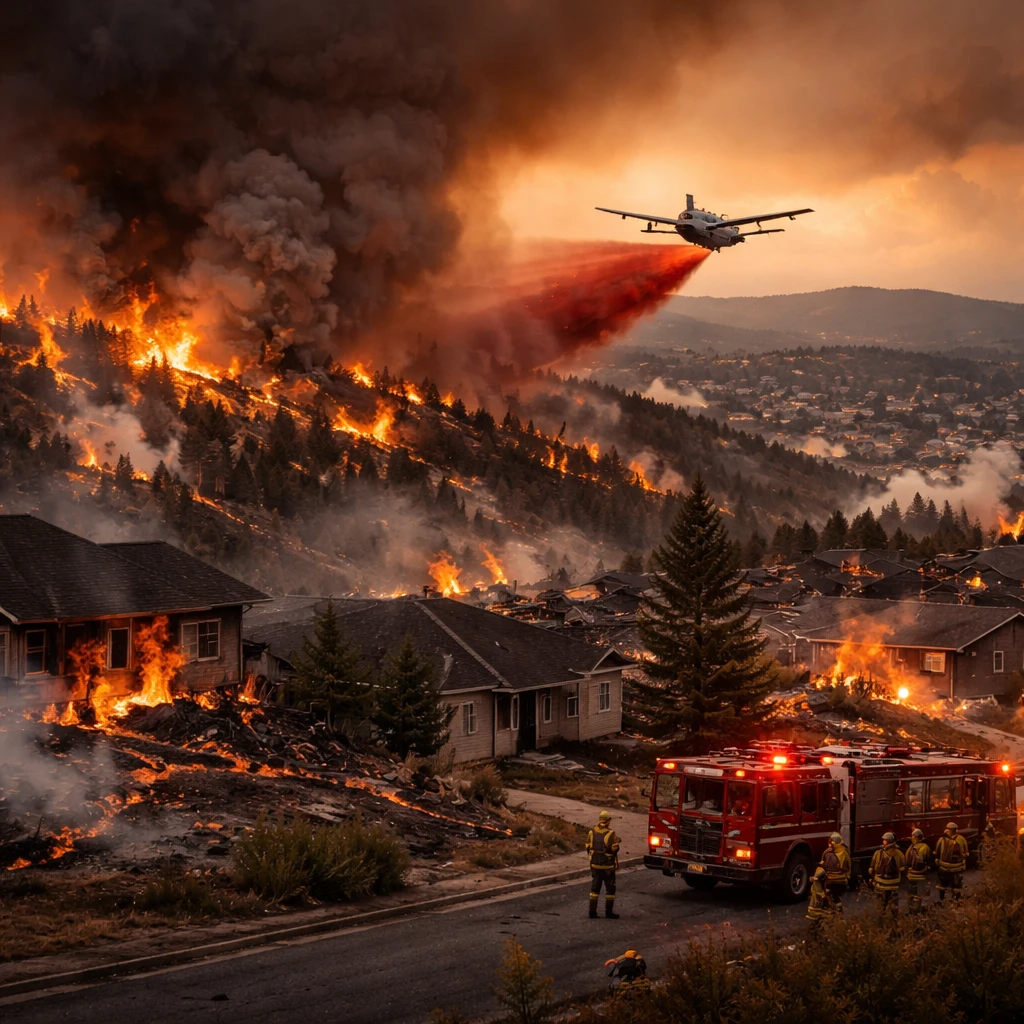
Wildfires on the northern fringe of Spokane, Washington, entered a third day of intense activity on Monday, leaving at least 700 buildings destroyed and prompting immediate evacuation orders for roughly 64,000 people, officials said. The three fires have become the highest firefighting priority in the United States, outstripping other blazes spreading across the drought-stricken Pacific Northwest.
First detected on Saturday, the cluster of fires has blackened more than 8,000 acres in and around suburbs north of the city, which is home to about 230,000 residents and sits west of the Rocky Mountain foothills near the Idaho border. As of Monday, evacuation orders covered some 64,000 people, up from about 4,000 a day earlier, according to Benjamin Cossel, a spokesperson for the incident command center.
“At least 700 structures have gone up in flames, most of them in residential areas,” Cossel said, and aerial infrared surveys suggested as many as another 400 buildings, including homes, may have been damaged or destroyed. The origin of the fires remains under investigation.
Officials reported no confirmed injuries or fatalities to date, but cautioned that condition may change. “There’s a high probability that will change in the coming days,” Cossel said, noting that teams have been unable to reach several devastated communities while extreme fire activity continues.
Urban areas and missing persons
As the flames moved out of wooded sections and into built-up neighborhoods and commercial zones, authorities said the fires were “turning from a wildfire to an urban conflagration.” An unspecified number of people have been reported missing amid the fast-moving infernos.
Roughly 1,100 firefighters were assigned to the Spokane-area response on Monday, a small portion of the more than 29,200 personnel working wildfires nationwide. National resources remain heavily concentrated in the Northwest, particularly Oregon, Washington state and Idaho, the incident command center reported.
Air and ground assets, and weather window
Aerial firefighting support in the Spokane area was limited to four fixed-wing tanker aircraft at the time of the report, with no water-dropping helicopters available, Cossel said. Fire managers expressed guarded optimism that a narrow window of cooler, less windy weather expected on Monday and Tuesday could allow crews to make progress, ahead of a forecast return of extremely high temperatures, low humidity and gusty conditions later in the week.
Even though fire activity in some places had eased compared with Sunday, officials were hesitant to lift evacuations across most of the affected zone. “The worst thing in the world is to let people go home only to have to evacuate them again 24 to 48 hours later,” Cossel said.
As of Monday, none of the three fires in the Spokane area had been contained, officials said.
National fire picture and broader conditions
The Interagency Fire Center has recorded a total of 44,722 wildfires so far this year nationwide, the highest tally for this time of year in at least a decade, with nearly 5.2 million acres burned. The acreage consumed from January through early August was the largest since 2022, the agency reported.
Officials also reported more than 100 large new wildfires on Sunday spread across 15 states, the majority in the Northwest, stretching firefighting resources thin across the region.
Across the border in British Columbia, flames continued to burn and officials warned of record drought conditions that have produced what they described over the weekend as “explosive” fire behavior in the southern part of the province.
Outlook and uncertainties
Authorities continue to investigate the cause of the Spokane-area blazes. With a significant portion of the affected neighborhoods inaccessible while fires are active, officials acknowledged uncertainty about the final toll in property damage and potential human casualties. The limited availability of aerial water-dropping assets, the forecast return of hot, dry and windy weather, and the high number of simultaneous fires nationwide all complicate suppression efforts.