
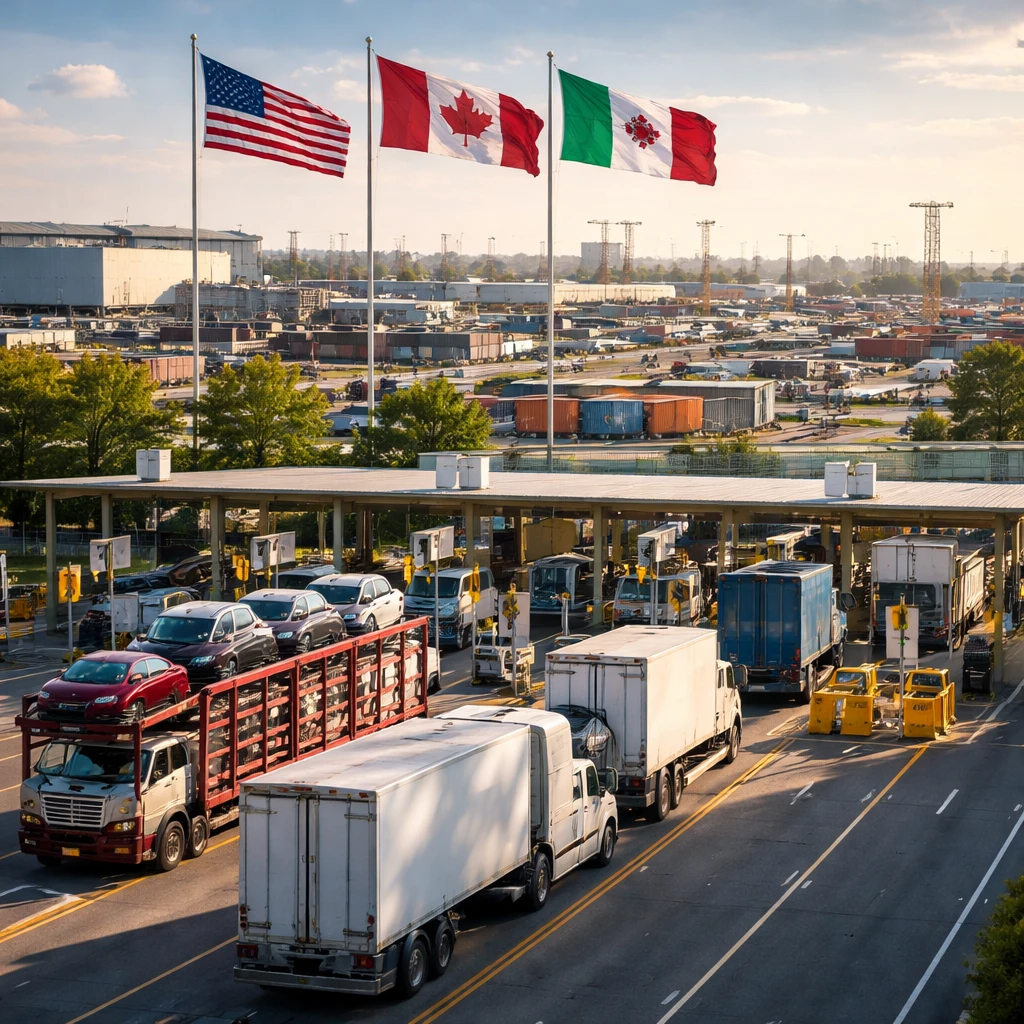
The U.S. decision not to renew the United States-Mexico-Canada Agreement for an additional 16 years, announced on July 1, has shifted negotiations into parallel bilateral tracks with Canada and Mexico. Although the trade deal remains in effect, it now requires annual reviews until either the three parties agree on an extension or the pact lapses in 2036.
Washington has escalated pressure on Ottawa by imposing 50% tariffs on a broad range of Canadian imports, citing Canadian policies on autos and dairy as well as provincial restrictions on some alcohol sales. Those tariffs are scheduled to begin on August 19. U.S. officials said the tariffs are a response to those Canadian policies; Canadian officials and business groups have urged quick progress to avoid the measures taking effect.
Diplomatic engagements are continuing on a bilateral basis among the three governments, according to sources familiar with the talks in all three capitals. Negotiators expressed the hope that bilateral accords could eventually be reconciled within a trilateral framework. But aligning two separate tracks with the priorities of three different countries presents a practical challenge, especially where the United States, Canada and Mexico face distinct trade realities and domestic political constraints.
Separate tracks, common stakes
Canada and Mexico both send most of their exports to the U.S., and North American production networks frequently cross borders multiple times during manufacturing processes. That reality makes the outcome of these negotiations consequential for automakers and companies whose supply chains are integrated across the region.
Mexico has advanced further in talks with Washington. Officials familiar with the negotiations said Mexico is entering its third round of formal bilateral discussions while Canada has yet to begin formal sessions. Ottawa has pursued a series of phone calls and occasional meetings in Washington between Dominic LeBlanc, Canada's minister responsible for U.S. trade, and U.S. Trade Representative Jamieson Greer.
A Mexican official familiar with the discussions described U.S.-Mexico talks as roughly six months ahead of the informal U.S.-Canada engagement. That headway could translate into greater investment certainty for Mexico and, potentially, more favorable terms in specific areas such as steel tariffs, the official said.
Points of agreement and steps taken
Mexican and U.S. officials broadly agree on a set of objectives they want to tackle. Those include addressing declining U.S. manufacturing employment, the increased use of Asian components in vehicles assembled in North America, and the transshipment of goods through the region from outside suppliers. "Mexico and the U.S. are in agreement about the goals," the Mexican official said. "What we are discussing is how to reach them."
Mexico has already implemented measures to respond to some U.S. concerns, including imposing tariffs on non-free-trade partners, tightening customs procedures and addressing intellectual property issues. Mexican President Claudia Sheinbaum has also pursued concessions that can be portrayed domestically as advancing Mexico's priorities, such as tighter border security, reduced fentanyl trafficking and more scrutiny of Chinese investment.
Political dynamics and negotiating room
Political constraints differ markedly across the three countries and are shaping each government's negotiating latitude. Observers note that Mexico's leadership appears to have more room to maneuver than Canada, where political imperatives complicate concessions to Washington.
Canadian Prime Minister Mark Carney, who won election last year promising to push back against the U.S. president, faces domestic expectations to resist unfavorable terms. That political positioning affects Ottawa's strategy and tempo. Carney and President Trump agreed to intensify talks, Carney said on Tuesday, while also signalling that provinces might delay restocking U.S. alcohol products until a broader agreement is reached.
Juan Carlos Baker, a former senior Mexican trade negotiator, summarized the strategic difficulty: "The challenge is to keep those two processes moving in the same direction so that they feed into the trilateral mindset that Canada and Mexico have - and that the U.S. has expressed doubts about." Baker also noted that Mexico will pursue its national interest while still preferring to preserve the trilateral structure of USMCA and resisting proposals that would explicitly dismantle it.
Leverage and timing
One central risk for both Canada and Mexico is that successful bilateral agreements could become de facto templates that the remaining country will be pressured to accept or to contest. There is concern that the United States might extract concessions from Canada that Mexico has already agreed to in its talks with Washington.
Canada faces a narrow window to make swift progress before the new tariffs take effect on August 19. Matthew Holmes, executive vice president at the Canadian Chamber of Commerce, urged rapid movement within the 30-day period prior to tariff implementation. Still, Canadian officials say they will not accept adverse terms simply to expedite a deal. That stance is reflected in a government message highlighted by Holmes: "What I’ve heard from the prime minister and other members of the negotiation team is, 'We want a good deal for Canada, not a fast deal for Canada.'"
Canada has also signalled it expects the U.S. to remove existing steel and aluminum tariffs as part of any agreement and to refrain from implementing the newly announced tariffs.
Official positions and responses
Canada has maintained it is prepared to accelerate discussions and has submitted proposals described as fair, balanced and beneficial for the wider North American economy, Gabriel Brunet, a spokesperson for Minister LeBlanc, said. The Mexican Economy Ministry declined to comment when approached for this story. The U.S. Trade Representative did not respond to a request for comment.
Observers also note that political incentives could keep the trade agreement politically salient in the United States. The Mexican official said attacking the trade pact could retain political utility for President Trump among voters who attribute manufacturing job losses to trade agreements, ahead of the U.S. midterm elections in November.
What is at stake
The three economies currently conduct roughly $1.6 trillion in annual goods trade under USMCA, and the agreement has historically sheltered Canada and Mexico from many of the broader U.S. global tariffs. The pact, negotiated by President Trump during his first term to replace the 1994 North American Free Trade Agreement, remains active even as its future is now subject to annual review.
For businesses embedded in cross-border production networks - notably automakers and parts suppliers - the shape and timing of these negotiations will influence investment plans, supply arrangements and regulatory certainty. Officials and industry groups will be monitoring whether bilateral outcomes can be stitched back together into a trilateral renewal before the agreement's eventual expiration in 2036.
As negotiations proceed in separate channels, Ottawa and Mexico City will have to balance immediate national interests against the longer-term value they place on a unified North American trade architecture. How that balance plays out will determine whether the separate tracks become stepping stones to a trilateral renewal or the seeds of a fragmented approach to the region's economic integration.