
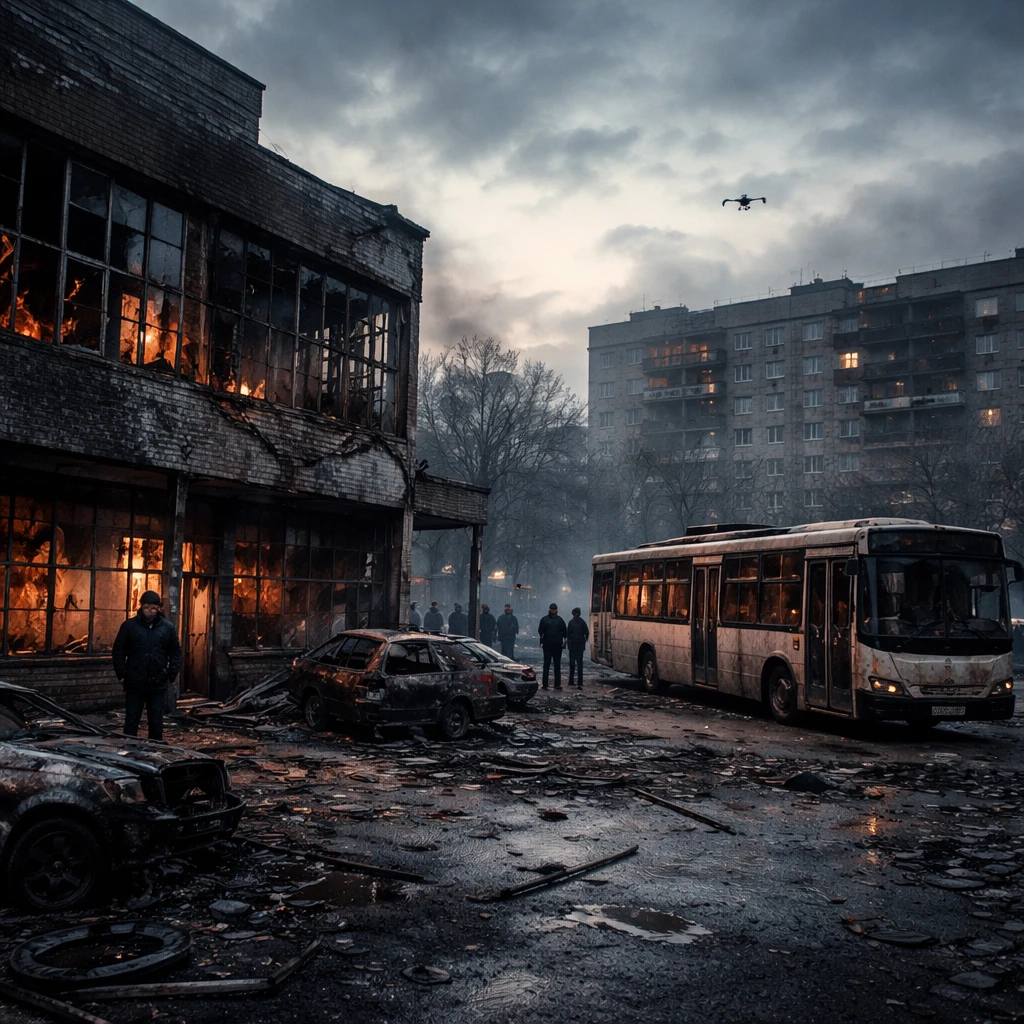
When two bombs struck the seafood processing business owned by 41-year-old Kateryna Lahuta last month in Zaporizhzhia, the incident erased what little predictability remained in her daily life. The blasts destroyed parts of the facility that supplied her retail outlets and frightened away customers, compounding labour shortages tied to military mobilisation.
Since the opening weeks of the 2022 invasion, Moscow’s forces have been positioned just south of Zaporizhzhia, a manufacturing hub of about 700,000 people, subjecting the city to repeated missile and drone strikes. In recent weeks, however, a new phase of attacks has made living and operating businesses inside the city more perilous, residents and local officials say.
"Even half a year ago it was still scary, of course, and there were strikes. But it wasn’t like this," Lahuta said. "Now it’s just a 'safari'." Ukrainians in frontline areas have begun using the term 'safari' to describe the way first-person-view, or FPV, drones appear to hunt down people and vehicles in the streets - a tactic residents of Kherson have endured for some time.
Reporters visiting Lahuta’s damaged processing facility had to seek cover when the telltale buzzing of an FPV drone drew near. These small, highly manoeuvrable drones, piloted by video from a remote operator, can carry explosives and have been described by locals as creating a "kill zone" along front-line corridors.
Escalation and intent
Local authorities and residents characterise the recent campaign as intended to both damage infrastructure and to terrorise the civilian population. Officials say Russian forces have introduced FPV drones into attacks on the city more frequently and are employing larger glide bombs with increasing regularity.
Zaporizhzhia is the administrative centre of one of the regions that Russia has claimed as part of its territory, although Russian forces control about three-quarters of that region. Ground offensives have made only incremental progress along a narrow corridor south of the city, where Ukrainian defenders have resisted advances.
From positions south of Zaporizhzhia, Russian-launched FPV drones have struck at groups of civilians, private vehicles and public transport in the city’s southern districts, Governor Ivan Fedorov said. "The enemy is making it a priority to create maximum pressure on the civilian population," he said during an interview in an underground school adapted to serve as a bomb shelter.
Officials note that FPV drones have been modified to extend their range, while air-launched glide bombs are harder to intercept without more advanced air-defence systems. Russia’s Defence Ministry did not immediately respond to a request for comment.
Public transport and urban life under fire
Despite frequent air-raid alerts, parts of central Zaporizhzhia retain elements of normal daily life: cafes operate and commuters move along familiar routes. Yet the atmosphere is subdued, particularly in neighbourhoods that lie closer to the front.
In the area near Motor Sich, the heavy-engine manufacturing complex, many residential and office blocks still show damage from repeated bombardment. In the southern Kosmos district, municipal authorities have begun installing overhead drone netting along roads after several incidents in which FPV drones struck vehicle windshields and roofs.
Two private bus drivers who operate a route serving Kosmos described a spike in attacks that has alarmed both drivers and passengers. "Drone netting won’t save you from the big ones," one driver said on condition of anonymity.
Governor Fedorov estimated that overall Ukrainian air-defence measures stop most FPV drones, but that "less than 5% of enemy FPV drones get through Ukrainian air defences." On particularly bad days - which he described as occurring several times per month - that small fraction can still translate into as many as 10 drones causing casualties or damage.
The city transit authority has started trials of drone-monitoring equipment for bus drivers and is testing new shatterproof glass for vehicles, said transit director Volodymyr Sukhachov. So far in the current year, 12 city-run buses or tramcars have been damaged either by FPV strikes or by blasts from larger munitions, he said. Despite the risks and damage, the authority has no plans to curtail services.
Lives compressed into shelters and routines
Residents have adapted to a new routine governed by the timing and frequency of strikes, which people say have increasingly occurred around midday and in early evening - intervals that chillingly structure daily life.
Ania Syvova, a 34-year-old seamstress whose husband is fighting in the war, described seeing an FPV drone crash into a bus near her home last month as she returned to the city’s southern districts. She sends her six-year-old daughter to an underground kindergarten and said she has become accustomed to living with the constant danger. "Maybe I have a good guardian angel," she said. "For now, unfortunately, we don’t have another one."
Meanwhile, in Kharkiv to the northeast, officials report similar tactics. Mayor Ihor Terekhov described FPV drone strikes there as "one of the main instruments of terror," saying that 45 such strikes were registered in the previous month.
Back in Zaporizhzhia, Fedorov described a pattern in which glide bombs are dropped on the city four to six times daily. On one recent Sunday, he said, eight bombs struck residential districts within an hour and a half, killing one person and wounding 31 - an account he relayed on Ukrainian television.
Personal cost and the calculus of staying or leaving
Outside a damaged apartment block, 38-year-old Tetiana, a government employee, described a week when her neighbourhood was bombed six times. Torn between the impulse to leave and the need to remain because locals depend on her municipal work, she said she feels drained. "Honestly, I’m already totally empty," she said, gesturing toward the charred shells of cars scattered in her courtyard. "No emotions."
For business owners such as Lahuta, the combination of physical damage and an eroded customer base has made long-term planning impossible. She said the shortage of labour - driven in part by the need for men to serve as soldiers - has further constrained operations. "Every day is like some kind of battle," she said.
Mitigation and limits
Local authorities are responding with incremental measures: testing tougher glass for buses, trialling drone-monitoring tools for drivers, and installing protective netting in vulnerable districts. But officials caution that these measures have limits. The transit director and frontline officials emphasise that while many FPV drones are intercepted, the more powerful glide bombs cannot be reliably stopped without more advanced air-defence capabilities.
The human toll, disruption to services and damage to infrastructure underline the difficulties of maintaining urban life under sustained aerial pressure. Residents and officials described a city that seeks normality amid a repeated campaign of strikes that they say aims to produce fear as much as physical destruction.
What remains uncertain
Civilians, municipal services and businesses alike face ongoing uncertainty about the scale and timing of future attacks. Authorities report rises in both the frequency of FPV strikes and the use of glide munitions, but the degree to which defensive measures can adapt to those evolving threats remains constrained by available technology and resources.