
Recent intelligence reports and official statements from Kyiv and Seoul describe a deepening military partnership between North Korea and Russia that now includes personnel deployments, a missile unit, and large-scale transfers of ammunition and rockets. Authorities in Ukraine say a North Korean missile unit has begun positioning in western Russia and may be armed with significant ballistic missile capability, while other assessments track thousands of North Korean personnel in Russian regions near the Ukrainian front.
Latest operational reports
Ukrainian military intelligence has reported that a North Korean missile unit is deploying to western Russia and could be equipped with as many as 120 ballistic missiles and six launchers for use against Ukraine. The unit, the intelligence agency said, consists of about 90 North Korean personnel and is expected to be based in Russia's Voronezh region. Independent verification of those specific deployment details was not available at the time the claims were reported.
Ukrainian President Volodymyr Zelenskiy in July said Russia was preparing facilities in Voronezh to receive additional North Korean troops and that Moscow aimed to bring in another 30,000 personnel. Those remarks reflect a broader narrative from Kyiv that Russian leaders are seeking greater manpower and materiel from Pyongyang.
Scale and movement of troops
Estimates of how many North Korean soldiers have been transferred to Russia have varied over time. Initial assessments from Ukrainian, U.S., and South Korean sources placed early deployments at roughly 10,000 to 12,000 troops in late 2024. In January 2025, a U.S. deputy ambassador to the United Nations was cited as saying there were more than 12,000 North Korean soldiers in Russia. Subsequent Ukrainian and South Korean estimates increased the figure for the Kursk region to about 14,000 to 15,000.
More recent commentary from a Ukrainian official indicated that around 9,500 North Korean troops remained in the Kursk region but were not then directly engaged in operations against Ukraine. Russia and North Korea publicly confirmed in April 2025 that North Korean forces had fought Ukrainian troops in Kursk. Moscow's senior military leadership commended their contribution after Russian authorities said they had retaken territory there, and Pyongyang said the deployment was ordered by leader Kim Jong Un.
Additional personnel and engineering support
Beyond combat troops, Moscow has reported plans for technical and reconstruction support from North Korea. In June 2025, Russia's Security Council Secretary Sergei Shoigu stated that North Korea would send 1,000 sappers and 5,000 military construction workers to the Kursk region to clear mines and assist in rebuilding infrastructure damaged by fighting. That same month, South Korean lawmakers, citing a briefing by their National Intelligence Service, reported that North Korea appeared to be recruiting personnel for further deployments while continuing to provide Russia with artillery ammunition and missiles in return for economic cooperation and technical assistance.
It remains unclear, however, how many engineers, deminers, or additional troops have actually arrived in Russia or whether they have been used in direct combat roles.
Weapons transfers and shipping activity
Ukrainian and independent assessments have concluded that North Korea has supplied Russia with very large quantities of munitions and missile systems. Intelligence reporting indicates transfers of millions of artillery and mortar rounds, ballistic missiles, long-range artillery, and multiple-launch rocket systems.
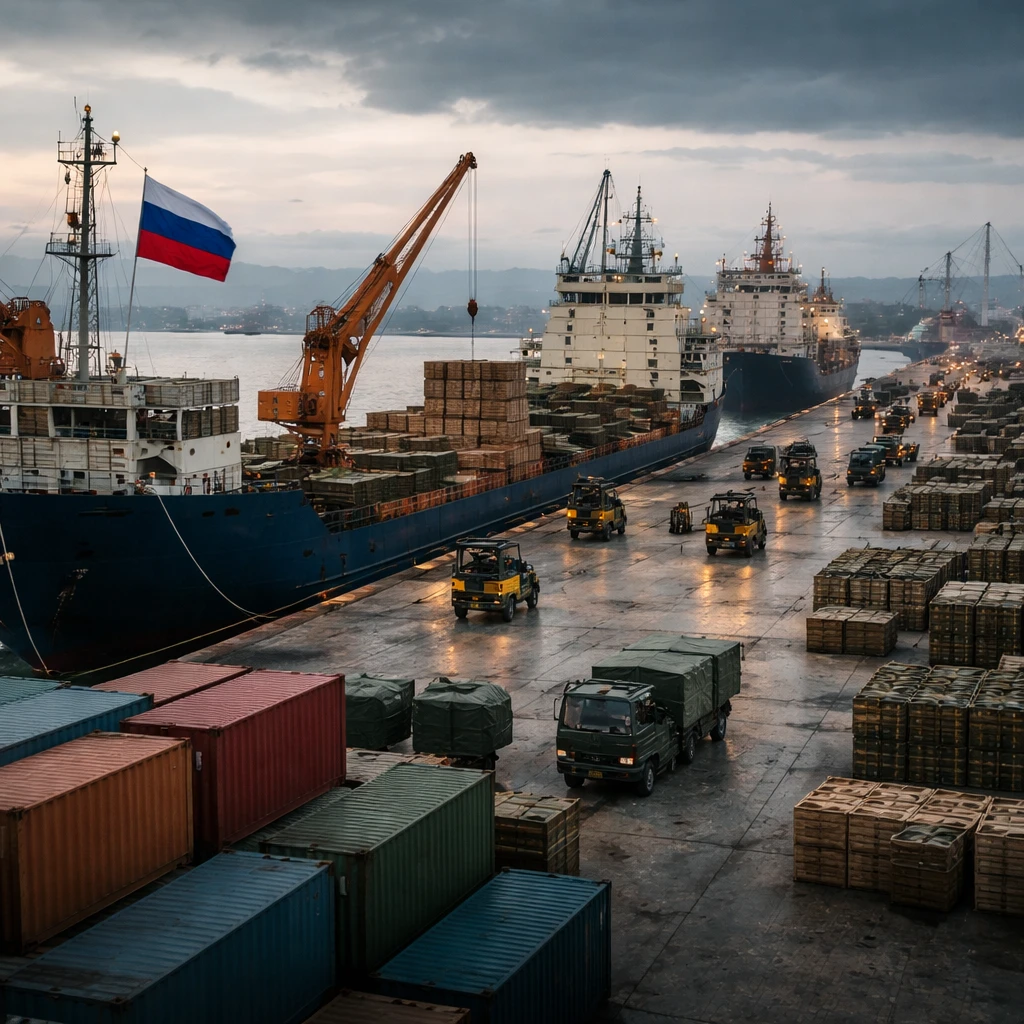
An analysis of maritime activity found that four Russian-flagged cargo vessels made multiple voyages to North Korea's Rajin port between September 2023 and March 2025, collectively completing 64 round trips and carrying nearly 16,000 containers of ammunition to Russian ports. Ukrainian officials have said North Korea provided roughly half of the munitions Russia required at the front lines.
Kyiv's military intelligence agency reported that North Korea had delivered about 4 million artillery shells from mid-2023 onward, not counting mortar rounds, and that 148 KN-23 and KN-24 ballistic missiles had been supplied by the start of 2025.
Motives and strategic framing
The deepening military cooperation follows a comprehensive strategic partnership treaty signed by Russian President Vladimir Putin and North Korean leader Kim Jong Un during Putin's visit to Pyongyang in June 2024. The pact includes a mutual assistance clause applicable if either party faces external aggression. Pyongyang has described its deployments as support for a treaty partner, and Kim said in May 2025 that participation in the conflict was justified as an exercise of North Korea's sovereign rights in defense of a "brother nation."
Analysts assessing these moves have emphasized what Pyongyang stands to receive: hard currency, oil and other forms of economic support, access to Russian military technology, and practical battlefield experience for its soldiers and weapons systems. North Korean personnel operating alongside Russian forces have had exposure to drones, electronic warfare, artillery coordination, and contemporary battlefield tactics, while North Korean munitions manufacturers have been able to evaluate their products under combat conditions.
International response and sanctions
The United States and allied governments have declared that the troop deployments and arms transfers violate U.N. Security Council resolutions that govern North Korea, which has been subject to U.N. sanctions since 2006 for its nuclear weapons and ballistic missile programs. Those sanctions prohibit countries from hosting North Korean trainers, advisers, or other officials for military, paramilitary, or police training.
In response to the cooperation, Washington imposed additional sanctions in December 2024 on North Korean and Russian entities tied to Pyongyang's military and financial assistance to Moscow. South Korea has added individuals and organizations to a blacklist for involvement in illicit military cooperation. NATO officials have warned that Russia's expanding military and economic ties with North Korea, China, and Iran represent a security challenge that extends beyond Europe to the Indo-Pacific and North America.
What remains uncertain
Several details remain unclear or unverified publicly: precise counts of engineering and demining personnel delivered to Russia, whether additional recruited personnel have arrived and been employed in combat roles, and independent confirmation of some reported missile deployments and specific basing locations. Those uncertainties complicate assessments of the full operational impact of North Korean forces and supplies on the conflict in Ukraine.
Sector impacts - The reported flows of weapons and personnel have implications for defense manufacturers and logistics and shipping sectors, which are directly involved in the movement and production of munitions. Energy and commodity markets may be affected via the exchange of oil and economic support cited as motives for North Korean assistance. Financial institutions and international trade channels are implicated through sanctions enforcement and the targeting of entities alleged to be facilitating transfers.