
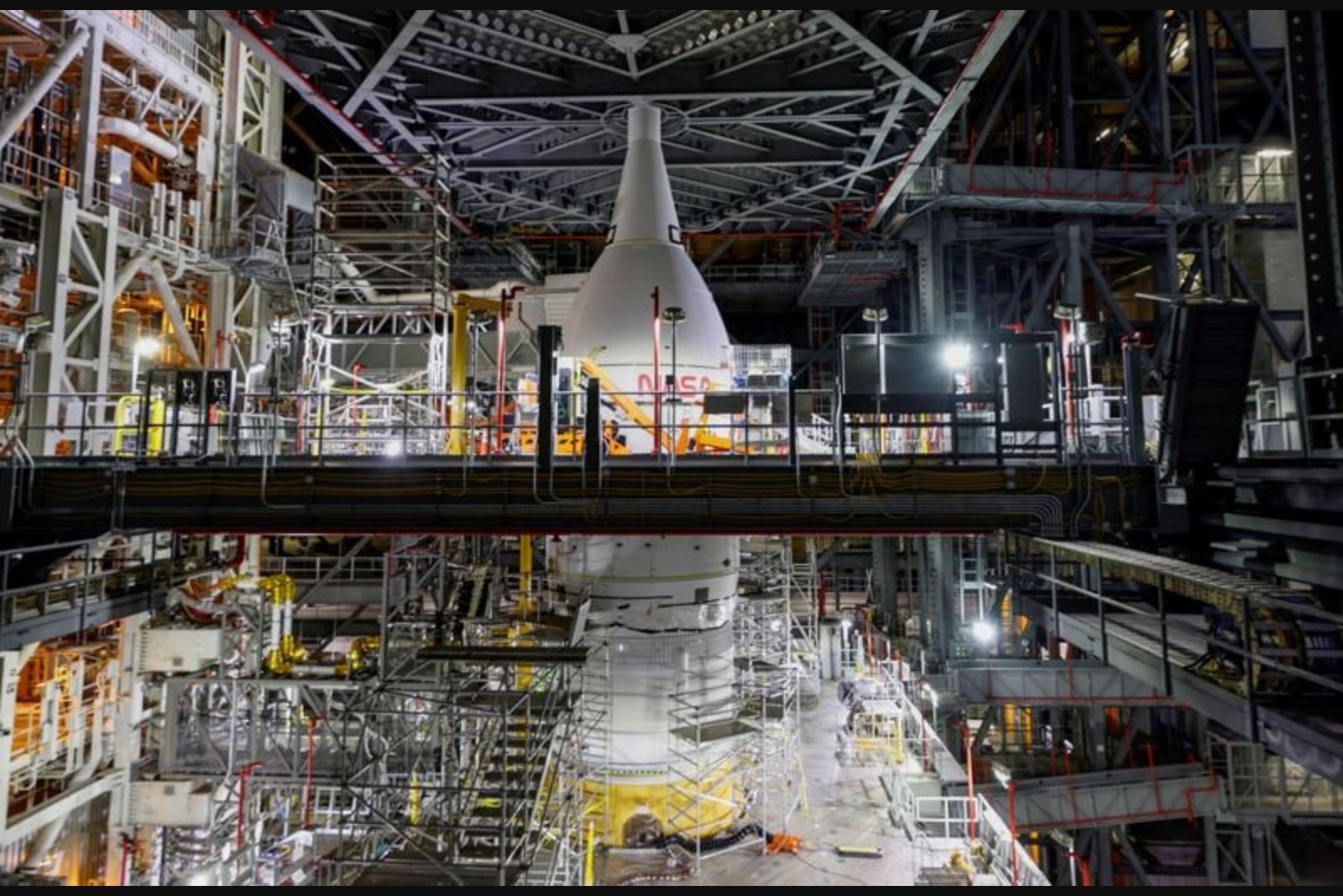
NASA on Tuesday revealed the crew that will fly on its next Artemis mission, designating three United States astronauts and one Italian astronaut to undertake a high-profile docking demonstration in Earth orbit next year. At a ceremony in Houston, NASA Administrator Jared Isaacman announced U.S. astronauts Andre Douglas, Frank Rubio and Randy Bresnik, alongside Italian astronaut Luca Parmitano, as the Artemis III crew. The mission is scheduled to launch late next year.
Agency officials described Artemis III as a complex operation that will involve a short, tightly coordinated sequence of launches and spacecraft maneuvers. "Artemis III is an incredibly exciting, complicated, and highly coordinated multi-launch campaign," Jeremy Parsons, NASA’s Artemis program manager, said at the Houston event. "It’s going to happen in a short period of time with three of the world’s most powerful rockets."
The planned flight will not travel to the lunar surface. Instead, it will operate in low-Earth orbit as a testbed for the two commercial landers that NASA intends to use on subsequent Artemis missions. For the first time in spaceflight, SpaceX’s Starship and Blue Origin’s Blue Moon will each dock with NASA’s Orion spacecraft. Orion is the crew capsule that lifts off Earth atop NASA’s Space Launch System rocket.
During the mission the three spacecraft are expected to take turns linking up with Orion, exercising docking mechanisms and performing close-proximity operations that include hovering around one another. Those maneuvers are intended to validate the mechanical and operational interfaces of the landers in an orbital environment before they are employed in a lunar landing context.
The Artemis III assignment follows a sequence of preparatory flights in NASA’s broader Artemis program. Artemis I, conducted in 2022, executed an uncrewed return loop around the moon. Earlier this year, four U.S. astronauts flew around the moon and back on Artemis II. Artemis III is the second crewed voyage in the program and is described by NASA as the final mission planned before the agency attempts to land astronauts on the lunar surface.
Officials also acknowledged the strategic context surrounding the Artemis program. The program faces competitive pressure from China, which is targeting its own crewed moon landing in 2030. Within NASA’s planning, the docking demonstration of both commercial landers in Earth orbit is positioned as an important validation step prior to committing to a crewed lunar descent.
Summary of the mission:
- The Artemis III crew will consist of three U.S. astronauts and one Italian astronaut and is due to launch late next year.
- The mission will test SpaceX’s Starship and Blue Origin’s Blue Moon docking with NASA’s Orion in low-Earth orbit.
- Artemis III is the final planned mission before NASA attempts a crewed lunar landing.