
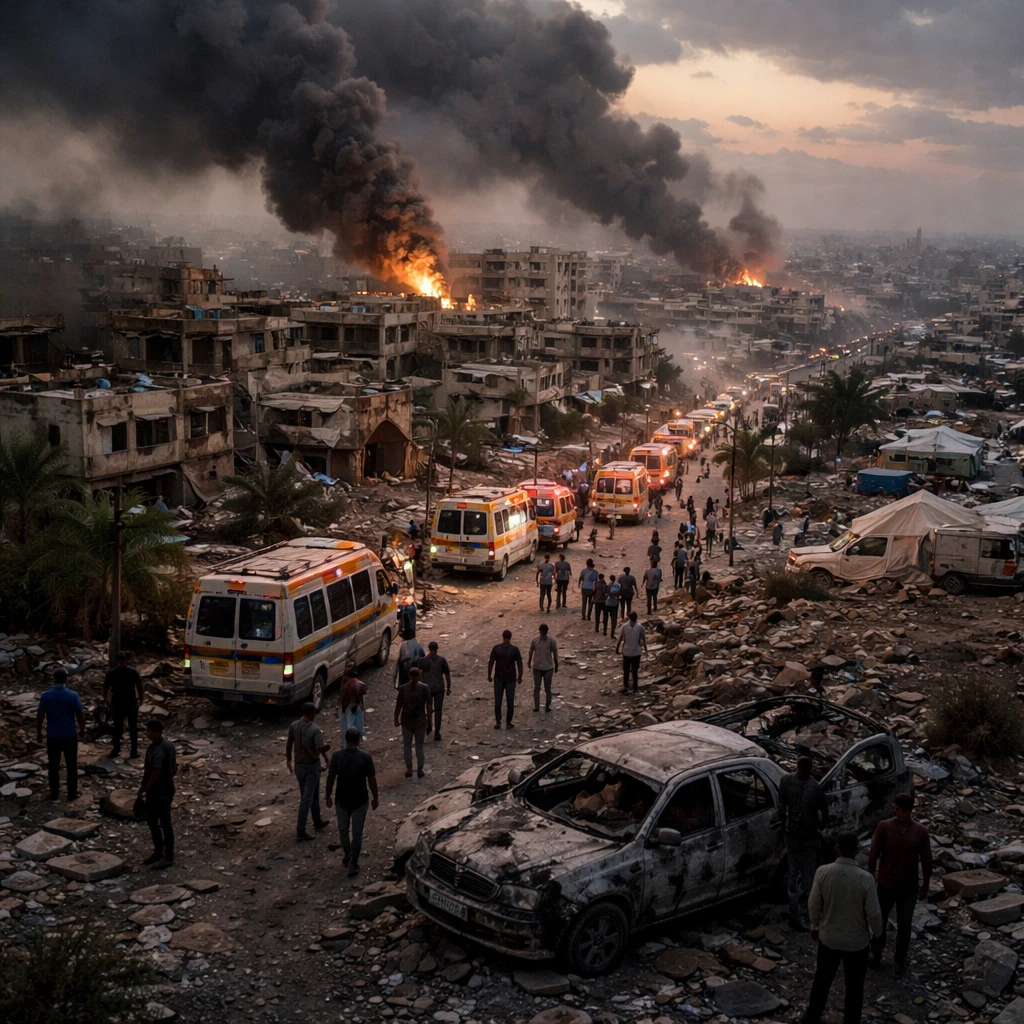
CAIRO/JERUSALEM, Aug 2 - Israeli air operations pummeled Gaza for a second straight day on Sunday, killing at least 18 Palestinians, medical officials in the Palestinian territory said, even after U.S. authorities announced progress toward executing last year’s ceasefire arrangements.
From first light, Israeli aircraft struck targets in northern Gaza City, in Deir al-Balah in the centre of the enclave, and in the south near Khan Younis. Palestinian health authorities described the day’s toll as the highest single-day number of fatalities in several weeks, with victims coming from strikes on tents, residences and vehicles.
U.S. President Donald Trump had on Thursday asserted a breakthrough, saying Hamas and other armed groups had agreed to disarm, words that raised hopes the long-stalled ceasefire implementation could move forward. On Sunday, officials in Israel cautioned that the political process remained uncertain and that combat operations had not been paused.
Speaking on Israel’s Army Radio, Israeli Energy Minister Eli Cohen - who sits on Prime Minister Benjamin Netanyahu’s security cabinet - said the government would offer Hamas a chance to disarm but added he was "very sceptical" it would do so. He said there had been no arrangement to halt military operations in Gaza and argued that if Hamas failed to disarm, Israel - which he said already controls roughly 70% of the territory of the enclave - might have to assume full control.
Cohen reiterated a central condition for the Israeli side: "In the deal we signed with the United States, our stance is that Hamas must be dismantled. This is the first thing that must happen," he said.
Later on Sunday, a spokesperson for the prime minister’s office told Reuters that Israel had raised concerns with U.S. officials regarding the disarmament plan. Doron Spielman, a spokesperson for the Israeli prime minister’s office, said Israel’s chief priority was ensuring Hamas "completely and truly disarms" before any other steps are taken.
Casualties and targeted strikes
Palestinian medics reported that strikes on Deir al-Balah killed at least four people. In Mawasi, near Khan Younis, a separate strike wounded five people and set several tents ablaze, according to the civil emergency service. In Mawasi, officials reported a strike on a house that killed a couple and their 9-year-old son.
In Gaza City, medics said an apartment strike killed another couple and their child. Two additional deaths were reported after a strike hit a tent located near the office of the Egyptian representative mission. Later in the day, medics said two more people were killed in Gaza City’s eastern Zeitoun neighbourhood, and Palestinian officials said one person was killed near Jabalia in the north.
The Israeli military said its strike on an apartment in Deir al-Balah targeted two commanders of Hamas’ elite "Nukhba" force. It also said strikes in Gaza City and Jabalia were aimed at what it described as "military operatives" but that assessments of those incidents were still under review.
In a subsequent strike on Gaza City, medics reported that an Israeli air attack on a car near Saraya Square killed at least three Palestinians.
U.S.-led roadmap and diplomatic efforts
On Friday, the U.S.-led Board of Peace overseeing the ceasefire published a 15-point roadmap outlining final steps for implementing the agreement. The board’s lead envoy for Gaza, Nickolay Mladenov, said the day’s strikes occurred despite efforts by mediators to secure Palestinian agreement on that roadmap.
In a post on X, Mladenov said he was working with parties, mediators and regional partners to "de-escalate and create the space for the full implementation of the President’s plan" and added: "Achieving a lasting peace is hard but achievable if everyone makes their best efforts."
Broader toll since ceasefire and positions of involved parties
Gaza health authorities say that since a ceasefire took effect in October, at least 1,230 Palestinians have been killed in Israeli strikes. The group Hamas does not publish figures for its own war dead. Israeli tallies show four Israeli soldiers have been killed over the same period.
Hamas officials have insisted Israel must cease its attacks and withdraw its troops in line with other core elements of the ceasefire deal before the group would approve handing over weapons to a newly named Palestinian body intended to administer Gaza. A senior Hamas official, Basem Naim, said on Sunday the movement had shown "considerable flexibility" but accused Israel of escalating strikes to impose facts on the ground.
"This escalation, coinciding with progress on the political track, clearly demonstrates that the occupation government is seeking to undermine efforts aimed at ending the war and to impose facts on the ground by force," Naim said in a statement.
Mediators and continuing contacts
Mohammed Dahlan, a former senior Fatah official based in the United Arab Emirates, posted on Facebook that Jared Kushner - identified as a senior U.S. adviser involved in the initiative - had told him he was coordinating with Israeli officials to halt the strikes on Gaza. Dahlan said contacts with the U.S. were continuing to try to ensure full implementation of the agreement, and that success hinged on Israel stopping its daily attacks on Gaza.
Reuters said it had sought comment from the U.S. State Department regarding Dahlan’s remarks; there was no immediate response from Israel, the agency added.
Context and immediate implications
The strikes that killed at least 18 people came amid rival claims over the pace and sequencing of political and security steps required to implement a detailed U.S.-backed plan. Israeli officials reiterated that disarmament of Hamas remains a precondition for advancing the deal, while Palestinian figures and mediators warned that ongoing military actions are complicating efforts to reach agreement.
For now, the diplomatic track and the battlefield remain intertwined: mediators are pressing for de-escalation in order to allow the roadmap’s final steps to proceed, while Israeli leaders stress the need for tangible security assurances in the form of disarmament.
As events unfold, details reported by local medics and official statements from both Israeli and Palestinian actors continue to shape the immediate environment and prospects for implementing the U.S.-led roadmap.